
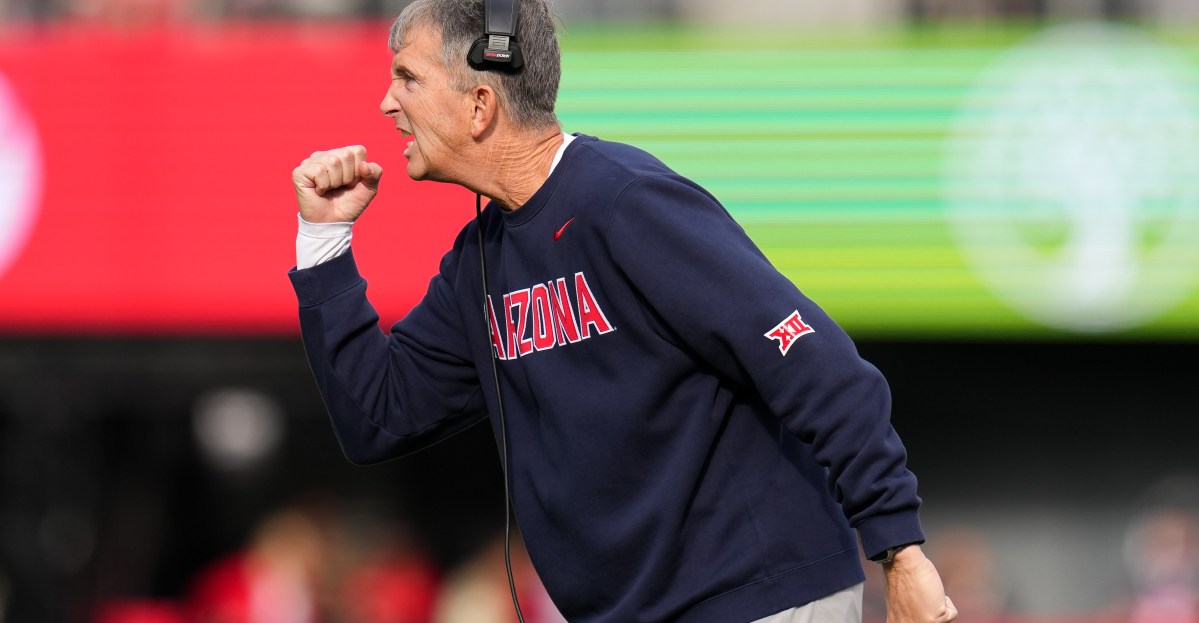
Last season Brent Brennan may have been coaching for his job.
This season he may be coaching for his future.
Granted in a college football landscape where momentum is difficult to achieve without the kind of resources that allow a program to buy a roster, every season can be viewed as a bit of a one-off. Good or bad, nothing says the next season will be the same.
Brennan and Arizona are coming off a good season, and Arizona’s recent history has shown a program that has difficulty sustaining success.
But if you go back and take a look at some of Arizona’s more successful coaches, even those who had some early success showed something more in their third year at the helm.
Dick Tomey’s 1989 squad earned eight wins and had the first bowl appearance of his tenure. Mike Stoops guided Arizona to a 6-win season in 2006, which was a considerable achievement at the time. Rich Rodriguez’s third year (2014) resulted in Arizona winning the Pac-12 South and playing in the Fiesta Bowl, while Jedd Fisch oversaw a team that won 10 games and the Alamo Bowl in 2023.
Now is there something unique about that third season? Perhaps more than anything a coach finally has not only his system in place, but a roster filled with his players. Some may have been recruited by the previous coach, but by that third season it’s safe to say that everyone who is on the roster is someone who that coach and his staff want to have on the roster.
Of that group only Rodriguez was coming off a bowl season in year 3, making Brennan — whose team won nine games last season — a bit of an outlier.
And yet, it’s probably not unfair to look at this season as the one that will, if not define the head coach’s tenure, than at least put it on whatever trajectory it will take for the near future.
After all, plenty seems to be going in the Wildcats’ favor.
The schedule features seven home games against five road tilts, and as things stand today the Cats would likely be favored to win all but a few of their matchups. The beginning of the season isn’t necessarily soft, but it certainly sets up so that the team could get off to a fast start and make later-season games at Texas Tech and vs. Utah really matter.
The coaching staff is largely returned from the one that guided last year’s team, including offensive coordinator Seth Doege and defensive coordinator Danny Gonzales. Then there’s the roster, and while it’s not the most talented in the conference on paper it does have something no other conference foe can claim:
A 5th-year senior QB who is experienced in the system he’ll be running. Of course, Noah Fifita also happens to be the reigning First-Team All-Big 12 QB and several of the skill players he had around him last season have returned, including receivers Tre Spivey, Chris Hunter and Giovanni Richardson. The running back group looks good, too, and the team added a bevy of tight ends in the transfer portal.
As long as the offensive line holds up, the team should be able to move the ball and score plenty of points.
There are more questions defensively, especially after losing multiple members of the secondary to the NFL Draft. However, the team returns enough talent and spent a lot of time plucking guys from the portal to help rebuild that side of the ball, and there’s no reason to think Gonzales won’t make it work.
Working against Brennan and the Wildcats is history.
Most of us are well aware of the program’s inability to maintain success. Arizona’s best seasons have rarely been followed by anything close. The 1998 Holiday Bowl team went from 12 wins to just six victories the next season, the 10-win 2014 Pac-12 South champs fell to seven wins and the 10-win Alamo Bowl squad dropped to four wins (albeit with a surprise coaching change in between).
The last time Arizona had back-to-back seasons with bowl eligibility was 2014 and 2015. Not elite seasons, not seasons of contention. Just consecutive seasons with at least six wins.
Going back to the Year 3 thread, the most recent coaches to struggle at Arizona—Kevin Sumlin and John Mackovic—never made it to Year 4. Sumlin’s third season was mercifully short due to the COVID-19 pandemic while Mackovic was fired during his third season because of reasons.
Neither of those coaches experienced any level of success in Tucson, though, so their dismissals were hardly a surprise. But that third year for them, as it has been for every other coach, was a big one.
Which brings us back to Brennan.
Even with the justifiably high expectations many have going into the season, it would take quite the collapse for anyone to seriously think that the program should make a change. That’s a nice place to be.
But this year is not so much about if Brennan is capable of doing the job, but instead it should provide a glimpse as to just how good of a job he can do.
Is he destined to be a solid coach who keeps Arizona mostly decent but can’t be much more? That would be okay.
Is he set to be the guy who will struggle to sustain success at a place where that has been historically difficult to do so? That would be familiar.
Or, maybe, he is a coach who can build a program and lead it to excellence in those years where things seem to line up in the Cats’ favor.
Let’s hope for that one.
The wonky nature of college football along with the typical luck that helps dictate a season means all outcomes are on the table. Nothing says this season has to determine Brennan’s fate and direction at Arizona, but if history is our guide this season, his third at the helm, should tell us plenty.