

US President Donald Trump continued to threaten Iran on Sunday despite a lull in fighting between the two nations, posting AI-generated images of the Islamic Republic’s ships and energy infrastructure being blown up and taken over by the US military.
Trump’s posts followed two days of calm in the Middle East after 13 days of intensifying airstrikes on Iran. The Pentagon suspended the bombing campaign late on Friday, with no US attacks reported on either Saturday or Sunday. Iran, which had been following each night of US attacks with its own strikes on neighboring countries that host US bases, has also held fire, saying it will continue to do so for as long as the US does.
The break in fighting came after Trump’s advisers reportedly warned him that they were running out of targets to strike and expressed worries about depleting the US arsenal.
Trump rebuffed the reports, however, telling the Wall Street Journal that the US has “far more munitions than anyone in the world, and far more than we need.”
US military officials in recent days have also cautioned that bombings over the past two weeks meant to deter Iranian threats to shipping in the Strait of Hormuz — a narrow waterway that has become a key flashpoint in the war — had largely exhausted the pre-selected sets of targets, a US official said on Sunday, speaking on condition of anonymity.
Get The Times of Israel’s Daily Edition
by email and never miss our top stories
By signing up, you agree to the terms
This did not prevent Trump from continuing to issue threats relating to the strait, however.
On Sunday night, the president posted a string of AI-generated images on his Truth Social platform relating to the destruction or capture of Iranian assets and infrastructure.
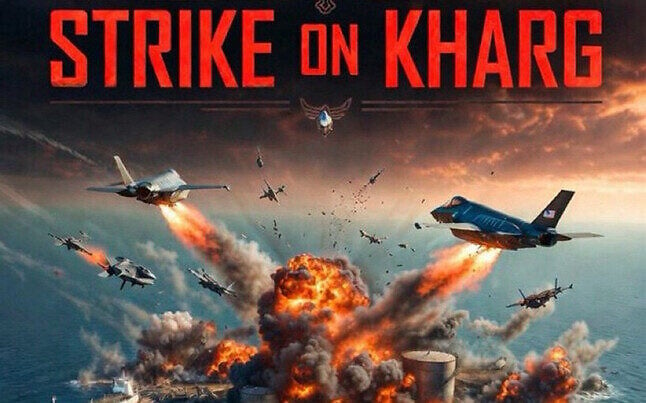
Detail from an AI-generated image showing US forces attacking Kharg Island, where Iran processes almost all of its crude oil exports, posted by US President Donald Trump on his Truth Social platform, July 26, 2026. (Truth Social)
One such image shared by Trump showed warplanes bombing an oil facility with the caption “STRIKE ON KHARG,” referring to Iran’s Kharg Island, the main oil export hub for the Islamic Republic.
He then posted several images in quick succession, all captioned “It’s Our Oil Tanker now!”
Each one showed an AI-generated image of the US president holding an American flag on an apparently Iranian ship. One version of the post features US soldiers in it as well, and another features both soldiers and what appears to be a depiction of Iranian religious leaders.
He followed up these posts with another captioned “NO MORE ENGINES,” featuring an Iranian ship being blown up.
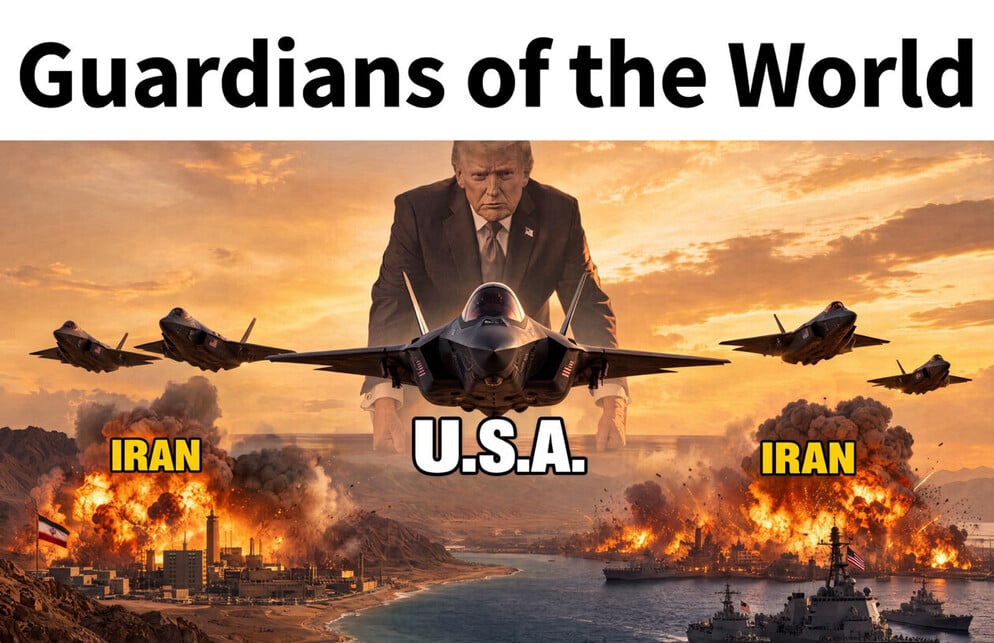
One in a series of AI-generated images against Iran posted by US President Donald Trump on his Truth Social platform, July 26, 2026. (Truth Social)
Despite Trump’s threats, global oil markets seemed to bounce back on Sunday and early Monday amid the pause in fighting.
About half an hour into trading on Asian markets on Monday, the price of a barrel of international benchmark North Sea Brent crude was down 5.89 percent to $91.08, after briefly dipping below the $90 mark. US counterpart West Texas Intermediate slid 5.73 percent to $84.19.
‘Divine victory’
Meanwhile, Iranian Supreme Leader Mojtaba Khamenei issued a written statement on Sunday pledging his country’s ongoing support for the Hezbollah terror group in Lebanon.
“No path remains except jihad and resistance,” read the statement addressed to Hezbollah leader Naim Qassem, which was published on Khamenei’s Instagram and carried in English by the dissident-aligned Iran International.
Praising Hezbollah’s fight against Israel as an “inspiring message,” Khamenei vowed that the terror group’s actions would bring about “divine victory” over Israel, Iran International reported.
He said that any fresh ceasefire with the US would require a “complete and unconditional” end to Israeli attacks on Lebanese territory.
The US and Israel jointly launched a bombing campaign on Iran on February 28 in a bid to destabilize its regime and destroy its ballistic missile and nuclear programs.
Iran responded with missile and drone strikes across the region and by blockading the Strait of Hormuz, which previously carried about a fifth of the world’s commercial oil shipments.
The fighting entered a truce on April 8, and the US and Iran last month reached a memorandum of understanding for peace talks. Israel was not a party to the agreement or the talks. The US has since attacked Iran in response to the Islamic Republic’s continued attacks on Hormuz shipping.
We can’t do this work alone.

The war with Iran has been draining for all of us in Israel. But when I heard about a high casualty incident – ballistic missile impacts in Arad and Dimona that left nearly 200 people wounded – I drank a cup of coffee, packed a bag, and headed south.
There, I spoke with Shilgit, the head of an after-school program for underprivileged youth. Standing outside her destroyed center, Shilgit said it was a miracle that no children were hurt and spoke about the community coming together in the hours since.
As a Times of Israel reporter, I’m committed to telling stories of resilience like Shilgit’s. But my colleagues and I can’t do this alone. If you value work like this, please consider joining our reader support group, The Times of Israel Community. Your financial support is essential to keep real human reporting like this going.
— Stav Levaton, military reporter
Already a member? Sign in to stop seeing this
You’re a dedicated reader

That’s why we started the Times of Israel – to provide discerning readers like you with must-read coverage of Israel and the Jewish world.
So now we have a request. Unlike other news outlets, we haven’t put up a paywall. But as the journalism we do is costly, we invite readers for whom The Times of Israel has become important to help support our work by joining The Times of Israel Community.
For as little as $6 a month you can help support our quality journalism while enjoying The Times of Israel AD-FREE, as well as accessing exclusive content available only to Times of Israel Community members.
Thank you,
David Horovitz, Founding Editor of The Times of Israel