
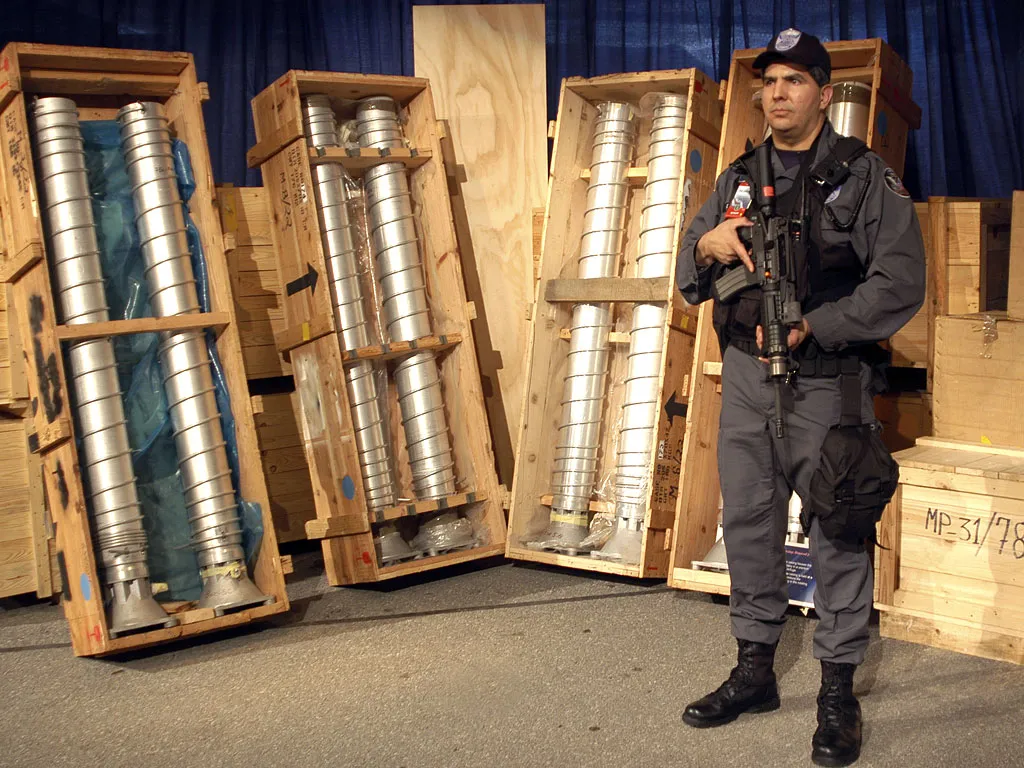
 Gas centrifuges for uranium enrichment seized from a cargo ship en route to Libya, in 2003. The illicit cargo was traced directly to the A. Q. Khan proliferation network—a global black-market network led by Abdul Qadeer Khan, the father of Pakistan’s nuclear weapons program. The designs and technical blueprints of the components originated from Khan Research Laboratories in Pakistan, based on centrifuge designs originally derived from European enrichment technology. (Credit: US Energy Department)
The Trump administration is pursuing two contradictory policies with uranium enrichment: It has insisted that zero uranium enrichment in Iran is necessary to achieve its goal of preventing Iranian access to a nuclear weapon. But the administration has also shown an apparent tolerance for the spread of the same uranium enrichment technology elsewhere as part of its push for expanded nuclear exports. There is an essential tension between the administration’s readiness to use military force to prevent enrichment in Iran while condoning the technology’s spread elsewhere.
President Donald Trump showed greater comfort with the spread of enrichment in two high-level meetings in late 2025. Following his October 29 meeting with South Korean President Lee Jae Myung, the White House stated that the United States now supports “the process that will lead to the Republic of Korea’s civil uranium enrichment and spent fuel reprocessing.” This was a notable departure from past US policy against Republic of Korea enrichment.
A month later, during Saudi Crown Prince Mohammed bin Salman’s visit to Washington, US and Saudi officials previewed a pending nuclear cooperation agreement between the two countries, also known as a “123 agreement.” Past administrations have been unable to conclude such an agreement with Saudi Arabia in part due to Riyadh’s insistence on the need for domestic enrichment, which US policy opposed. While no text has yet been made public officially, President Trump recently approved the agreement, and there are indications that the nuclear cooperation deal will, at the least, leave open the possibility of future Saudi enrichment.
Consistent with a shift in the administration’s direction on enrichment is a May 2025 executive order directing aggressive negotiation of at least 19 additional 123 agreements by the end of 2028—a significant increase from the 26 such agreements currently in force. These deals could be a boon for US leadership in the responsible global expansion of nuclear energy and potentially help strengthen nonproliferation standards. However, with the clock ticking to meet the president’s tight timeline, US negotiators may seek to relax past positions on enrichment if they are perceived as impeding agreement.
The trouble with spreading enrichment. Enrichment is a truly dual-use technology: The same process that can turn raw uranium into fuel for a power plant (if uranium is enriched to 3 to 5 percent uranium 235) can also be used to make material for a bomb (if enriched to 90 percent or higher).
A state with civilian enrichment capabilities has several otherwise unavailable pathways through which to pursue nuclear weapons: It could divert material, misuse facilities within declared civil programs, or establish a covert enrichment facility to support a military program. Enrichment technology exported to a US ally could be proliferated to a third country, as was the case with the A.Q. Khan network’s illicit transfer of European enrichment technology to Pakistan. Such scenarios could unfold rapidly, providing short timeframes for detection.
Once acquired, states are loath to relinquish a capability considered prestigious, and knowledge of enrichment technology cannot be erased. There are also norms to consider: Today’s allies with enrichment technology could become tomorrow’s adversaries—and today’s adversaries could take advantage of a precedent once set. For these reasons, US practice has been to stave off future proliferation challenges by preventing any new enrichment entrants, even friendly ones, in the first place.
Why states pursue enrichment. Countries commonly frame domestic enrichment as a right to the peaceful uses of nuclear energy. Economically, states want to have their share of the multi-billion-dollar enrichment industry. In terms of energy security, countries with a nuclear power program are concerned that dependence on another state for enrichment puts them at risk of a supply disruption. According to this line of thinking, domestic control of the entire fuel cycle—not just enrichment—is the only surefire answer to this concern.
A third argument, often unstated, is that enrichment enhances national security by also providing the technical ability to produce material for a nuclear weapon. While seeking access to enrichment, South Korean and Saudi officials have each entertained the idea of having their own nuclear weapons program, and experts speculate that Iran’s desire to linger on the nuclear threshold motivated its enrichment program.
These motivations should be taken seriously, but without overstatement. In almost every case, it is cheaper to purchase reactor fuel from foreign suppliers than to produce it domestically. Enrichment facilities cost billions of dollars, take years to build, and have long, uncertain return horizons. Energy supply arrangements have proven extremely reliable, even years after Russia began its invasion of Ukraine. A state seeking security benefits from enrichment should also consider whether attacks like those by Israel and the United States on Iran’s enrichment facilities suggest this hedge may leave a state less safe, not safer.
Limiting enrichment through negotiation. Any global expansion in nuclear energy will require enriched uranium to fuel reactors. The question, therefore, is not whether but where that uranium enrichment will take place. The United States, which is both a competitive nuclear supplier and a long-time champion of nonproliferation, has several tools to navigate rising international demand for enrichment technology.
Early US legal frameworks recognized the sensitivity of enrichment, protecting enrichment-related information in the same way that it protects nuclear weapons design information—and demanding that partners seek advance US consent before enriching US material. The United States has historically discouraged the development of new enrichment programs by neither providing advance consent to enrich US material nor transferring enrichment technology to countries that did not already have that capability.
But the US nuclear industry is less globally dominant than it was when these policies were initiated, meaning that a US partner could forego the ability to enrich US material while separately partnering with another state or working to indigenously enrich non-US material. The United States has therefore sought commitments from partners against acquiring enrichment from other states or developing it themselves. Some worry this position could turn off potential partners and open the door to more permissive suppliers like Russia or China. Indeed, few partners have agreed to the more stringent approach—the United Arab Emirates being one of the few examples.
Such fears of ceding ground to China or Russia through a stronger negotiating stance could be overblown. The multilateral Nuclear Suppliers Group, which includes China and Russia, has tightened controls on enrichment and shown little appetite for its transfer.
Neither Russia nor China uses indigenous enrichment as an enticement for potential nuclear energy customers. Instead, Russia includes both front- and back-end fuel cycle services in its long-term contracts, and China offers front-end services. Rebuilding US enrichment capability, if coupled with similar front-end guarantees for partners, could help obviate the need for domestic enrichment by partners.
The United States must use all available leverage during negotiations to ensure the benefits of a US civilian nuclear agreement to a partner state outweigh its nonproliferation requirements. Quality technology and competitive financing are necessary elements, but potential partners may seek more. The United States can seek to reduce the allure of an enrichment program by offering instead a suite of political, economic, and military sweeteners—even outside of the official nuclear energy package—that other suppliers may not be able to provide.
Security incentives could be addressed through US conventional military technology; while often treated separately, potential nuclear customers are often also defense cooperation partners. Security considerations may be even better dealt with through security guarantees or non-aggression pacts. Cooperation on data centers and advanced computing technology, potentially powered by nuclear energy, could also entice states with economic motivations.
Viewing international cooperation in civilian nuclear energy technology in a vacuum undersells US bargaining power and ignores the broader geopolitical context of such cooperation. In addition to improving US bargaining power through nuclear technology exports, Washington should consider pairing nuclear exports with the non-nuclear offerings they are intended to power—such as data centers or hydrogen production plants—advancing US nonproliferation goals without giving up the sale.
Accommodating demand for enrichment. The United States can successfully hold a hard line on transferring enrichment technology by working with partners to develop alternative arrangements that address the underlying economic, energy security, and national security factors driving interest in enrichment.
Alternative fuel supply options can directly address energy security concerns, while also financially disincentivizing enrichment aspirants by creating well-funded competition. In 2023, the United States, the United Kingdom, France, Canada, and Japan—collectively known as the “Sapporo 5”—formed a coalition of uranium producers to secure reliable fuel supply chains and diversify from Russian supply. The group has secured $5.6 billion in government and private investment for new enrichment and conversion capacity. The US element of this effort seeks to leverage significant funding from the US Energy Department to generate more domestic and international investments in US companies.
Instead of pursuing domestic enrichment, international partners should take advantage of this opportunity, acquiring an equity stake in existing US enrichment companies. Direct investment by states without enrichment in existing companies would enhance confidence in access to the product, without spreading the proliferation-sensitive technology, addressing both fuel supply and economic considerations without domestic enrichment. Less ambitiously, countries could instead seek contractual arrangements with existing enrichment companies to build confidence that their supply would not be disrupted; such contracts could provide, for example, improved uranium distribution mechanisms or more robust contingency planning, including arrangements for a secondary supplier to complete a hypothetical disrupted transaction.
Regional fuel cycles could also reduce energy security concerns by introducing mutual dependence between states across the entire fuel cycle, including enrichment, uranium mining, and fuel fabrication. For example, an arrangement could link Japanese enrichment, South Korean fuel fabrication, Mongolian uranium mining and milling, and Taiwanese uranium conversion. Experts have also suggested similar arrangements for states in the Middle East. Each partner state would have access to the products—but not the technology—of the entire fuel cycle, leaving it dependent on the others for the fuel cycle steps it lacks while allowing it to benefit economically from its own link in the chain.
Some have suggested that partner demand for guaranteed access to enrichment in the country could be squared with technology protection needs through what are known as “black-box facilities,” in which an extant supplier builds and operates the facility, and the host country owns the land and the product but has no access to the technology. Such proposals for enrichment are untested and therefore raise new regulatory, security, and legal hurdles.
International control of parts of the fuel cycle would go further. In 2019, the International Atomic Energy Agency (IAEA) opened a bank containing 90 metric tons of uranium enriched up to 5 percent available to member states experiencing reactor fuel supply disruption. This bank could be exhausted by just one fuel reload of a large reactor, but more expansive arrangements could provide more assurance. Contingency supply reduces the need for domestic enrichment for energy security purposes by preventing a supplier from using reactor fuel delivery as leverage against a state that needs it. Expanding such fuel banks, or even international enrichment, could help address energy security concerns.
Adapting with enhanced monitoring and verification. If enrichment technology does spread, the international community should enhance existing nuclear verification efforts and introduce new monitoring tools to quickly detect any attempt to produce nuclear weapons. Because states with enrichment capabilities can acquire weapons-usable material more rapidly than those without, they require more intense scrutiny.
A starting point is broader implementation of existing tools like the Additional Protocol, even making it a global condition of nuclear exports. This protocol enhances IAEA measures for detection of undeclared nuclear activities. If the United States stops conditioning deals on adoption of the Additional Protocol (apparently likely in the upcoming US-Saudi 123 agreement), expanded access to enrichment would only become riskier.
Iran’s example shows the Additional Protocol is necessary but insufficient. The Joint Comprehensive Plan of Action (JCPOA), also known as the Iran nuclear deal, allowed Iranian enrichment up to 3.67 percent. But the deal also instituted a verification regime that went well beyond the Additional Protocol in its monitoring of centrifuge manufacturing, enrichment, and uranium mining and processing. More widespread enrichment would demand broader application of such verification measures. Other relevant upgrades to the Additional Protocol could include wide-area environmental sampling, weaponization-related inspection authorities, and updated reporting of nuclear-related imports, with particular importance in states where enrichment takes place.
Broader access to enrichment and, therefore, condensed proliferation timelines should motivate the development of new tools that address the issue of nuclear intent.
The current nonproliferation regime is agnostic to intent, benefitting from the fact that most of the international community is far from a nuclear weapons capability: As long as monitoring can confirm that nuclear materials stay where they should, there is no need—and the IAEA has no mandate—to confirm that a state’s nuclear activities are consistent or inconsistent with a peaceful purpose.
With broader access to enrichment, states may need to develop new mechanisms to demonstrate consistency between their capabilities and their intentions and, therefore, that their activities are more consistent with civilian purposes than military ones.
States with existing enrichment capabilities should set the standard for newcomers. Establishing a monitoring precedent in these countries, beneficial on its own merits, would lay the groundwork for early warning if new states acquire enrichment technology. Tripling nuclear energy by 2050—as more than 30 countries have pledged to do—will strain already-stretched IAEA resources; new enrichment facilities on top of numerous new reactors would dramatically worsen the burden, as the IAEA spends up to 15 times more inspection days safeguarding an enrichment facility than a reactor.
As the Acheson-Lilienthal report posited 80 years ago, no amount of verification can fully compensate for the increased risk of broadly available enrichment capabilities. North Korea, by ejecting IAEA inspectors and then pursuing nuclear weapons, showed that even strong verification measures cannot prevent a country determined to join the nuclear weapons club. Allowing the spread of enrichment technology only intensifies this reality; stronger verification tools are necessary, but not sufficient to address this challenge.
The significant challenges posed by uranium enrichment do not justify opposing the expansion of nuclear energy in and of themselves. Rather, they simply call for not expanding nuclear energy at the cost of nonproliferation. The current wave of renewed enthusiasm for nuclear energy provides an opportunity to rally support for bolder action on nonproliferation than could have been considered only a few years ago.
Recent US military operations in Iran demonstrate the seriousness of a breakout enrichment capability; a nuclear renaissance should not be undertaken in a way that creates more such crises. Ambitious plans for small modular reactors that can power data servers or space stations will not succeed if they create their own proliferation crises. The reality of those stakes aligns US international trade and national security interests around blocking proliferation pathways, and it should prompt a broader conversation about how sustained investment in nuclear energy can be coupled with the means to harness the atom responsibly. Developing new tools of nuclear bargaining, fuel arrangements, and verification should be part of that conversation.