
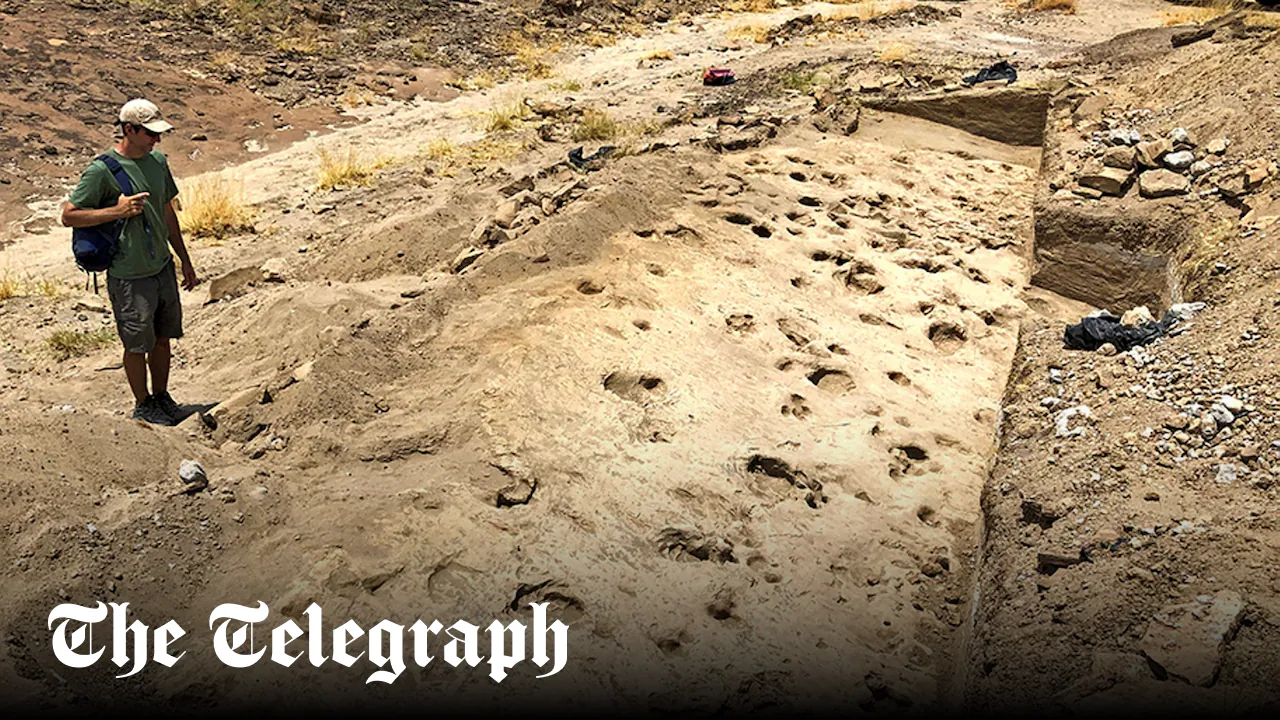
Paranthropus boisei was a species of australapithecene that lived in east Africa between 2.5 and 1.15 million years ago, the Early Pleistocene.
Although not a direct ancestor of modern humans, the group is a cousin, sharing a common ancestor with australopithecus afarensis, before branching off along another line and later becoming extinct.
Before the new trackway was found, the overwhelming majority of Paranthropus boisei fossils were skulls with large jaws and teeth, and little had been known about their anatomy from the neck down.
From their chunky bone structure, it was assumed that males averaged about 4ft 6in in height, but when researchers carried out 2d and 3d imaging of the tracks, and looked at foot shape and locomotion patterns, they were found to be far larger.
The tracks were similar sizes to those left by Homo erectus, which lived nearby but was thought to be significantly bigger than Paranthropus.
‘Surprising result’
“The sizes of the footprints indicate human-like body sizes – up to 6ft tall and around 165lb,” said Dr Kevin Hatala, an associate researcher at the Max Planck Institute for Evolutionary Anthropology in Leipzig, Germany.
“This was a surprising result but we also have not known much about the anatomy of that species from the neck down, because most of their known fossils represent just their skulls and teeth.”
He added: “Fossil footprints are really the only kind of data that can provide us with this direct window to social behaviour in an extinct species.
“This seems to indicate that this species lived in multi-male groups, with cooperation between adult males potentially being an important part of their social strategy.”
The research team used volcanic ash in the surrounding rock to date the trackway to the Early Pleistocene around 1.43 million years ago.