
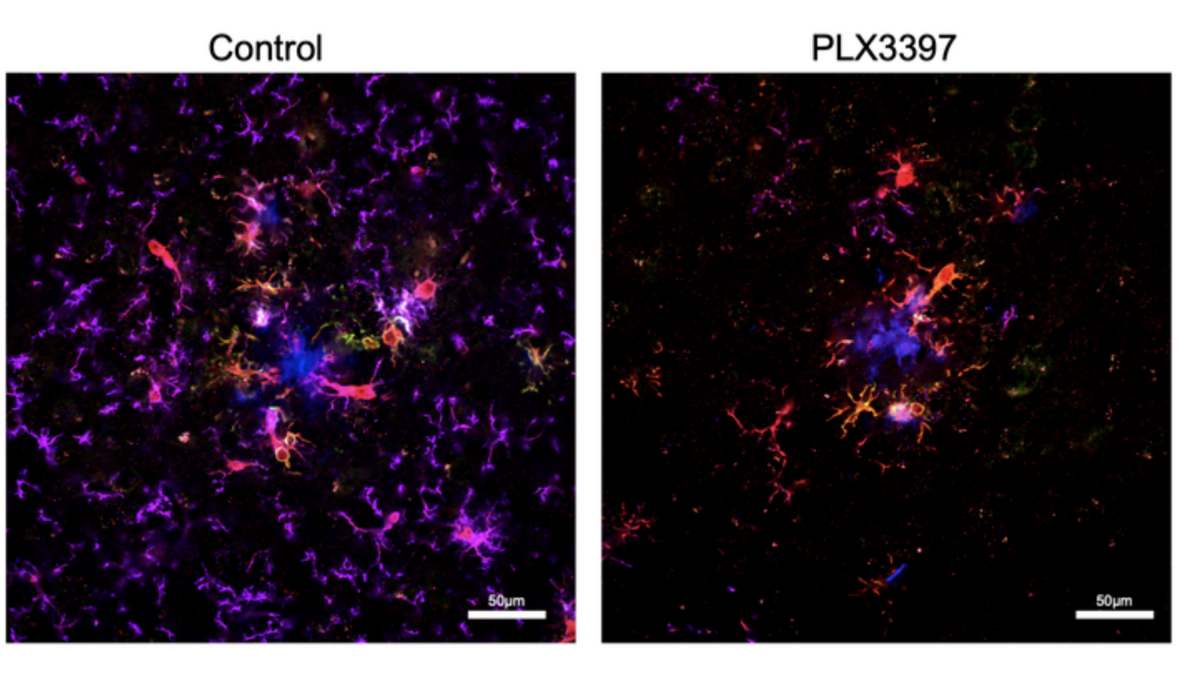
Microscopic images of brain tissue, microglia and amyloid plaques. Immune cells are activated in the control image, and “turned off” in the image of treated cells.
Nicholas Constantino
A new approach to Alzheimer’s research successfully restored two hours of sleep for subjects, and could become a tool for early detection and slowing progress of the disease, researchers at the University of Kentucky found.
For decades, Alzheimer’s research strictly focused on neurons. But building off of a broadening of focus in the field, a UK research team found answers in an unexpected place.
The team led by Dr. Shannon L. Macauley, an associate professor in the UK College of Medicine, and Dr. Nicholas J. Constantino, a UK doctoral graduate, published findings in July uncovering how microglia, or immune cells in the brain, are the primary drivers of sleep loss.
Alzheimer’s is an aging disease, and plaques in the brain develop decades before cognitive symptoms, Constantino said. Uncovering measurable pathological processes like sleep loss as an early biomarker ahead of damage could inform early detection and treatment.
“The idea that targeting microglia could have this much of an improvement on sleep is something that I haven’t seen people think about much, and Nick and I were just over the moon about finding a new angle,” Macauley said. “If we can’t put the neurons back in somebody suffering from Alzheimer’s disease, maybe we can target another process and still give them a better quality of life.”
Sleep loss can be imagined as if you had a small fire in your house, but before you could extinguish it, the house’s sprinkler system turned on, flooding the entire house. The safety response damaged the entire house. Alzheimer’s has a similar effect: When plaques build up and hurt the brain, microglia, the first line of defense meant to protect the body and clean up the plaques, hurts the body by overdoing it.
The researchers have discovered this harmful process for the first time, and have figured out how to turn it off.
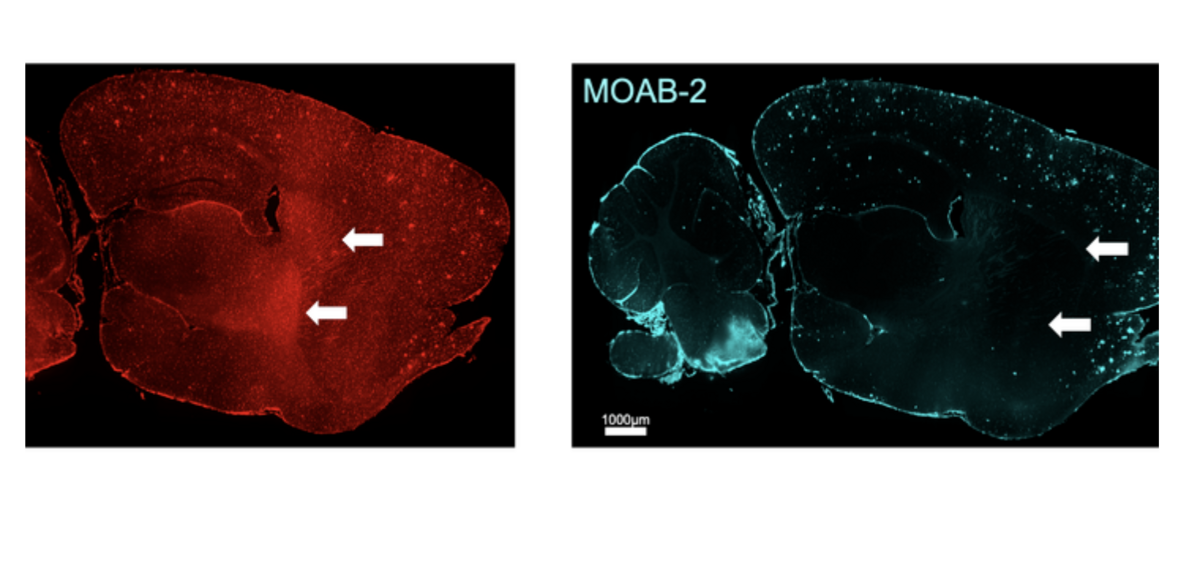 Whole-brain imaging of an Alzheimer’s disease mouse model shows microglial expansion and amyloid-beta plaque deposition. There is increased microglia in all regions despite little or no amyloid buildup. Nicholas Constantino
“These little garbage men in your brain are doing some great things,” Macauley said. “It’s when they get stuck in this really restrictive program that things actually become pathological.”
Sleep loss is one of the earliest and most debilitating symptoms of Alzheimer’s because it creates a harmful feedback loop for patients, limiting the body’s ability to repair. This breakthrough means it’s possible that damage is reversible.
“The immune cells, unlike neurons, are what we call self-propagating, meaning they just keep renewing within the brain,” Macauley said. “So the idea that we can target these microglia, maybe reprogram them, then maybe you can have some benefit is actually really, really exciting from a therapeutic standpoint.”
By taking a “whole house” approach to sleep loss and looking to new avenues, therapies could avoid struggles seen in treatments today. Many treatments focus on neurons in sleep loss. With a predominantly aging population affected by Alzheimer’s, this can have adverse effects.
“This targets a mechanism that’s out of our control,” Macauley said. “Maybe this is something that could avoid some negative effects like drowsiness or falls.”
The study found that after a certain threshold of amyloid plaque build up does not affect restorative sleep, Constantino said. But when removing the brain’s immune cells, restorative sleep increased by two hours.
Aiding restorative sleep is essential to long term health, as it is crucial to memory formation, repair and preventing further damage, Macauley said. Further understanding the cause of sleep loss could enable researchers to track it as a biomarker, informing patients years before cognitive symptoms show up, Constantino said.
“Years before you can’t recognize a loved one, sleep loss is happening,” Macauley said. “A lot of data suggests that if you normalize sleep or improve sleep, you then can improve or push off cognitive problems or cognitive decline.”
The next step is to find a way to control or reprogram the microglia, rather than eliminate them. Microglia play an important role protecting the brain when functioning properly, Constantino said.
To go from preclinical studies to human trials, more research must be done, Macauley said. The findings used mice subjects, human biofluids, advanced imaging, mathematical modeling and more, but the research team is hopeful their findings could eventually improve the quality of life for Alzheimer’s patients.
“We identified a mechanism, and we have other work in the lab that’s trying to find a druggable target,” Macauley said. “We have two of these compounds that we’re investigating, and I’m hoping in the next year we can start to do some really preliminary studies with those.”