
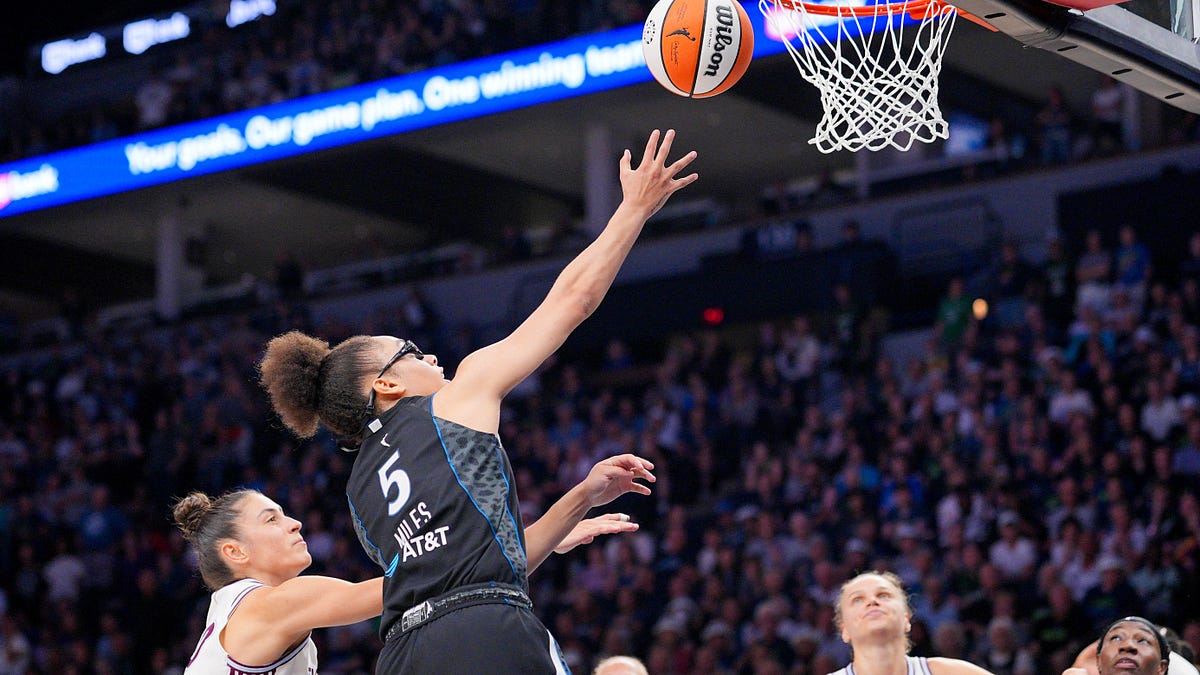
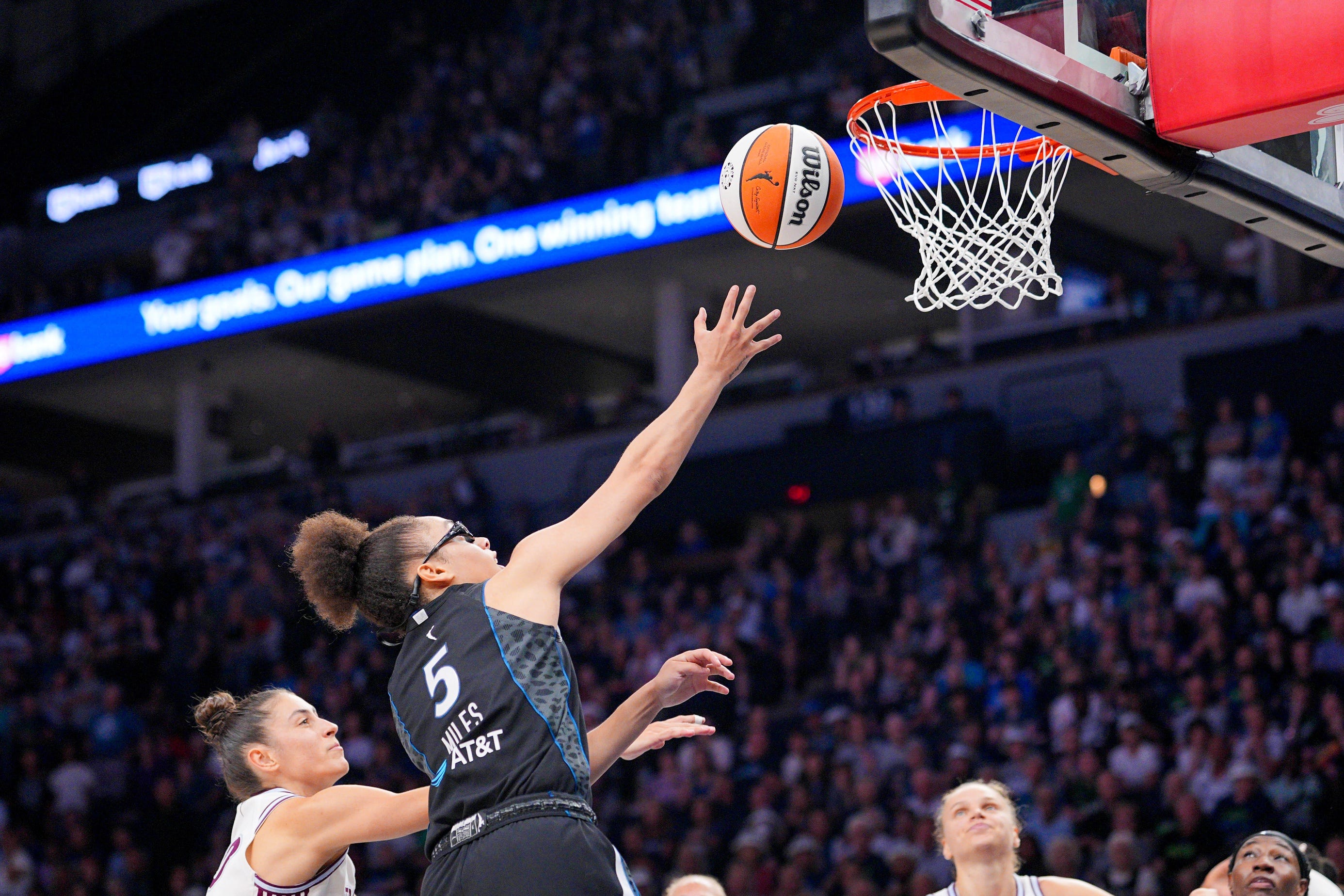
 Jul 28, 2026; Minneapolis, Minnesota, USA; Minnesota Lynx guard Olivia Miles (5) shoots against the Toronto Tempo in the fourth quarter at Target Center. Mandatory Credit: Brad Rempel-Imagn Images
Thanks for reading the Her Hoop Stats newsletter. We’re excited to announce a new partnership with Hudl. Hudl’s industry-leading tools – Sportscode, Instat, and Fastmodel – elevate the preparation, performance, and player development of WNBA and NCAA teams. We appreciate their support and look forward to working with them to help bring more insight about the women’s game to you.
You can find me on Bluesky and Twitter and you can find HHS on Bluesky, Twitter, YouTube, Facebook, and Instagram.
Haven’t subscribed to the Her Hoop Stats Newsletter yet?
The first half of the WNBA season was filled with a lot of performances that popped. Let’s have a dive into some numbers that tell a story about where things are headed in the second-half of the year…
(all rankings are among players with at least 20 games)
Is Olivia Miles an MVP candidate?
Short answer: Yes. Miles is fourth in win shares (4.4), fifth in PER (23.2), eighth in points per game (19.3), eighth in assists per game (6.0) and is shooting 49.4% from the field.
Her scoring at the bucket has been terrific with 111 makes inside five feet and her 3-point shooting is solid (35.8%). If Miles improves on her midrange scoring (9-for-36) she will be one of the most efficient shooters in the league.
With Napheesa Collier out, Cheryl Reeve has put the offense on her plate and delivered for the W’s best team.
The question is where Miles’ numbers will go with Collier back in the lineup. Last year’s MVP runner-up had 20 shots in her first game. From a team perspective, it’s good for the Lynx to add a superstar to the lineup, but from an MVP candidacy angle it might be harder for Miles to have around 20 points per game with Collier taking over games.
Kelsey Mitchell is scoring at a prolific rate
While the internet argues about a bunch of other subjects regarding the Fever, folks seem to be missing that Kelsey Mitchell has been the best backcourt offensive player in the WNBA this year. She’s averaging the most points among guards at 23.3 per game and is making 54.5% of her 2-point shots and 42.5% of her threes. Those are both career highs. She is the only player in the league shooting over 40% from deep on more than five attempts per game.
It might be difficult for someone who only averages 1.7 rebounds and 2.7 assists per game to get into the MVP race, but Mitchell has been the best scoring guard in the WNBA thus far.
Paige Bueckers’ efficiency
When she was at UConn, Geno Auriemma would often remark that he wanted Bueckers to shoot more often. In her second year with the Wings, she’s averaging 15.5 shots per game but you could argue that it could be even more.
Bueckers’ 57.2% effective field-goal percentage is second among guards who take at least 10 shots per game to only Kelsey Mitchell.
Normally in today’s basketball, players shy away from midrange shots, but Bueckers is the exception to the rule. She has taken a league-leading 90 shots from 10-15 feet from the basket and made 50 of them, putting her in the 91st percentile from that distance.
The crazy thing about her stat sheet is that it’s even better than it looks from distance. When she takes normal 3-point shots from 22-27 feet, Bueckers is making an outrageous 45.2% of them. What brings her percentage back to human levels is that she hasn’t made the long threes, going 4-for-23 beyond 27 feet.
Is Jess Shepard the new Alyssa Thomas?
While Shepard was always a quality player for good teams in Minnesota, nobody expected her to turn into a triple-double machine in Dallas. The former Notre Dame standout is averaging 14.9 points, 12.0 rebounds and 5.4 assists per game for the Wings. She only ranks behind A’ja Wilson in win shares this season.
It’s hard to find any comparable power forwards who score, rebound and pass at the level of Shepard in 2026. The only comparable player may be superstar Alyssa Thomas, who averaged 15.4 points, 8.8 rebounds and 9.2 assists per game last year and is the runaway all-time leader in triple-doubles.
Head coach Jose Fernandez’s innovative approach of using Shepard as a point-forward has worked brilliantly to get Bueckers moving away from the ball to create open looks for her.
Caitlin Clark’s trend
It’s been an up-and-down season for the Fever guard, but the results thus far have been very similar to Clark’s debut season. She was in the 44th percentile in field-goal percentage in 2024 and currently sits in the 42nd percentile. She was in the 60th percentile in 2024 in 3-point percentage, whereas she’s in the 55th percentile h this year. In terms of passing, she led the league in assists per game and turnovers per game in 2024 and she’s currently second and first in those categories, respectively.
In terms of win shares, she ranks 19th, which is clearly an All-Star level. The question is whether there is another step to her game. That would come in the form of protecting the basketball. She’s averaging 1.2 turnovers more per game than the next highest player. And many of her deep threes continue to not be efficient, with shots from 27-32 feet away only landing 32.1% on 81 attempts this year.
One thing that is evening out the numbers is free throws, where she’s up to 6.1 per game from 4.5 as a rookie.
Defensive metrics are tough to pin down, but the Fever have been a better defensive team by opponent offensive rating by +4.4 points per 100 possessions when she’s been on the sidelines. We have seen opponents try to isolate her in matchups as well.
If Clark can take the next step in terms of protecting the basketball, limiting high-difficulty deep threes and defense, the Fever have the other pieces to be a serious contender and she can elevate into the rare air of the WNBA.
Rhyne Howard’s best year
If you only look at points per game, the Atlanta All-Star is right on par with the rest of her career. But this year her effective field-goal percentage has improved to 52.0%. Her previous high was 47.7%. While that only ranks 61st out of 126 players with at least 20 games played, she has been able to produce the same number of points with fewer shots. She’s currently attempting a career-low 14.1 shots per game.
When you add average-level efficiency to the high volume 3-point shooting and elite defense (she leads the league in steals per game and ranks fourth in defensive win shares), Howard is suddenly one of the more valuable players in the league.
If she maintains these numbers through the rest of the season, it will be Howard’s best season to date and point the arrow up on her career in the expansion era.
Jordin Canada and Veronica Burton are emerging point guards
By win shares, Burton is a top-10 player in the league this year. She’s tied for fifth in defensive win shares and raised her field-goal percentage to over 40%. Most importantly, Burton has the league’s second best assist-to-turnover ratio (3.24) among starting guards.
Canada is first in assist-to-turnover ratio among starters. She has also reached a new peak in field-goal percentage with a career-high 45.3% to go along with 52.5% from 2-point range.
Kiki Iriafen’s quiet strong start
It’s been a strange year for the young Mystics as they yo-yo between rough outings and games that inspire for the future. Amidst the chaos, Kiki Iriafen has subtly upped her game from a strong Year 1 by scoring on 50.6% of her field-goal attempts and averaging 9.2 rebounds per game. An interesting development is that she has tried 29 3-pointers and made nine. That percentage isn’t great, but she has the talent to turn into more of a threat from beyond the arc as her game develops.
Where is Arike Ogunbowale headed?
While Dallas’ guard has picked up per play lately, the first half of 2026 has not been kind to Ogunbowale. Out of 126 players with 20+ games, she is 105th in effective field-goal percentage and 119th on 2-point shots. She is finishing at the basket at a career-low rate of just 48.7% (17th percentile) and is making just 32.3% of midrange shots.
These brutally inefficient numbers are not a big departure from the rest of her career, but the Wings likely hoped that she would improve with much more talent around her.
Is there an answer? Or is there a trade partner the Wings could find to add someone who can help them defensively and score more efficiently?
Kamilla Cardoso breakout season
It’s a shame that the Sky have struggled so much this season because Cardoso is turning into a handful for opponents to face. She’s scoring on 58.6% of 2-point shots while scoring 14.1 points per game and grabbing 8.4 rebounds. If she can cut down on fouls (3.5 per game), the former draft lottery pick could really come into her own as a star center.
Syd the scorer
Undrafted Sydney Taylor has become the centerpiece of the Sky offense in the first half of the season. She ranks fifth in the WNBA in points per 40 minutes while making 58.7% of her 2-point shots. Chicago desperately needs talented young players for the future with, and Taylor is becoming one of them.
DPOY?
There are a bunch of good candidates for Defensive Player of the Year thus far. The leader in defensive win shares is Washington’s Shakira Austin (1.6), but she has a narrow lead over Natasha Howard (1.5), Kiah Stokes (1.5), Rhyne Howard (1.4), A’ja Wilson (1.4), Angel Reese (1.4), Veronica Burton (1.4) and Gabby Williams (1.3).
The rim protectors and rebounders are always going to get a lot of credit in the numbers, but Williams stands out as a defender who often matches up with the best scorers in opponents’ backcourts. Her individual defensive rating is third best among starters, and she is third in steals per 40 minutes.
Give NaLyssa Smith some credit
The Aces have so many stars that it seems to go forgotten that acquiring Smith from Dallas was a season-shifting move for Las Vegas last year. This season she ranks No. 1 in effective field-goal percentage at 67.3% while averaging 12.2 points and 6.1 rebounds per game. Adding more depth to the Aces’ scoring and size/length defensively has made them a more complete team.
Marina Mabrey spreading her offensive wings in Toronto
Everyone knew that Mabrey had offensive talent, but she’s answering the question: What if she shot 20 times per game? Mabrey is leading the WNBA with 11.4 3-point attempts per 40 minutes and making them at an outstanding rate of 39.2%. She has kept Toronto in the mix despite a rash of injuries, and she’s become must-see TV for the expansion team.
Angel Reese’s offense hasn’t changed
Out of 33 players who average 10 field-goal attempts per game, Reese ranks 33rd in points per play, 33rd in effective field-goal percentage, 28th in offensive win shares per 40 minutes and 32nd in restricted area field-goal percentage.
At some point, the shot selection has to improve or the volume has to decrease because Reese is an anchor on Atlanta’s offense.
Thanks for reading the Her Hoop Stats Newsletter. If you like our work, be sure to check out our stats site, our podcast, and our social media accounts on Twitter, YouTube, Facebook, and Instagram.