
Sometime in the fall of 2020, a wooden throne with a velvet-lined seat, seven feet high and 200 pounds, sold for $75 on Facebook Marketplace.
The buyer was a football coach in Idaho.
Each Friday, the throne followed the Skyline High School football team in Idaho Falls. A parent would load it onto a pickup truck and deliver it to the sideline for games. A player forcing a turnover would be feted like a king: gold chain (with a thick wooden paw and “Grizz” insignia across the middle) draped around his neck. He’d then climb onto that wooden throne — the “Turnover Throne” — and be lifted by celebratory teammates.
The throne followed Skyline throughout its state championship run in 2020, and it was present for the title game in 2021, too. However, by the end of that game, the throne had a human-sized dent in the side of it.
The damaged throne still stands. Years later and 2,200 miles east, the kid responsible for the damage shrugs his shoulders.
“I broke it, I guess,” Kenyon Sadiq says.
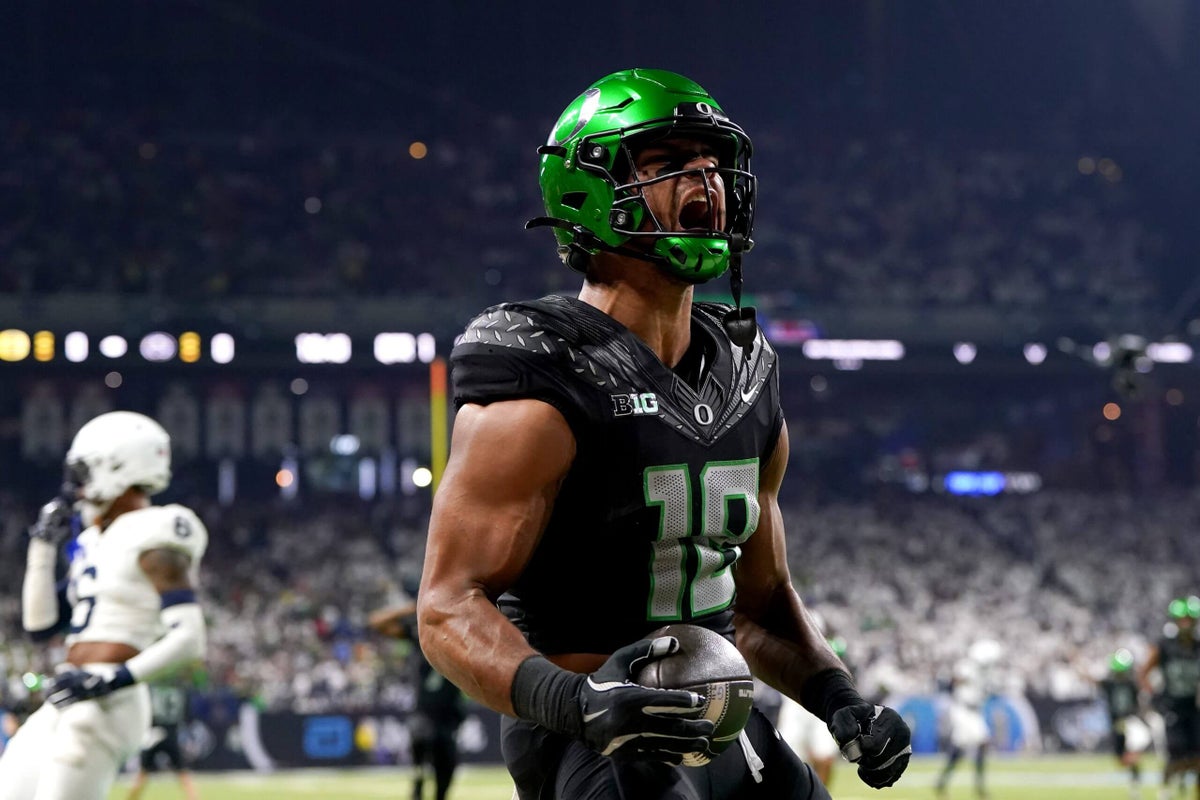
Standing outside the New York Jets’ facility in northeast New Jersey, Sadiq, the Jets’ first-round rookie tight end, looks around and smiles. He appreciates the sounds of silence — or, at least, how it sounds tucked into a quiet area, when construction at the facility isn’t roaring. He prefers peace.
When he found out the Jets drafted him, the prospect of living in Manhattan stressed him out — it’s a long way from the woods of southeast Idaho. When he first arrived in Florham Park, he breathed a sigh of relief.
Silence soothes him, but the tranquility also animates him. Through a life lived in nature, much of it spent fishing with his late grandfather, he learned to turn the volume down in his brain. Most people exercise to fast-paced music. Sadiq listens to slow jams when he works out.
And the way he plays football, he might as well be wearing noise-canceling headphones. He rarely hears the sounds of a crowd, even the deafening noise of Oregon’s raucous Autzen Stadium, where he played his collegiate home games. He says there are moments when all he sees is the man in front of him, or the ball as he leaps for a catch or the end zone as he runs toward it.
“What Kenyon would explain to me,” his mother, Heather Pledger, says, “is the game slows down in his head. So he could feel himself in the air and then catch the ball. Like, the ball would come in slow motion to him.”
Beast Breakdown: Kenyon Sadiq
Dave Helman
His preparation is so intense, so thorough, that all he needs is a task — beat the man in front of you on a route, catch the ball when it’s thrown to you, make defenders miss once it’s in your hands. Or, block the man in front of you and don’t stop until he’s on the ground.
Pledger recalled moments that made her think of the movie “The Blind Side,” when Michael Oher blocked someone through the back of the end zone and over a fence at the end of a play. Sadiq did something like that more than once. His mom would ask him: Where’d you go, son? Did you forget the game was still going on?
“You tell Kenyon to finish, he’s gonna finish,” she says. “Whatever that means.”
That’s what he did in that 2021 state title game. He took a Sandpoint High defensive back and blocked him through Skyline’s sideline, and then he kept going.
Crack.
He finally stopped. He’d blocked the kid into the throne. It tipped over.
“He broke it!” his mom says, laughing.
The image was fitting. A throne symbolizes power, and with that comes fame and adulation. Sadiq never had interest in any of that.
McCammon, Idaho, is a two-stoplight town with a population in triple digits. The area it covers is so small that a bike ride across the entire town takes about 10 minutes. For locals, “going into town” means driving 30 minutes away to Pocatello to get groceries at Walmart. A few years ago, McCammon got its first-ever Family Dollar, which was a big deal.
In this small stretch of land, Terry Pledger, Sadiq’s maternal grandfather, was beloved. An Idaho boy from Pocatello, Pledger was a three-sport high school star who stayed home to start a family with Alaina, the love of his life, rather than pursue dreams of playing baseball professionally.
As an offensive lineman, he had offers to play college football, too. Instead, he worked at Kraft for a time, then became a police officer, a coach and a girls basketball referee. He pushed his daughter to find her passion. Heather danced, ran track, played volleyball and basketball. Terry had her playing baseball too; she was the only girl on the team.
When Pledger looks at her son, she sees her dad: his athleticism, determination, kindness, intellect, love of nature — his essence. Even his hands, which she calls an “exact” replica of her father’s. Perhaps that’s why grandfather and grandson got along so well.
“He saw a lot of himself in my son,” she says.
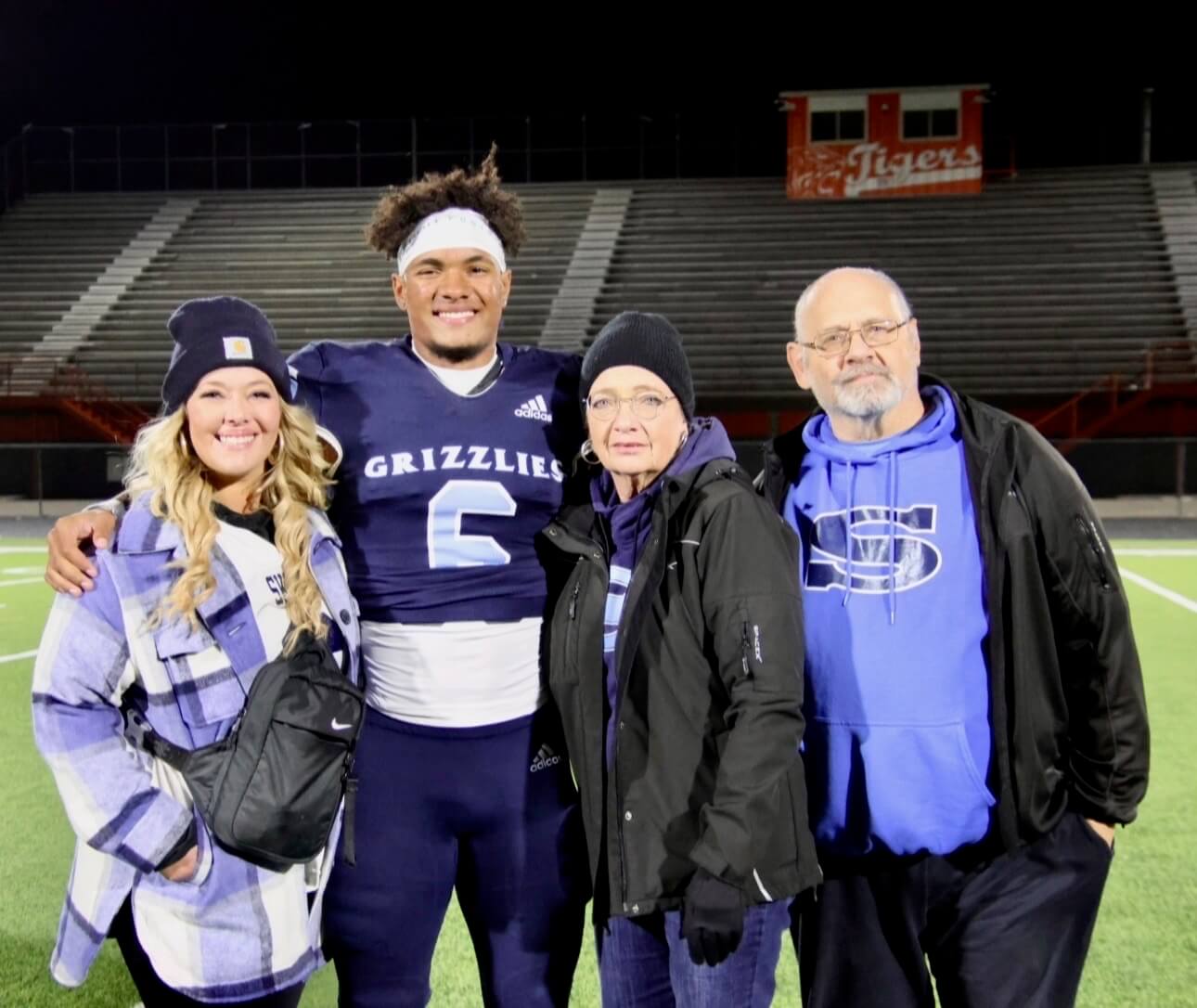
Sadiq with mom Heather (left) and his grandparents, Alaina and Terry. (Courtesy of Heather Pledger)
There were stretches when Heather, with Kenyon’s father out of the picture, was working as many as three jobs at a time — running restaurants, working at dental offices, graveyard shifts at the hospital, gigs at the local horse track, among others — for her three kids: Kenyon, his sister, Daisha, and his brother, Mikhi.
Kenyon learned to do his own laundry at 5, and he and his siblings sometimes had to cook for themselves. For stretches, they’d move back in with her parents until she could get back on her feet.
There wasn’t a whole lot to do in town — and Kenyon, she says, was “very rambunctious,” a “daredevil.” Heather was constantly buying him new shoes because he would “run holes in all of them.”
Kenyon wanted to keep up with his sister, who was 14 months older than him, so he was already riding a bike without training wheels at 2. He’d come home sometimes, bloodied, and it was always: “Kenyon, what did you do now? We’ve got to get stitches because we told you not to do wheelies on your bike.”
Heather signed him up for sports, though soccer and baseball bored him. He did karate. He was a Boy Scout, earning every badge. However, it was football that satiated him. And it started when his grandpa put a ball in his hands for the first time, at 6.
“He’d always be saying cringy things like: Be the hammer, not the nail,” Sadiq says. “He was making sure I wasn’t a little wimp out there.”
Sadiq was 16, making himself breakfast, finishing schoolwork on the computer and then, around noon, going to the local gym to work out with his friends while other kids his age were at school.
His workout buddies were in their 50s and 60s, doctors and dentists on their afternoon breaks. After working out, he’d head home, make a protein shake, finish more schoolwork and then head to football practice. When his mom was picking up groceries, he’d give her a list of vitamins and amino acids.
COVID-19 sent students online in 2020, and Sadiq wanted to keep it that way. High school — the school part, at least — wasn’t for him. The NFL was his goal, so Sadiq pitched his mom on letting him join an online schooling program based in Idaho: It would allow him to devote more time to training and remove some of the typical distractions of teenage life. He wasn’t especially interested in socializing or partying. He wanted to work.
“I feel like I matured a bit faster than some of the kids that I was around,” Sadiq says. “So just being around them all day felt like a waste of time.”
Those old gym friends — he still talks to some of them — helped educate him on fitness and weight training. The exercise became a form of therapy, like fishing on a lake with his grandpa. He’d put on his headphones, listen to ’90s R&B and clear his mind. Sadiq found his center at 16, wise beyond his years.
The scholarship offers poured in, but not immediately. It takes a little longer for word to travel from Idaho to the big schools, and many college coaches are unwilling to make the trip.
However, Scott Berger, Sadiq’s high school coach, knew he had someone special. Sadiq transferred to Skyline after his freshman year. His previous coaches tried playing him at defensive end, but Sadiq wanted to play wide receiver. Berger happily obliged.
“What stood out about him right away was he was just so physical,” Berger says. “He loved to block, and he would really take those DBs and just bury them. After a while, these little DBs would turn and run.”
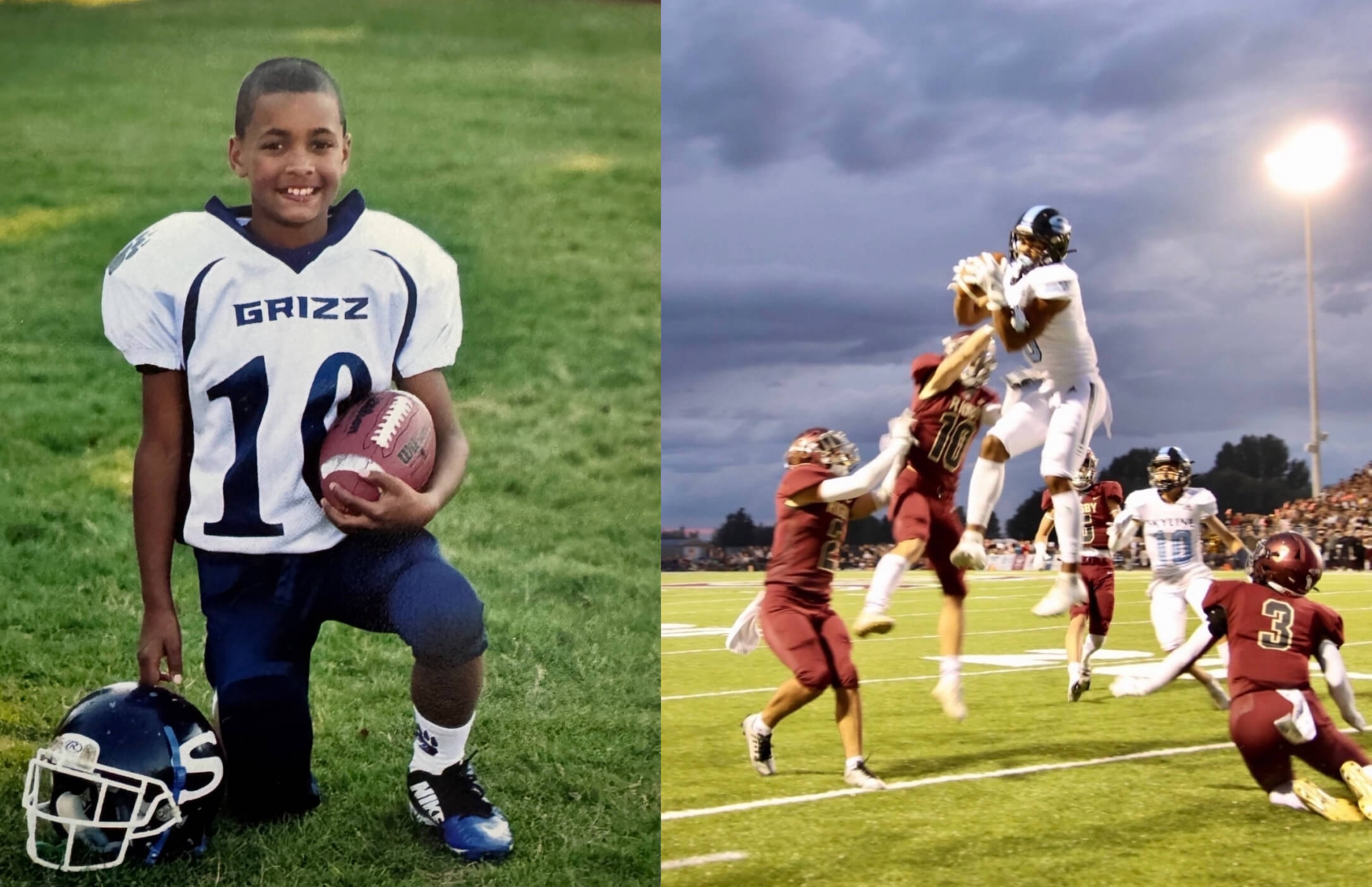
It didn’t take long for Sadiq to grow into an unstoppable force at Skyline High School. (Courtesy of Heather Pledger)
Once the speed and athleticism caught up with his strength and size, he was unstoppable.
In Sadiq’s junior year, Skyline was playing in the semifinals of the state playoffs in Pocatello, with more than 10,000 people watching. Sadiq hurdled an opponent — illegal in high school football.
“It was a penalty,” Berger says with a laugh. “But we all looked at each other like: Oh s–t.”
Sadiq finished his junior season with 1,162 receiving yards and 19 touchdowns, but still he had no offers. The first ones, from Big Sky Conference schools like Idaho and Idaho State, didn’t come until February. However, by the summer, big-time schools caught wind of the freak athlete from Idaho. Coaches flew in from all over to meet with him. He was bumped up to a four-star recruit.
At the end of his senior year, Sadiq had 246 receiving yards and five touchdowns (on six catches) in another semifinal playoff win.
In the championship, he did a little bit of everything. He had 130 yards receiving and two touchdowns. Berger put him in as a Wildcat quarterback, and he completed a two-point conversion on a jump pass. He subbed in as the punter and pinned it inside the 5-yard line, and on his way off the field after the punt, Berger told him to get back out there and get the ball back on defense.
On the first play, the offense ran right at him. He stripped the ball, and his teammates recovered it. They scored. He got to sit on the Turnover Throne — repaired from the previous year’s damage, though the dent on the side remains.
Added Berger: “He would touch the ball, and on the sideline I’d say: ‘Kickoff team, get ready, Kenyon is going to take the damn thing to the house.’ ”
He enrolled at Oregon a couple of weeks later.
Sadiq walked into Drew Mehringer’s office and sat down.
“I thought: Oh boy, here we go,” says Mehringer, Oregon’s co-offensive coordinator and tight ends coach.
Sadiq had been buried on the depth chart behind Terrance Ferguson, a future NFL Draft pick, and Patrick Herbert, the brother of Justin Herbert, two veterans who had earned their roles. College coaches know these kinds of conversations too well. Am I going to play? If not, I’m leaving.
However, that’s not what this was. Sadiq posed a simple question: “What else can I do to help the team?”
“I really just wanted to play,” Sadiq said, telling Mehringer he’d even play on special teams. “I just wanted to get on the field because I knew it was going to help me in the long run.”
Former Oregon offensive coordinator Will Stein, now the head coach at Kentucky, says that college players now “just run at the first sign of adversity or if you’re not getting your way — and so you don’t get to go earn it. But Kenyon wanted to earn it.”
Sadiq’s freshman year ended with five total catches. The fifth catch was special. In the Fiesta Bowl against Liberty, Oregon lined up in 14-personnel — four tight ends, one running back — and got the ball to Sadiq on a jet sweep. He ran it in for a 3-yard touchdown. The first people to greet him in the end zone: Ferguson and Herbert.
His grandfather celebrated that moment from home in Idaho. It was the last time he’d watch Kenyon play football; he passed away unexpectedly a couple of weeks later. For the next two years, Sadiq prayed and thought about him before every game. He still sees him when he goes fishing.
Sadiq played for his grandfather when he opened his sophomore season with two touchdowns against Idaho, but he didn’t play much after that. It was about the midway point of that season when he walked into Mehringer’s office and asked what he could do to help the team.
Mehringer told him a story: The San Francisco 49ers had sent a scout to Oregon’s practice and pulled Mehringer aside to say that Sadiq, despite barely playing at the time, had the potential to be a first-round pick.
Oregon wasn’t going to bench Ferguson — “statistically (the) greatest tight end” in program history — but Sadiq’s time would come.
Behind the scenes, Sadiq operated as he did in high school. He lived in an apartment complex with Ferguson and Herbert but spent most of his time outside of football alone. He took mostly online classes.
“Dude doesn’t drink, smoke or party. He doesn’t care about being popular. He doesn’t have a ton of friends because he’s not terribly interested,” Mehringer says. “All he cares about is being really good at football.
“He is unbelievably committed to this at the cost of a social life. That life isn’t for everybody. To him, it suits his personality. Is he shy? Is he timid? No, he’s not. He just is not terribly interested in engaging in whatever you want to call it — BS conversation, small talk. He wants to have an intelligent conversation.”
Mehringer laughs: “He listens to podcasts on deep space and black holes. He’s way more intrigued with those kinds of things than: Hey, what’s everyone doing tonight?”
In the Big Ten title game that year, Sadiq scored two touchdowns in an eight-point win, with one of them going viral when he hurdled a defender in Saquon Barkley-esque fashion.
“Freak, freak, freak, man,” Stein says.
When Sadiq got the ball and saw the defender in front of him, it was as if time stood still — it always unfolds like that. Back home, someone sent Berger a picture: The hurdle was being sold online as a Christmas ornament.
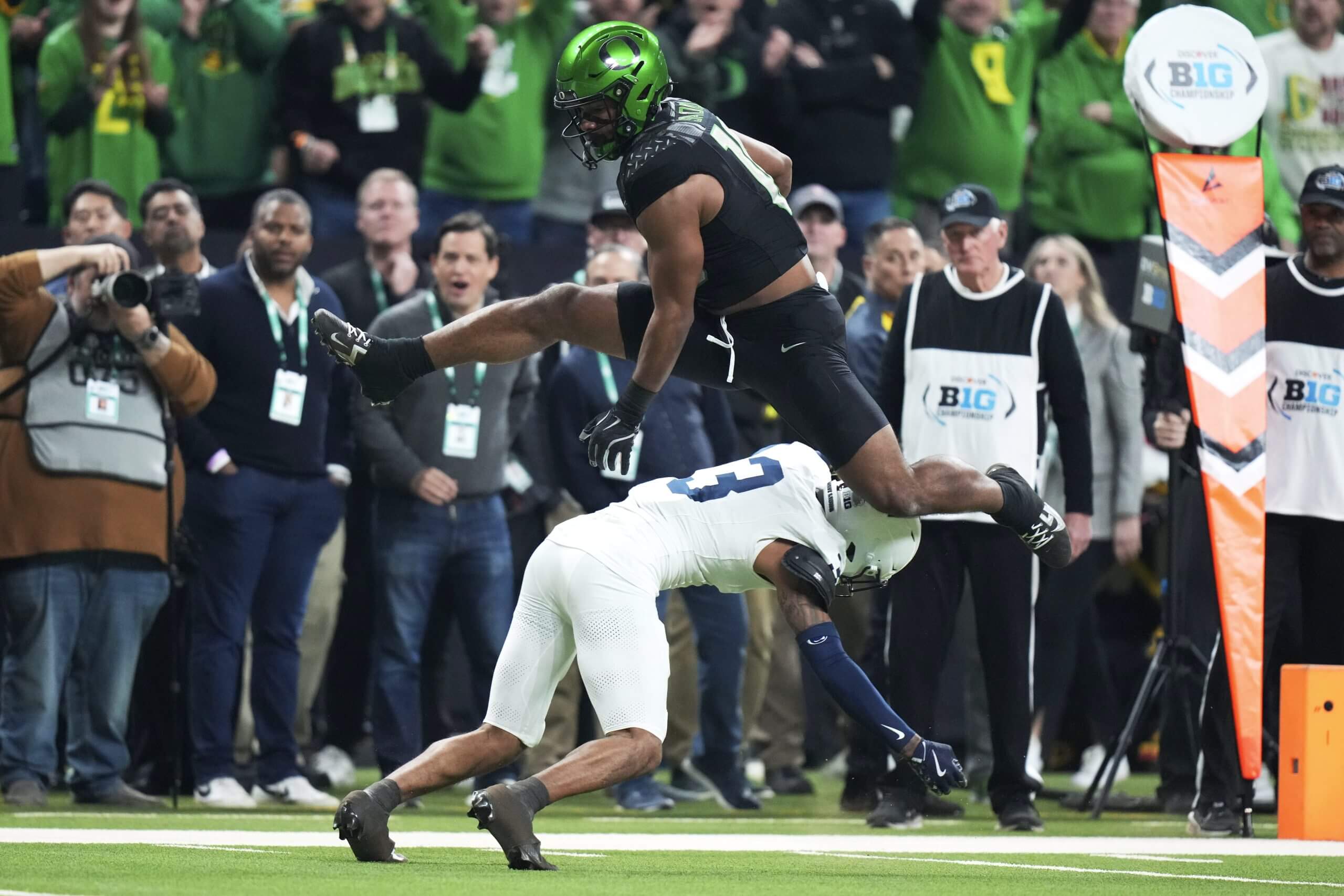
Sadiq was responsible for some of college football’s most dazzling plays the past two seasons. (AJ Mast / Associated Press)
Stein estimates that Sadiq was banged up in eight of Oregon’s 14 games last season, but he still toughed out 560 yards, eight touchdowns and enough tantalizing displays of athleticism to lock him in as a first-round prospect for 2026. Even so, at the end of the season, Sadiq walked into Mehringer’s office and had another question for him.
“Are you sure I should leave? I’ll come back for another year.”
Mehringer laughed. ‘I can’t in good conscience let you come back, bud.’
“I told all the NFL scouts,” Mehringer says, “the world does not deserve this kid.”
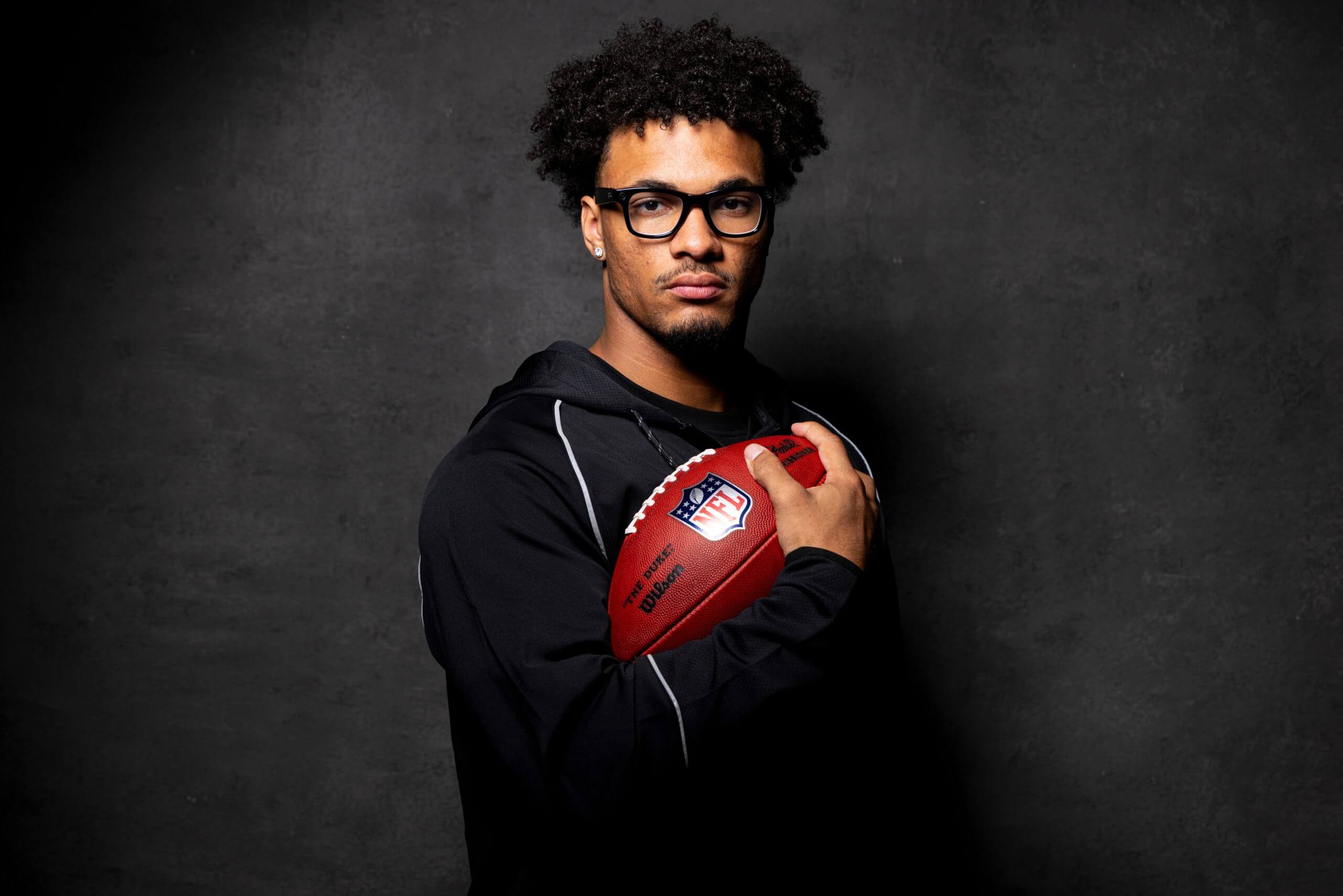
The Jets selected Sadiq with the No. 16 selection in the 2026 NFL Draft. (Logan Bowles / Associated Press)
Heather watched as her son answered his phone on the night of April 23, and her heart was full. The New York Jets were calling, and at the other end of the line was offensive coordinator Frank Reich, pumping his fist.
The Jets view Sadiq as the sort of versatile, athletic weapon — he set an NFL combine record for tight ends by running a 4.39-second 40-yard dash — that can unlock an offense that has lacked production at tight end since the last time they made the postseason 15 years ago.
“I can’t even breathe right now,” Reich told Sadiq on the phone. “I’m so happy.”
The feeling was mutual. When Sadiq hung up the phone, he took a deep breath.
“I’m going to throw up,” he told his mom.
“I’ve never seen him nervous,” she says. “And just to feel that deep breath when he got off was just like: Oh my gosh, I did it. He could feel all those years of this hard work and grind and just in that moment.”
On an afternoon at the Jets facility a few weeks later, in his NFL uniform, Sadiq is responding to a question about why he loves fishing so much.
“Me and my grandpa would take off and go fishing for the day, or two days, and it’s really just like — you clear out your mind when you get to a nice quiet place like that,” he says, then stops and looks around again.
“It’s actually pretty quiet here. Which is awesome.”