
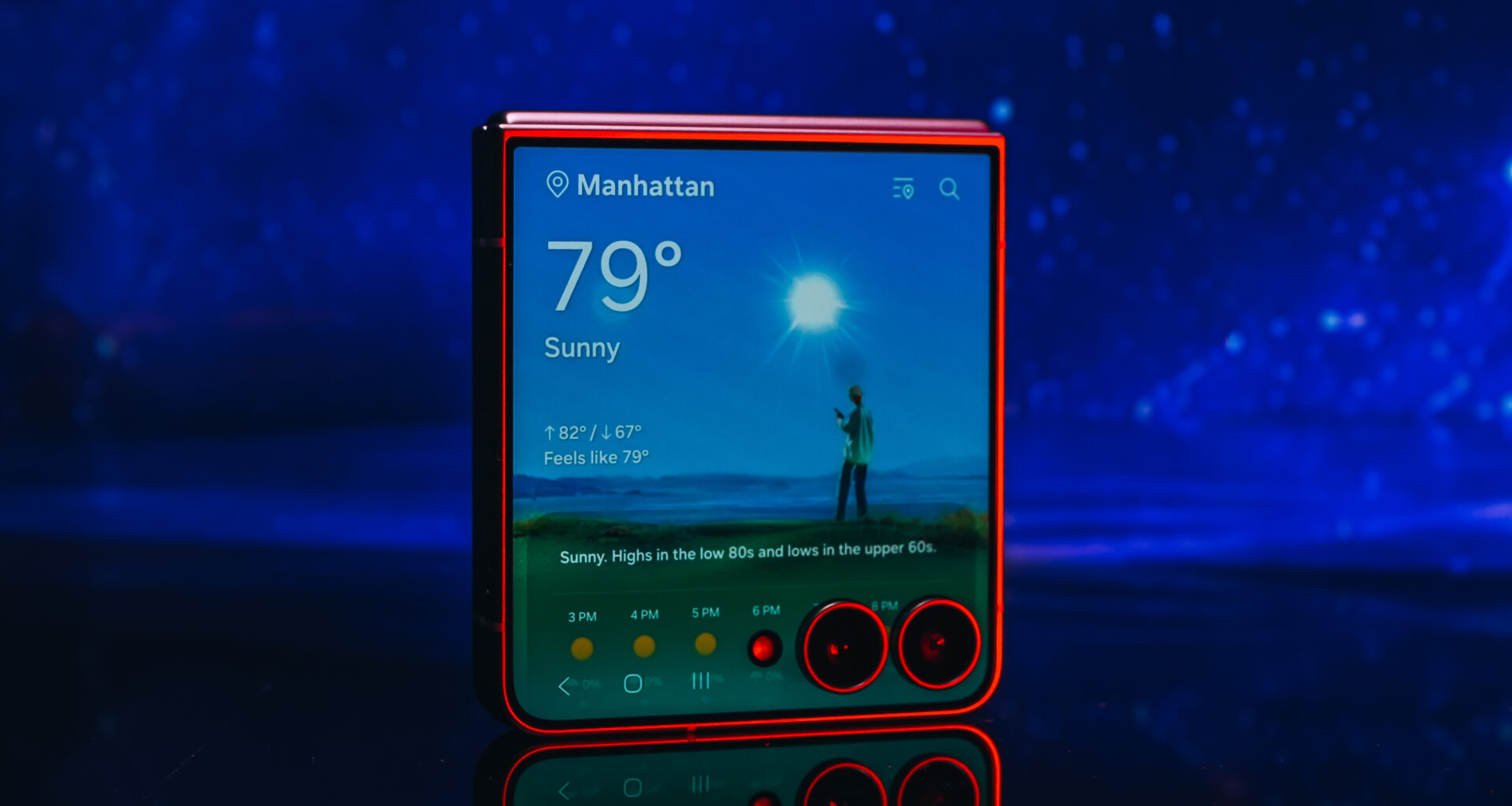
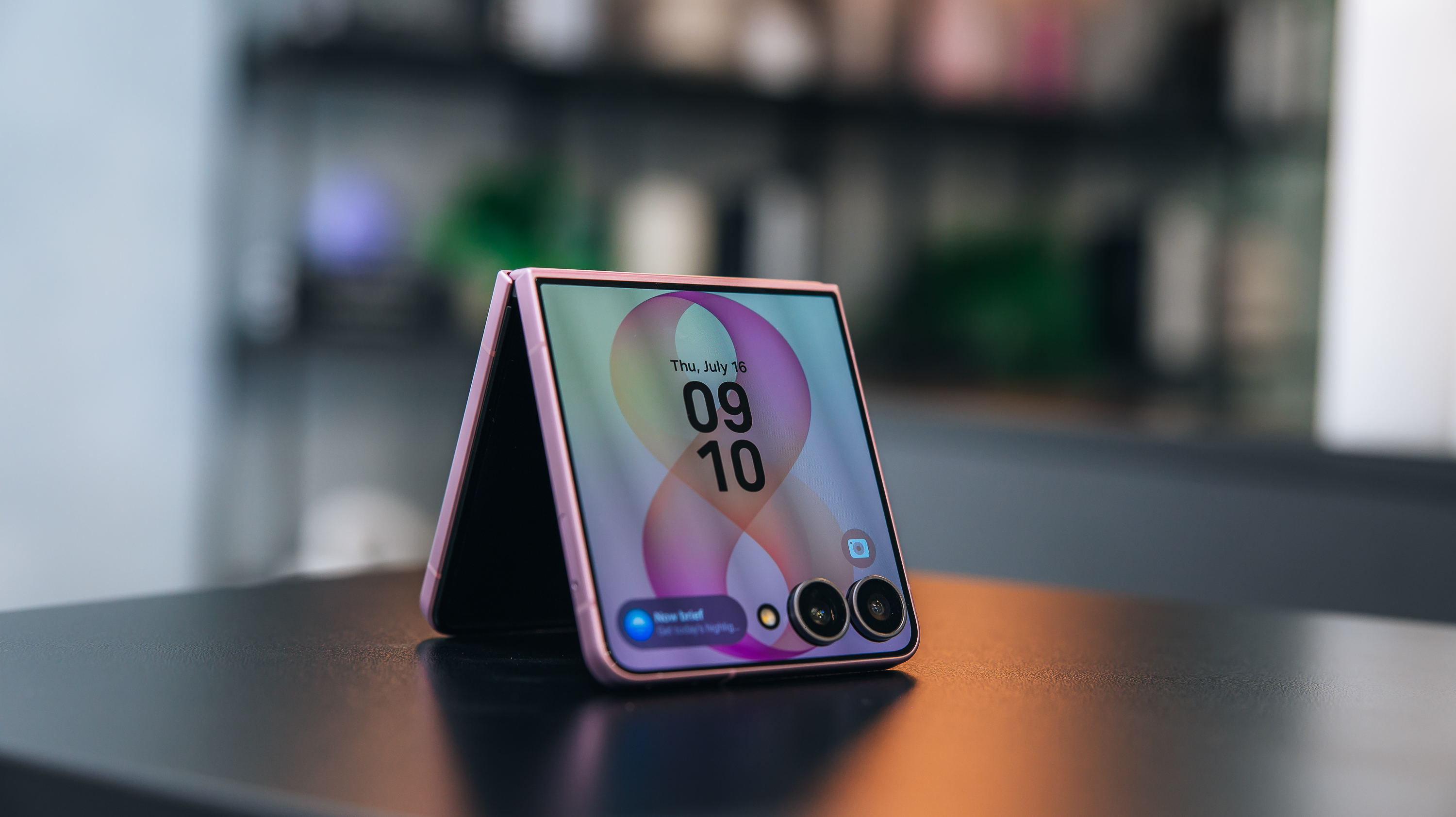
The $1,200 Galaxy Z Flip 8. / Joseph Maldonado/CNET
Pros & Cons
Thin and light design
Improved cover screen software
Most powerful flip phone so far
Higher price
Weaker battery life
Galaxy AI feels pushy
Samsung’s $1,200 Galaxy Z Flip 8 is easily the best-looking flip phone I’ve tested. While Samsung doesn’t appear to be releasing a sequel to last year’s Galaxy S25 Edge — a phone designed to be thin and light — the Z Flip 8 feels like it’s carrying on that thin design torch.
When unfolded, its 6.9-inch internal display feels extremely manageable: It weighs only 180 grams, compared to the non-folding Galaxy S26 Plus‘ 190 grams and smaller 6.7-inch display. This made the Z Flip 8 ideal for streaming shows while commuting on the train. Once I reached my stop, I could fold it in half and slip it into my pocket.
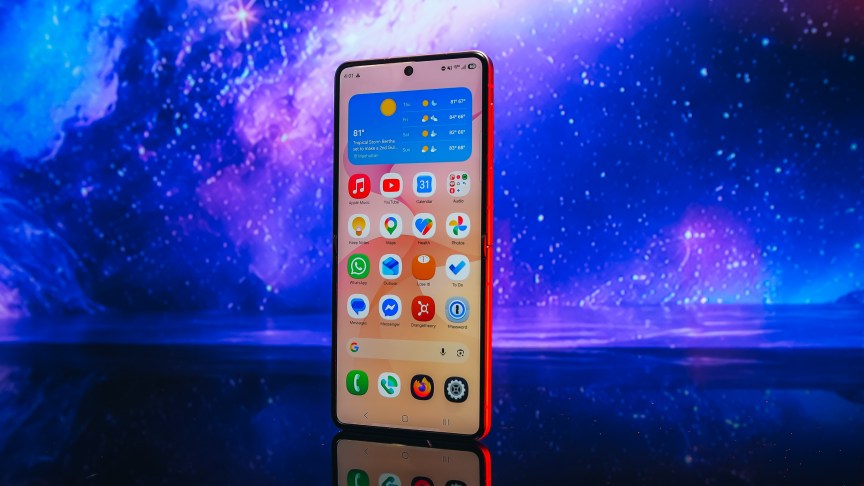 The unfolded Galaxy Z Flip 8.Joseph Maldonado/CNET
Samsung’s 4.1-inch cover screen is similar to the one on last year’s Z Flip 7, but it’s dramatically more useful thanks to the addition of the much-needed navigation options that make it easier to use Android apps.
The best is a small toggle that lets you adjust how much of the cover screen an app uses. It lets you cycle among a view above the two cameras; a larger, square view that uses the entire display, with the cameras acting like cutouts; and a vertical view that makes scrolling through apps such as Instagram and TikTok easier. You can also shift that vertical view to the left side of the screen, away from the camera cutouts.
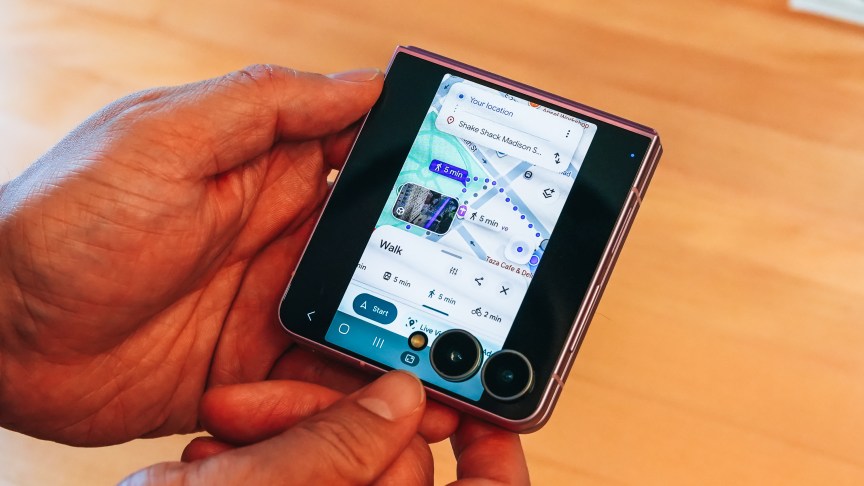 You can change how apps appear on the cover screen, choosing either a square layout that fits the full cover screen or a vertical layout.Joseph Maldonado/CNET
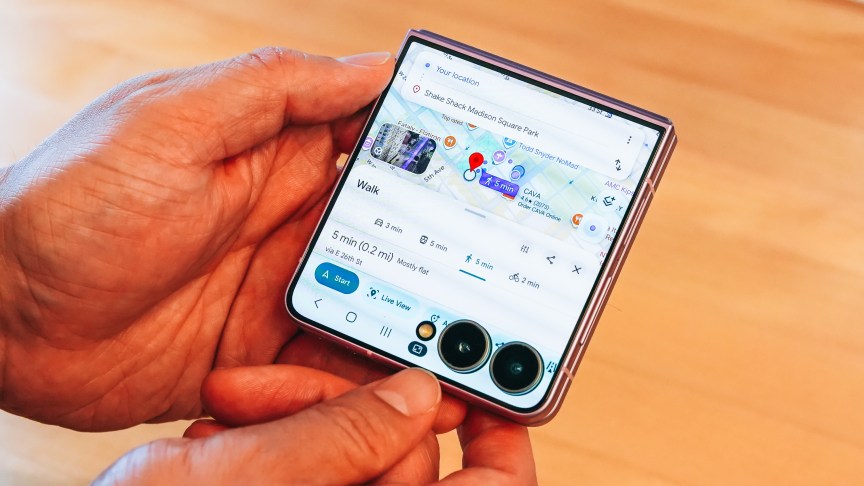 This option takes advantage of the full cover screen, but the two cameras block part of the view.Joseph Maldonado/CNET
These cover screen enhancements are a big help. While some Android apps have optimized modes for flip-style phones, most haven’t. But if you’ve just spent $1,200 for a 256GB flip phone (or $1,400 for a 512GB model), you should be able to use whatever apps you want.
That high price, driven by the overall higher cost to make electronics, is the real rub here. The ongoing RAM shortage is leading to higher prices for many phones, and we’ve seen Samsung raise prices on some of last year’s folding phones, too. Samsung’s Flip 8 is priced competitively with the $1,500 Motorola Razr Ultra 2026 when comparing both 512GB models, but if you just want a nice flip-style Android phone, there are several lower-priced options, such as the $800 Motorola Razr 2026 or last year’s $900 Samsung Galaxy Z Flip 7 FE.
And because Samsung didn’t improve some of the hardware over last year’s Flip 7, you’ll have to really love the phone’s thinner design to justify its premium price.
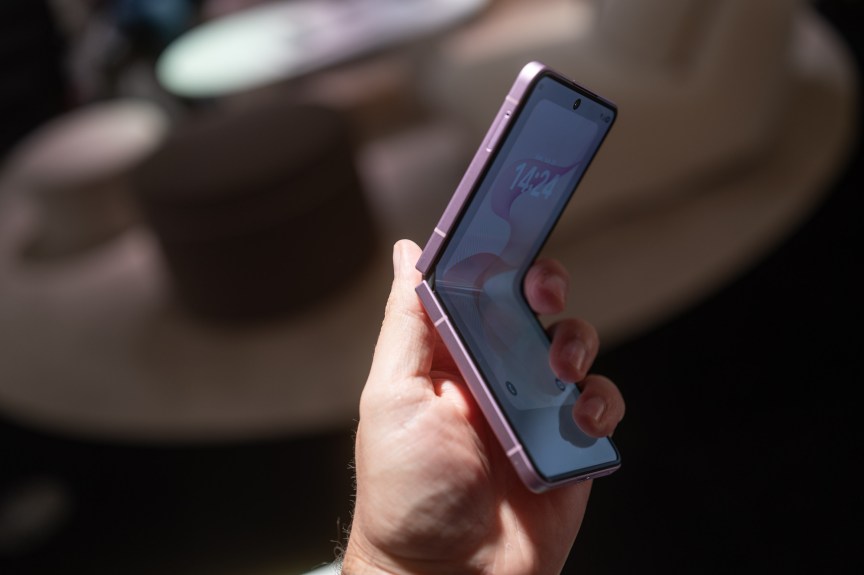 The Galaxy Z Flip 8’s thinner design makes it easy to hold.Andrew Lanxon/CNET
Galaxy Z Flip 8 design, software and battery
Samsung’s Galaxy Z Flip 8 is the most powerful flip-style phone we’ve tested so far, and that’s because it’s using the same Qualcomm Snapdragon 8 Elite Gen 5 for Galaxy processor as the rest of the Galaxy S26 line and the Z Fold 8 series. This processor scores higher in benchmarks than the older Snapdragon 8 Elite on the Razr Ultra 2026, and is a noticeable jump from the Z Flip 7’s Exynos 2500 processor.
Geekbench 6.0
Samsung Galaxy Z Flip 8
Single-core:
3493
Multi-core:
9823
Motorola Razr Ultra (2026)
Single-core:
2943
Multi-core:
7181
Samsung Galaxy Z Flip 7
Single-core:
2216
Multi-core:
7338
Note:
Higher scores are better.
In real-world use, I had no issues multitasking with the Z Flip 8, exporting subject-specific videos with Galaxy AI’s new My FanCam feature and playing 3D games such as Fall Guys on both screens. While the Flip 8 does get noticeably warm during these tasks, that’s typical behavior among flip-style phones and thinner devices, such as the iPhone Air.
3DMark Wild Life Extreme
Samsung Galaxy Z Flip 8
Score:
6330
Average frames per second (fps):
37.91
Motorola Razr Ultra (2026)
Score:
5324
Average frames per second (fps):
31.89
Samsung Galaxy Z Flip 7
Score:
3945
Average frames per second (fps):
23.62
Score
Average frames per second (fps)
Note:
Higher scores are better.
Aside from its thinner frame, the Galaxy Z Flip 8 has a few other additions over last year’s Z Flip 7. The cover screen now has some basic Android navigation that prior Flip phones lacked, including a Recent Apps button and simplified steps for adding more Android apps to the cover screen — but you’ll still see most non-Samsung apps listed in a “Labs” section within the app drawer.
Samsung’s new Galaxy AI features are nice, but I still don’t see any of them as a reason to buy a new phone. While I do enjoy making subject-focused videos with My FanCam, including in darker environments, I noticed that the feature can sometimes lose track of a subject: I tried running around on a dark rooftop and had a laugh afterwards as I watched myself run out of the frame while Galaxy AI slowly panned away looking for me.
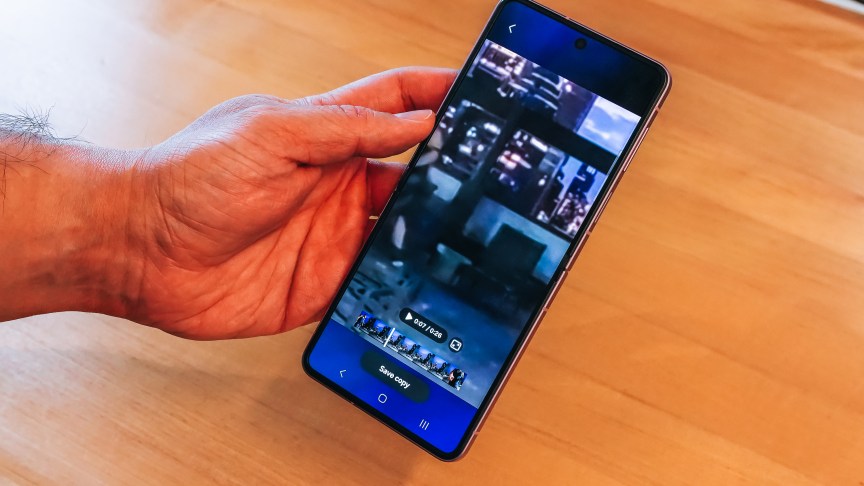 I attempted to use My FanCam while jogging on this roof, but Galaxy AI lost track of me in this darker setting, and I ran out of the frame.Joseph Maldonado/CNET
The updated Now Nudge feature, which is designed to remind you of important details and upcoming events, was also a little too nudgy for my taste. It would often bug me about the next event in my calendar even after I’d swiped away a previous notification. But it was occasionally useful when it showed at-a-glance information, such as whether my phone was still in Do Not Disturb mode.
Samsung’s Now Brief is one of the default screens on the cover display. It shows a summary of the day’s events along with web highlights you can customize. But I also found this to be a little too intrusive and preferred to relegate Now Brief to an app that I can open as I please, rather than something I see as soon as I unlock the phone.
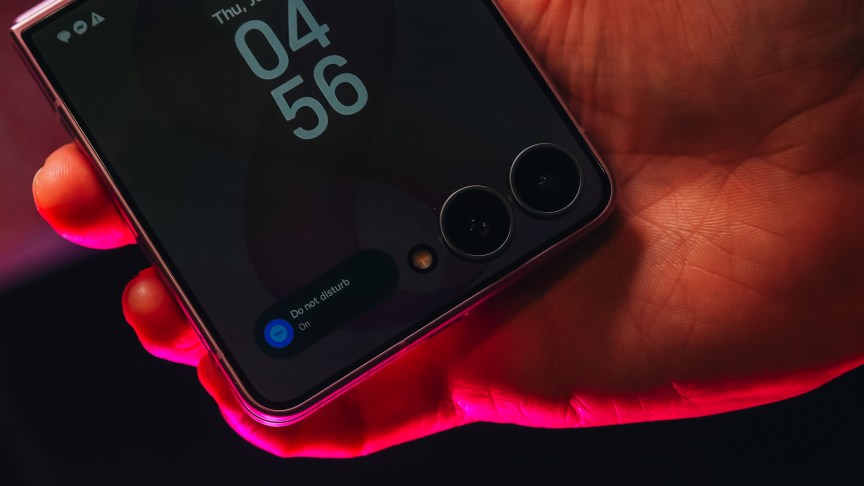 Now Nudge lets you glance at information ranging from this “do not disturb” status to upcoming events in your calendar.Joseph Maldonado/CNET
The Z Flip 8 is Samsung’s first flip-style phone to use silicon- carbon battery technology, but the phone’s actual battery life and charging speeds feel comparable to last year’s Z Flip 7. In my week of testing the Z Flip 8, I often ended my day with 10% to 20% of battery remaining, with the phone reporting between four to five hours of screen time each day. And the phone’s 4,300-mAh battery is on the smaller side compared to the Motorola Razr Plus (4,500-mAh) and the Razr Ultra (5,000-mAh).
3-hour YouTube streaming test
Samsung Galaxy Z Flip 8
Battery drain percentage:
18
Motorola Razr Ultra (2026)
Battery drain percentage:
13
Samsung Galaxy Z Flip 7
Battery drain percentage:
18
Note:
Percent of battery depletion over three hours of streaming from 100%. Lower scores are better.
On the other hand, the smaller battery size plays a big role in keeping the phone thin and light. While I’m not doing a teardown as part of this review, silicon-carbon battery technology does enable denser batteries. So even though last year’s Z Flip 7 has the same 4,300-mAh capacity, the Z Flip 8’s denser battery likely takes up less space.
30-minute wired charging test
Motorola Razr Ultra (2026)
Note:
Battery percentage gained over a 30-minute period.
The phone’s recharging speed is also similar to last year’s Z Flip 7: In our 30-minute wired charging test, the phone’s 25-watt speed recharged its battery from 0% to 56%, and in our 30-minute wireless charging test, its 15-watt speed recharged from 3% to 14%. These speeds and battery life are comparable to other flip-style phones, but other folding phones with silicon-carbon batteries, such as the book-style Razr Fold, are capable of substantially faster speeds. Maybe we’ll start seeing that in next year’s flip-style phones as more companies start using silicon-carbon batteries.
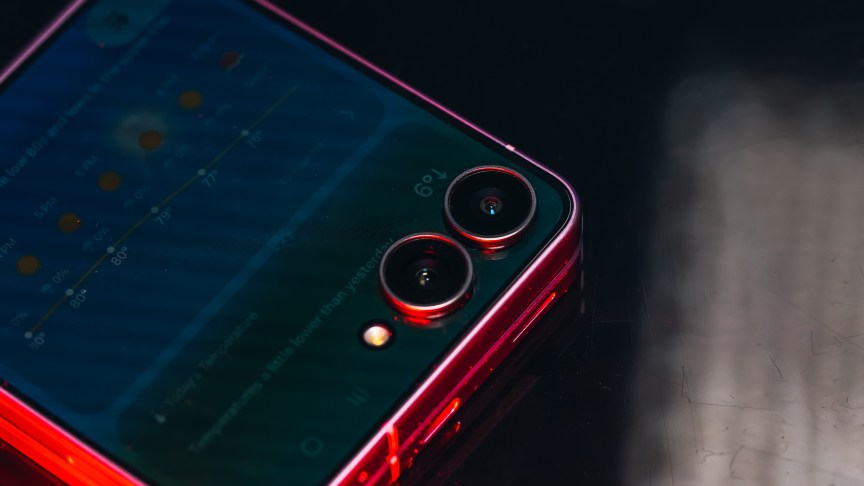 The Galaxy Z Flip 8 has a 50-megapixel wide camera and a 12-megapixel ultrawide camera on its cover screen. The internal display has a cutout for a 10-megapixel selfie camera that’s ideal for video calls.Joseph Maldonado/CNET
Galaxy Z Flip 8 cameras
Samsung’s Galaxy Z Flip 8 has similar cameras to last year’s Z Flip 7, which is both good and bad. On the bright side, it means that the same 50-megapixel wide camera, 12-megapixel ultrawide camera and 10-megapixel selfie camera are here, and you can take advantage of the phone’s cover screen for better selfie photos and videos using that wide camera. But now that the Z Flip 8 costs $100 more, its unupgraded camera suite’s value feels a little bit diluted.
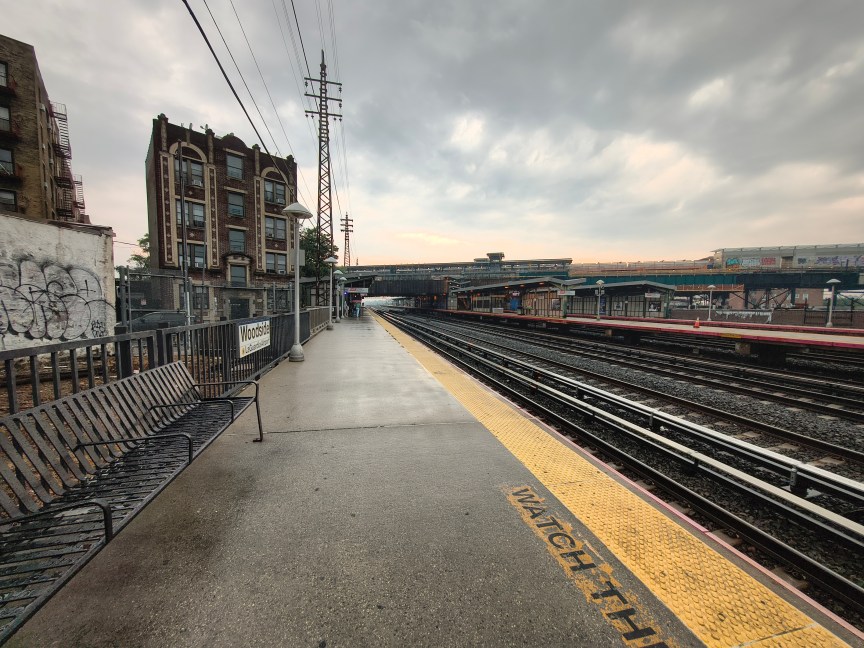
I took photos at a subway station in Queens on an overcast day, which creates ideal lighting conditions. The wide and ultrawide cameras managed to capture smaller details, including water and scratched-up paint on the platform.
 Taken on the Galaxy Z Flip 8’s wide camera.Mike Sorrentino/CNET
The ultrawide camera does a great job of getting details of the clouds with its wider landscape view, though at the expense of some of the finer details closer up.
 Taken on the Galaxy Z Flip 8’s ultrawide camera.Mike Sorrentino/CNET
Taking a photo at 2x zoom does lose some detail, because without a dedicated telephoto lens, the camera is cropping into the center of the wide-angle camera lens. However, image processing appears to help with some of these details further back. The platform signs, for instance, are more legible than they appear in the wide-angle photo.
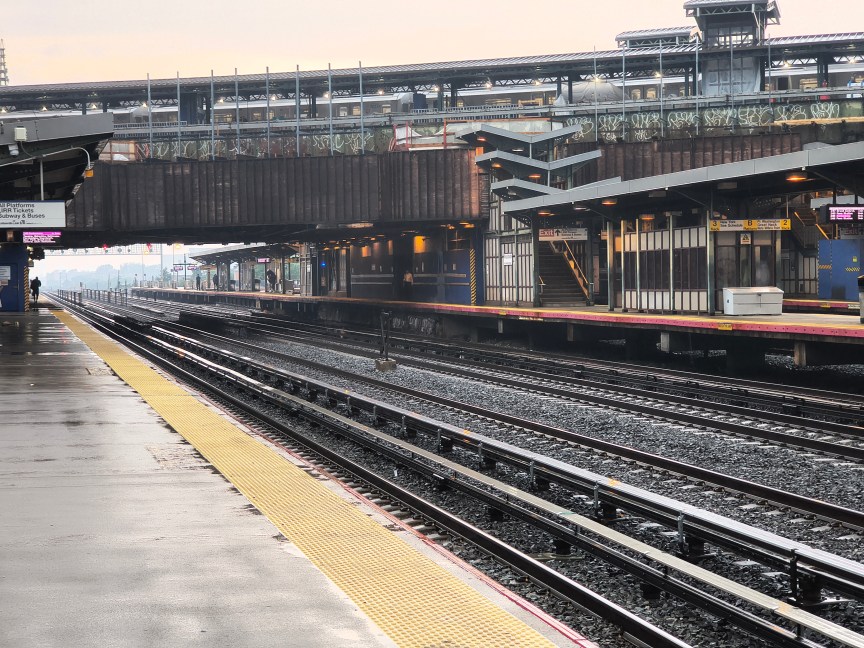 Taken on the Galaxy Z Flip 8’s wide camera at 2x zoom.Mike Sorrentino/CNET
I’m less impressed with the Z Flip 8 in darker environments, but it does well with static subjects. For instance, I took photos on a rooftop patio at night, and the image processing makes the space look much brighter while preserving the colorful pop of the lights on the buildings in the background.
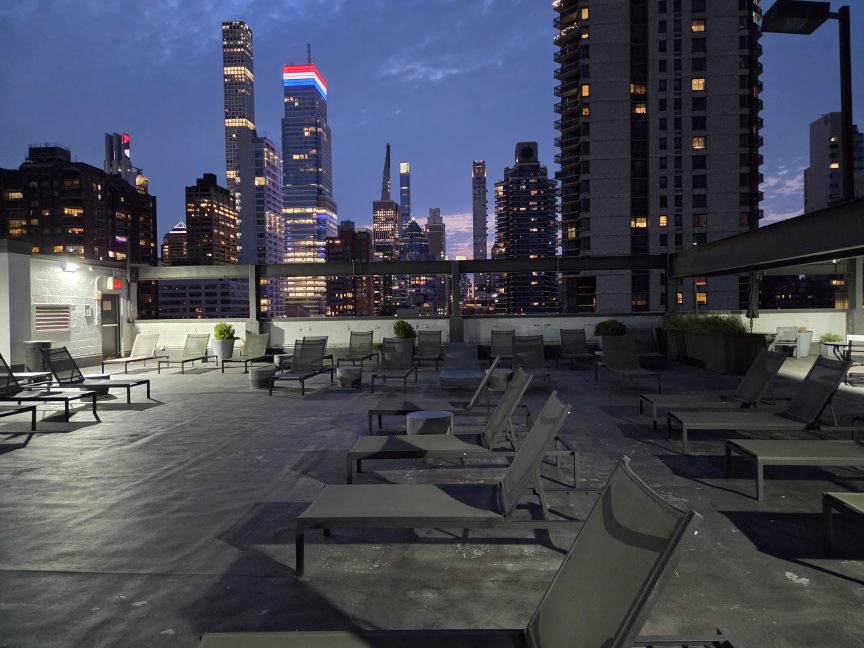 Taken on the wide camera on the Galaxy Z Flip 8.Mike Sorrentino/CNET
I also used the phone at my friend’s show at the Mercury Lounge in New York, where it was a bit tougher to get the camera to take a clean shot of the entire band. Concerts are a particularly challenging environment for any phone, but it’s also an area where non-folding phones in this price range with bigger sensors or a dedicated telephoto lens offer a little more flexibility for more challenging shots.
 The Firebreaks playing at Mercury Lounge. Taken on the Galaxy Z Flip 8’s wide camera.Mike Sorrentino/CNET
Selfie photos using the 10-megapixel camera on the internal display are also just OK. I took this photo at Samsung’s Unpacked event with my colleague Tara Brown, and the image came out a bit grainy. The camera’s otherwise fine for video calls, which are better to take on the larger inner display even though the smaller cover screen has better cameras.
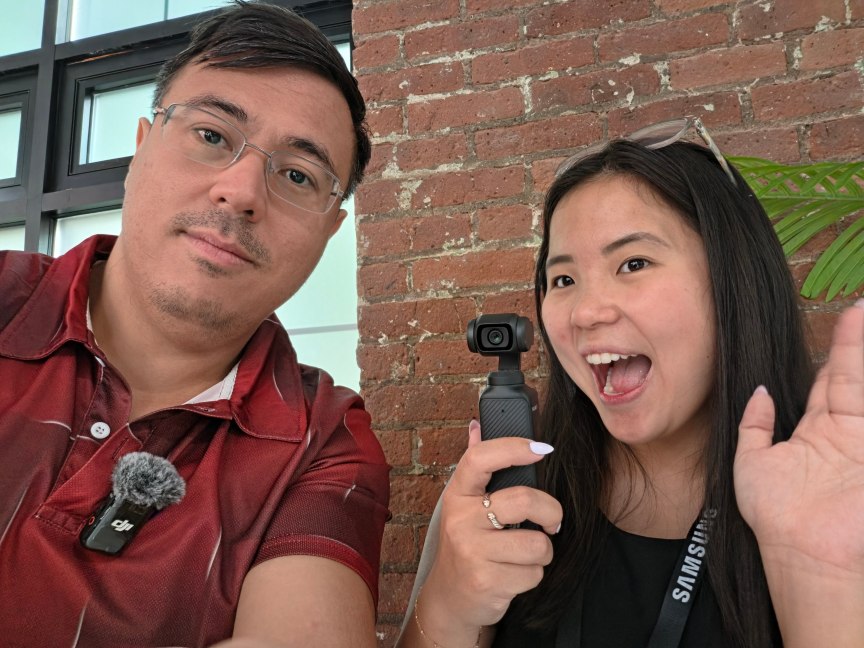 Taken on the 10-megapixel selfie camera.Mike Sorrentino/CNET
Using the selfie camera on the inner display on the same rooftop produced a slightly foggier image overall, which you can directly see when you compare how the red, white and blue lights in the background look in this photo against the one taken with the wide camera. Details on the buildings themselves are drowned out, and the photo doesn’t focus on my face much, either.
 Taken on the 10-megapixel selfie camera.Mike Sorrentino/CNET
The phone records video at up to 4K resolution at 60 fps, which can be particularly helpful when paired up with My FanCam, since that feature will crop into the frame to act like a dedicated cameraperson. But it’s still best to focus your camera directly on a subject for the best image quality — in case Galaxy AI loses track of the subject.
Galaxy Z Flip 8 bottom line
While I love the Galaxy Z Flip 8’s lighter design, the higher price does mean it’s important to consider the wider flip phone market. For instance, last year’s Galaxy Z Flip 7 is still on sale at its original $1,100 price for 256GB and $1,300 for 512GB — and as low as $990 if you get it from Samsung in refurbished condition.That phone is a little heavier and uses last year’s processor, but many of the software improvements seen on the Z Flip 8 will also likely make its way to the Z Flip 7, as Samsung often passes down some new features to older devices. And since the company gives its foldable phones seven years of software updates and security updates, it’s still worth investing in a model a year or two after its release.
And if you want to save even more money and are less concerned with how powerful the phone is, Motorola’s $800 Razr phone is a substantially lower-cost way to get a flip-style Android phone with decent cameras. But Motorola’s software support is more limited, with three years of software updates and five years of security updates.
If you aren’t trying to save money and are willing to spend big on an Android flip phone, the answer that’s best for you could come down to battery life. The Z Flip 8 is a sleeker phone with the fastest processor and more software support, but expect to keep a charger or battery pack nearby for longer days. The Razr Ultra might be a little heavier, but its bigger battery recharges faster than the Z Flip 8, and it comes in options that include materials such as wood and fabric.
Unfortunately, neither phone is getting cheaper anytime soon.
Samsung Galaxy Z Flip 8Motorola Razr Ultra 2026Samsung Galaxy Z Flip 7Motorola Razr 2026Cover display size, tech, resolution, refresh rate4.1-inch AMOLED; 1,048×948 pixels; up to 120Hz variable refresh rate4-inch pOLED, 1,272×1,080 pixels; up to 165Hz variable refresh rate4.1-inch AMOLED; 1,048×948 pixels; 120Hz refresh rate3.6-inch pOLED; 1,066×1,056 pixels; up to 90Hz variable refresh rateInternal display size, tech, resolution, refresh rate6.9-inch AMOLED; 2,520×1,080 pixels; up to 120Hz variable refresh rate7-inch AMOLED; 2,992×1,224 pixels; up to 165Hz variable refresh rate6.9-inch AMOLED; 2,520×1,080 pixels; 1 to 120Hz refresh rate6.9-inch AMOLED; 2,640×1,080 pixels; up to 120Hz variable refresh ratePixel densityCover: 342 ppi; Internal: 400 ppiCover: 417 ppi; Internal: 464 ppiCover: 342ppi; Internal: 397ppiCover: 413 ppi; Internal: 413 ppiDimensions (inches)Open: 6.57×2.97×0.24 in; Closed: 3.37×2.97×0.52 inOpen: 2.91×6.75×0.28 in; Closed: 2.91×3.47×0.62 inOpen: 2.96×6.56×0.26 in; Closed: 2.96×3.37×0.52 inOpen: 2.91×6.74×0.29 in; Closed: 2.91×3.47×0.62 inDimensions (millimeters)Open: 166.9×75.4×6.1mm; Closed: 85.7×75.4 x 13.1mmOpen: 73.99×171.48×7.19mm;
Closed: 73.99×88.12×15.69mmOpen: 75.2×166.7×6.5mm; Closed: 75.2×85.5×13.7mmOpen: 73.99×171.30×7.25mm; Closed: 73.99×88.08×15.85mmWeight (grams, ounces)180g (6.35 oz)199g (7 oz)188g (6.63 oz.)188g (6.63 oz)Mobile softwareAndroid 17 with One UI 9Android 16Android 16Android 16Cameras50-megapixel (wide), 12-megapixel (ultrawide)50-megapixel (wide), 50-megapixel (ultrawide)50-megapixel (wide), 12-megapixel (ultrawide)50-megapixel (wide), 50-megapixel (ultrawide)Internal screen camera10-megapixel50-megapixel10-megapixel32-megapixelVideo capture4K at 60 fps4K4K4KProcessorQualcomm Snapdragon 8 Elite Gen 5 for GalaxySnapdragon 8 EliteSamsung Exynos 2500MediaTek Dimensity 7450XRAM/storage12GB + 256GB; 12GB + 512GB16GB + 512GB12GB + 256GB, 12GB + 512GB8GB + 128GB, 256GBExpandable storageNoneNoneNoneNoneBattery4,300 mAh5,000 mAh4,300 mAh4,800 mAhFingerprint sensorSideSideYesSideConnectorUSB-CUSB-CUSB-CUSB-CHeadphone jackNoneNoneNoneNoneSpecial featuresIP48 rating, Corning Gorilla Glass Victus 2 (cover), glass fiber-reinforced polymer (rear), Advanced Armor Aluminum, 5G (sub6), Wi-Fi 7, 25-watt wired charging, 15-watt wireless chargingIP48 rating, 68-watt wired charging, 30-watt wireless charging, 5-watt reverse charging, dual stereo speakers, Corning Gorilla Glass Ceramic cover display, 3,000 nits peak brightness on cover display, 5,000 nits peak brightness on main display, 5G (sub-6). hall sensor, proximity sensorOne UI 8, IP48 water resistance, 25W wired charging, Qi wireless charging, Wi-Fi 7, Bluetooth 5.4, Galaxy AIIP48 rating, dual stereo speakers, 30-watt wired charging, 15-watt wireless charging, 1,700 nit peak brightness on cover display, 3,000 nit peak brightness on main display, 5G (sub-6)US price starts at$1,200 (256GB); $1,400 (512GB)$1,500 (512GB)$1,100 (256GB)$800 (128GB)UK price starts at£1,149 (256GB); £1,319 (512GB)N/A£1,049N/AAustralia price starts atAU$1,949 (256GB); AU$2,249 (512GB)N/AAU$1,799N/A
How we test phones
Every phone tested by CNET’s reviews team was actually used in the real world. We test a phone’s features, play games and take photos. We examine the display to see if it’s bright, sharp and vibrant. We analyze the design and build to see how it is to hold and whether it has an IP-rating for water resistance. We push the processor’s performance to its limits using standardized benchmark tools such as GeekBench and 3DMark, along with our own anecdotal observations navigating the interface, recording high-resolution videos and playing graphically intense games at high refresh rates.
All the cameras are tested in a variety of settings, from bright sunlight to dark indoor scenes. We try out special features such as night mode and portrait mode and compare our findings against similarly priced competing phones. We also check out the battery life by using it daily as well as running a series of battery drain tests.
We take into account additional features including support for 5G, satellite connectivity, fingerprint and face sensors, stylus support, fast charging speeds and foldable displays, among others that can be useful. We balance all of this against the price to give you the verdict on whether that phone, whatever its price, actually represents good value. While these tests may not always be reflected in CNET’s initial review, we conduct follow-up and long-term testing in most circumstances.

Mike Sorrentino
Senior Editor
Mike Sorrentino is a Senior Editor for Mobile, covering phones, texting apps and smartwatches — obsessing about how we can make the most of them. Mike also keeps an eye out on the movie and toy industry, and outside of work enjoys biking and pizza making.
See full bio