
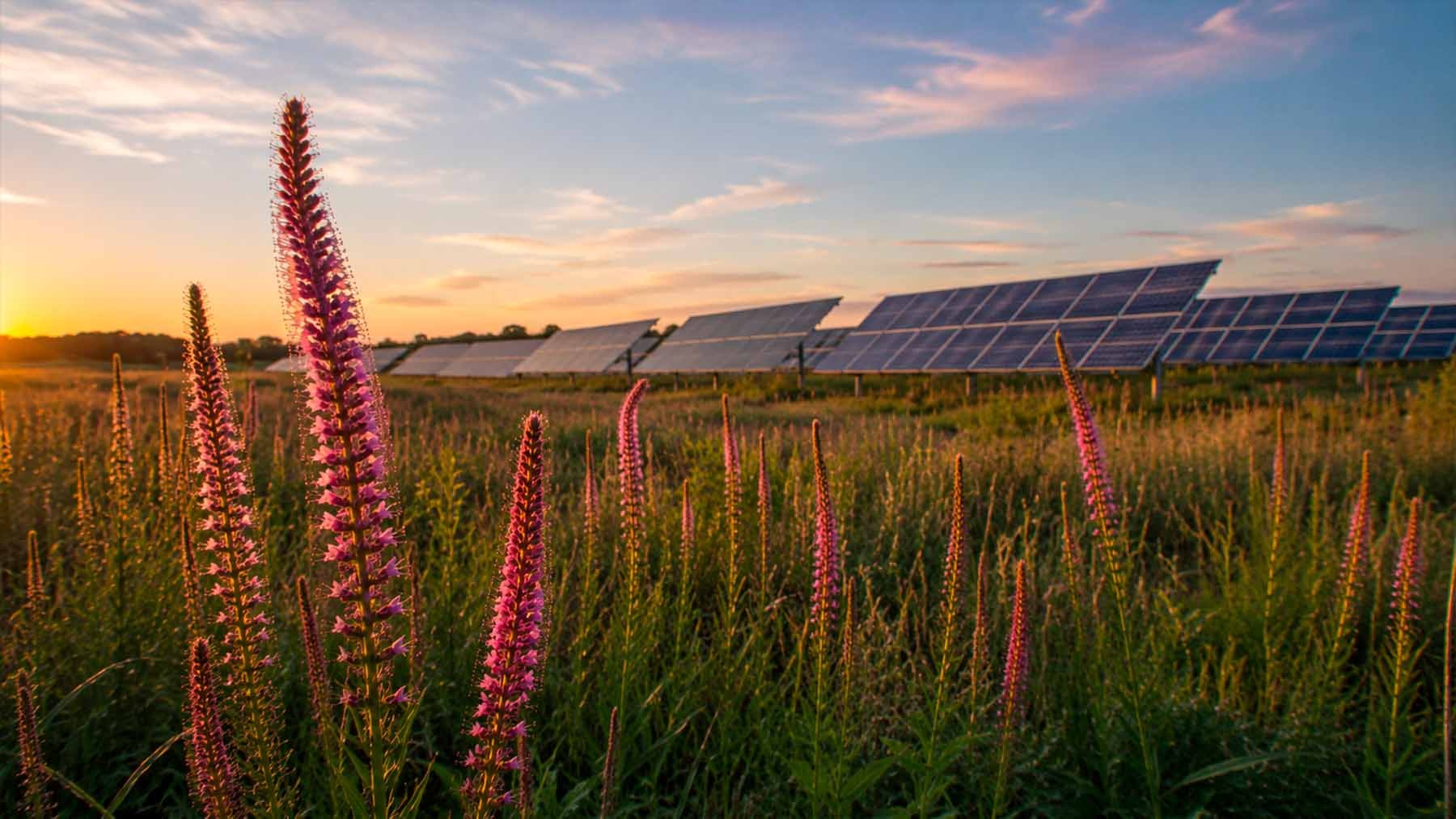
Across the Texas prairie, large stretches of open land have been transformed by solar development.
Large areas of open land are often developed when solar projects move forward.
But one solar development left nearly 1,000 acres completely untouched. The decision had little to do with electricity generation itself. Instead, it was driven by something already living on the land.
That choice would permanently change how part of the project was developed.
A prairie worth more than power
The Mockingbird Solar Center is located in Lamar County, Texas. It will eventually produce renewable power through solar panels.
Before construction began at Mockingbird, the land had remained native prairie for generations. Fewer than five percent of Texas’ original tallgrass prairies remain intact today.
These few remaining grasslands host numerous plant species, insect species, and animal species. They also represent potential habitat for the nearly extinct Attwater’s prairie-chicken.
Conservationists continue working to protect and restore habitat where the Attwater’s prairie-chicken may thrive again in the wild.
Protecting prairie habitat remains a priority while reintroduction efforts continue.
As a result, developers carefully evaluated each area of land before construction began.
They wanted to identify the areas with the highest ecological value.
The part of the site that stood apart
Many large-scale renewable energy projects require difficult choices. One of those choices involves how the land will be used. Some habitats may recover from being impacted.
Related
However, others may not be able to recover or be restored once they have been damaged. Conservation planning became part of the Mockingbird project before construction began.
Ørsted worked with conservation partners to identify sensitive prairie habitat before finalizing the project’s design. The Nature Conservancy helped evaluate ecological priorities that shaped land-use decisions at the site. Together, they identified environmentally sensitive areas before completing the final designs.
The area was known as the Smiley-Woodfin Native Prairie Grassland.
It contained one of the most intact sections of native prairie on the site.
Developers chose not to treat this native prairie as additional project land.
Instead, they decided against placing solar panels in that location.
A choice that changed the project
Instead of installing solar panels on that section of land, the planners chose a different solution.
Developers acknowledged that not all acres carry equal environmental value.
The native prairie stood apart from other areas on the property.
Its condition and quality made it the site’s most valuable habitat.
The land was worth more untouched
Ørsted identified the native prairie as the site’s most valuable resource. The area was better suited for preservation than conversion into a utility-scale solar array. To achieve this goal, Ørsted acquired approximately 1,000 acres of land.
Related
The property sits adjacent to the Smiley-Woodfin Native Prairie Grassland.
The Nature Conservancy then received the land as a donation. It established the area as the Smiley Meadow Preserve. It contains one of the few remaining pieces of native prairie in Texas.
Habitat conservation concerns prompted this decision. Attwater’s prairie-chickens rely exclusively on high-quality native prairie for survival. Because that habitat is now so scarce, protecting the remaining grasslands has become a conservation priority.
As a result, environmental planning removed this section of land from future development before construction even began. That planning allowed almost 1,000 acres to remain undeveloped.
Today, Ørsted produces electricity from renewable sources next to Smiley Meadow Preserve.
Clean energy production and conservation do not necessarily need to be mutually exclusive alternatives.
In the end, the project’s biggest decision was not where to build, but what was worth leaving untouched.
Rare species continue to influence development decisions elsewhere.
In another case, a small bird forced the suspension of a 10-million-panel solar project.
Disclaimer: Our coverage of events affecting companies or institutions is purely informative and descriptive. Under no circumstances does it seek to promote an opinion or create a trend, nor can it be taken as investment advice or a recommendation of any kind.