
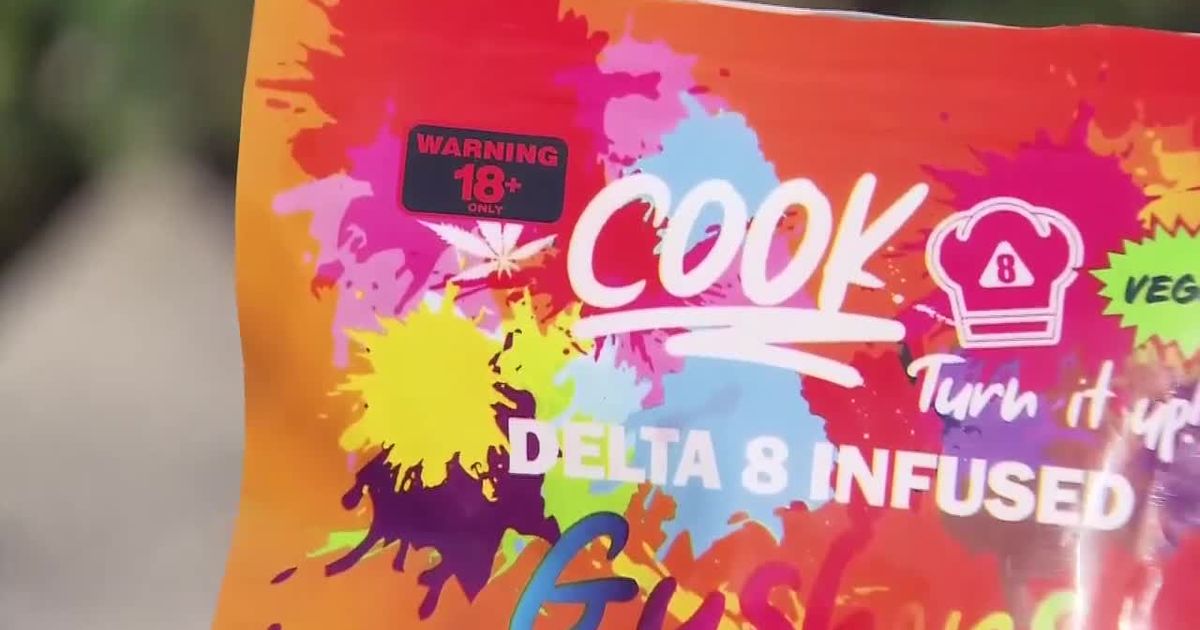
Hundreds of protesters packed into the state legislature Tuesday morning, warning North Carolina House lawmakers not to pass a bill that would ban nearly all intoxicating hemp drinks, gummies and other products in the state.
And by Tuesday evening the protesters had what they wanted, as the House agreed to pull the bill and rethink its potential consequences. Many North Carolinians use hemp products, which supporters say can help with pain relief, anxiety and other issues, but which opponents say are often engineered in a way that makes them too similar to marijuana.
Even though the Republican-led legislature legalized hemp nearly a decade ago, they never passed age limits, so even children can buy the products. There’s broad support among politicians and the hemp industry for fixing that and enacting age limits. But lawmakers keep trying to use an age-limits bill to also enact various other rules and regulations. It’s those other efforts that have bogged down the legislation, leading to nothing getting done on any of it.
House Speaker Destin Hall acknowledged the reality of that situation Tuesday, even as he made the decision to delay a vote on the bill. He plans to appoint a group of House lawmakers to study the issue.
“Folks recognize that the current state of our law is not tenable,” he told reporters Tuesday. “There are basically no rules. Things being sold that shouldn’t be. Things being sold to kids that shouldn’t be sold. The question is what to do about it.”
Hemp contributes billions of dollars and thousands of jobs to the state economy, according to Whitney Economics, a firm that analyzes hemp industry trends for investors and regulators.
Josh Lardie, a lobbyist for hemp dispensary chain Apotheca, said the hundreds of protesters packing the legislature Tuesday represented just a fraction of people who oppose the legislation.
“There are potentially millions of North Carolinians, who cannot be here on a Tuesday afternoon, who are constituents, who use these products on a daily basis,” he said in an interview.
What’s next
The hemp bill isn’t officially dead. But it’ll be at least several months before the legislature takes up any more legislation on hemp, possibly not until next year. And any new legislation is highly likely to look different than the current version.
The Senate already passed the bill in question, House Bill 328, and the House had indicated earlier this summer it would do the same. But after the protests and other feedback raising questions about the bill’s impact on the multibillion-dollar industry, Hall agreed to pull it from consideration after consulting with fellow Republican lawmakers.
This week is likely to be the last time lawmakers are in session until after the November elections. In the meantime, Hall said Tuesday, he’ll set up a new group of a few lawmakers to study the issue and come back with new proposals.
“There’s a general will — I think, nearly unanimously — to do something on it,” Hall said. “And that’s probably both across both parties. A lot of disagreement, though, about what to do.”
Law enforcement wants ban
In a last-minute push Tuesday, a handful of Republican lawmakers gathered with several dozen sheriffs, police chiefs, prosecutors and other law enforcement officials to support the bill in a news conference at the legislative building.
In addition to banning most hemp products, the bill seeks to put stricter age limits on anything that is still able to be sold.
The law enforcement leaders displayed some products packaged to look like candy. “It’s clear what the intent is: They’re targeting children,” Randolph County District Attorney Andy Gregson said Tuesday.
Craven County Sheriff Chip Hughes said he understood the protesters’ concerns that the ban could shut down businesses across the state that sell hemp products. He said that’s acceptable.
“Some will say this bill will put out stores out of business,” Hughes said. “I say, if a business depends primarily on selling these dangerous products to our children, then that will indeed be the result.”
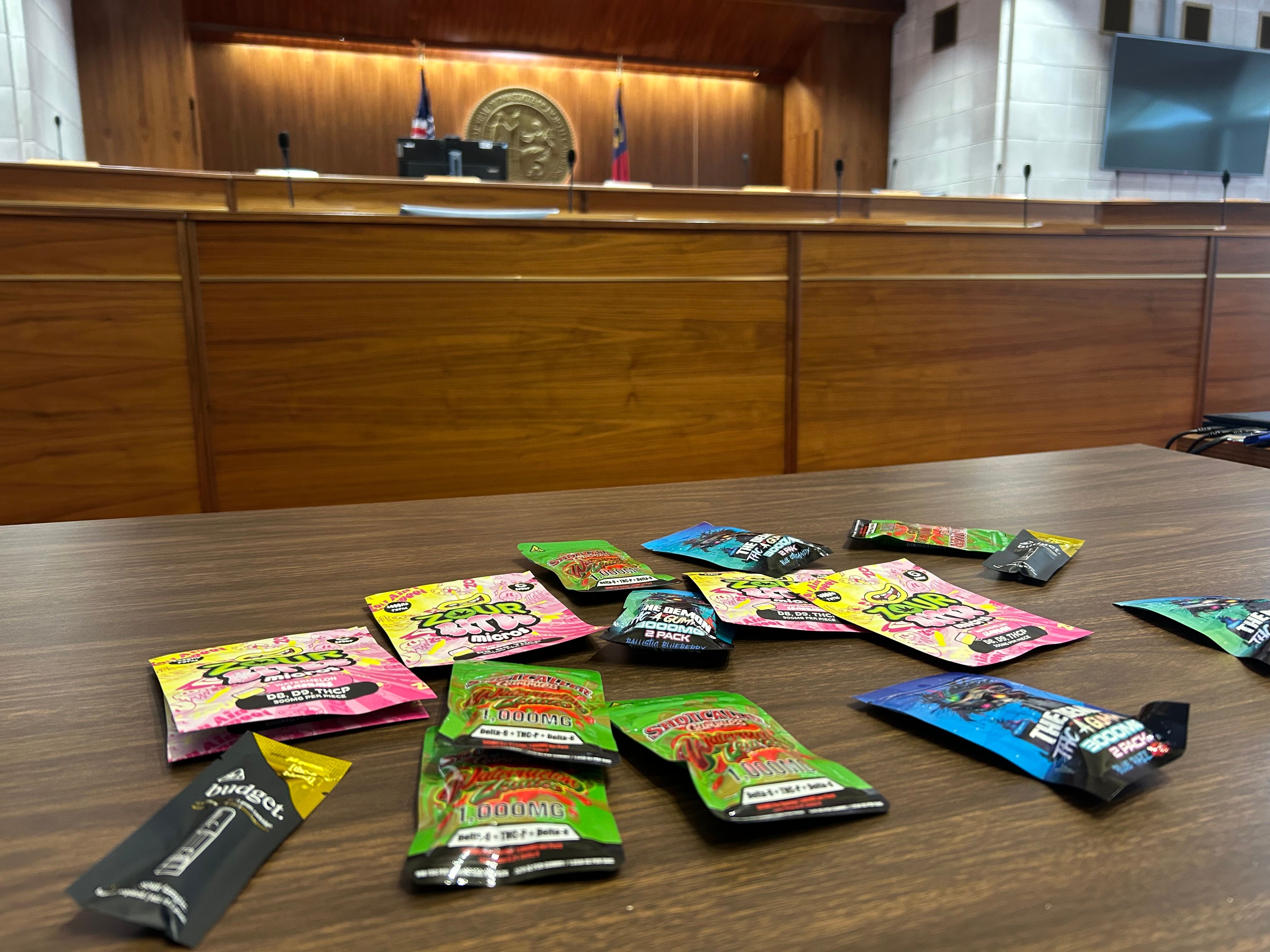 THC gummies Rep. Reece Pyrtle, R-Rockingham, brought to a press conference where he proposed banning them.
Some business owners say they support age limits, too. They said the bill should include only the age limits, and not the near-total ban, to protect children while still allowing adults to purchase and use the products.
“The entire industry is 100% on the same page about age restrictions,” said Adrian Larrea, co-founder of Haze Beverages in Raleigh, which makes THC-infused drinks. “We want to protect children, too.”
Bipartisan opposition
Democratic Gov. Josh Stein supports some of the bill’s provisions, such as age limits to stop minors from buying THC products. But he opposes the near-total ban on those products, and also questioned why lawmakers aren’t doing more to crack down on a different substance, kratom, which could fill in the gap in the market if hemp is banned.
“Kratom is this drug that people can buy in gas stations, and it’s an opioid-like drug,” Stein told reporters Tuesday at a monthly meeting of the state’s top executive branch leaders. “It does similar things to a person. If you take a lot of it, it will act as an opioid. So it is commonly called, on the street, gas station heroin.”
It’s not just Stein who voiced such concerns. Rep. Tricia Cotham, R-Mecklenburg, told WRAL on Tuesday she initially supported a plan to ban kratom but not hemp. As the legislature debated doing the opposite, before the near-total hemp ban was officially shelved, she told WRAL in an interview Tuesday she’d oppose it.
She urged fellow lawmakers to pause and rethink what a near-total ban on hemp would do to the state economy — since it supports so many jobs from farming to manufacturing and retail — not to mention people who use the products, many of whom reached out to her office, she said.
“This hits the people that I came here to represent. And plus, there are too many unknowns with this bill,” Cotham said. “There’s debate over ounces and packaging, and the federal government just recently said, ‘Let’s put a pause on this.’ Why should North Carolina take the lead, especially if we get it wrong?”
Details of the bill
Some provisions of House Bill 328 could continue on. The bill largely mirrors proposed federal restrictions. It would prohibit hemp products containing more than 0.3% THC by dry weight or more than 0.4 milligrams of THC per serving and limit sales to people 21 and older.
Some of the products lawmakers and law enforcement leaders displayed Tuesday — which they said they bought a short walk down the road — contained 1,000 or more milligrams of THC.
“The clerk that was working said, ‘Be real careful if you take these,'” said Rep. Reece Pyrtle, R-Rockingham, a former police chief who supports the ban and purchased the products for display Tuesday.
“I’m thankful that we were able to get it off the shelves today — even this little bit — so that a 12-year-old can’t walk in here and do the same,” he added.
THC is the main psychoactive ingredient in marijuana. Hemp and marijuana contain THC, but hemp is legal in the state because it contains THC at far lower levels than marijuana — enough to impart some side-effects that users seek out, but generally not enough to get people high. Some growers and manufacturers have figured out how to extract THC from hemp plants and introduce products into the marketplace touting the legal substance they do contain — cannabidiol, or CBD — but may possess enough THC to get someone high.
THC gummies Rep. Reece Pyrtle, R-Rockingham, brought to a press conference where he proposed banning them.
Federal restrictions expected to take effect later this year could eliminate many intoxicating hemp-derived THC products. Hoping to avoid that outcome, North Carolina businesses have pushed lawmakers to adopt regulations — including age restrictions, product testing and licensing requirements — without broadly banning products already on the market.
Hemp was federally legalized in 2018. North Carolina also legalized it shortly after. Now, several North Carolina law enforcement officials argue state law has failed to keep pace with increasingly potent hemp-derived products.
On Tuesday Rep. Jimmy Dixon, R-Duplin, said that when the state legislature legalized hemp nearly a decade ago it was due to the influence of “several misguided Republicans in the House. Misguided. Good people, but deceived.”
Congress, meanwhile, is considering a ban on many intoxicating hemp products that could take effect later this year, though many state lawmakers say North Carolina shouldn’t rely on federal action alone.
The state House’s decision to delay a vote exposed an unusual split between Republican leaders after negotiators from both chambers had already agreed on a final version of the bill.
Currently, the state has no age restrictions for purchasing intoxicating hemp-based products.
The Senate and House say North Carolina’s current laws leave children vulnerable and limit the ability to punish retailers who might sell products to kids. Stein has also called on lawmakers to more strictly regulate the industry, backing age limits as the bill proposes. Stein has also called for broader legalization of cannabis products, including marijuana.
Three of the groups that support the ban on most hemp products — the Alcohol Law Enforcement, the State Bureau of Investigation and the state Highway Patrol — report to Stein. The others are independent agencies or private groups representing local-level police, sheriffs and prosecutors.
“Failing to adopt this conference report means that anyone, no matter their age, will continue to be able to buy intoxicating THC products from any retailer that wishes to sell them without legal consequence in North Carolina,” the groups said in a recent letter to House lawmakers.