
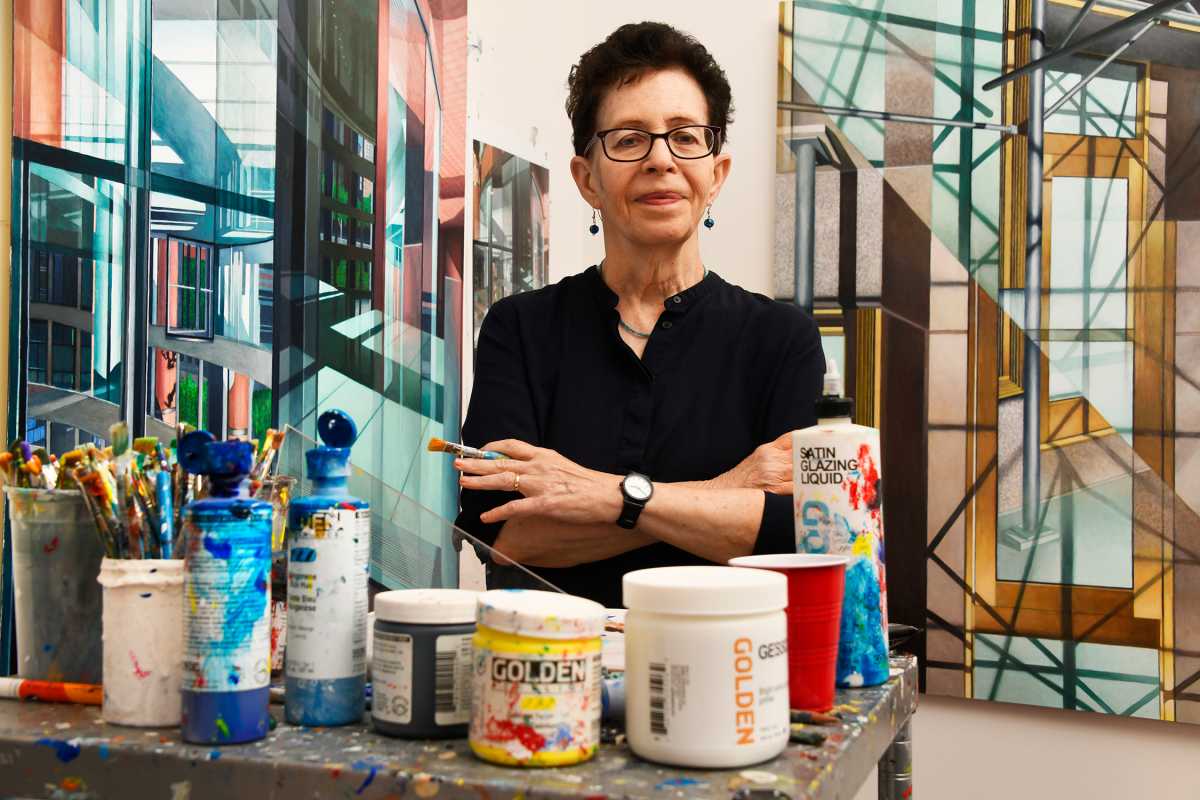
If Anne Finkelstein’s paintings look like she put a lot of work went into them, it’s because she did. The artist, an adjunct professor at both the Fashion Institute of Technology (FIT) and the Parsons School of Design, is happy to explain what goes into her visually arresting work.
“I walk around the city taking pictures of things that strike me because of color, pattern, light and shadow,” she says. After that, the images are worked on in Photoshop, combined to make elaborate digital collages that become the reference images for her paintings.
And although those digital collages can stand alone as art, they are just the beginning.
Finkelstein then makes a print that is the size of the projected work and lays that down on the chosen medium – sometimes canvas but frequently aluminum — with a piece of Saral (think carbon paper) between the print and the painting surface. She then carefully goes over every inch, tracing each line with a pencil, which leaves an impression on the painting surface. Then, finally, she goes to work painting.
But, she says, “it’s not hard work — it’s what I love to do. Sometimes there are parts that I can’t figure out, and it takes me a while to figure them out. But I keep going until I do. And sometimes you make the wrong decisions and you have to go back and redo it.”
 Anne Finkelstein working on an idea for a new paintingPhoto by Bob Krasner
  Anne Finkelstein putting finishing touches on “Ellipsis”Photo by Bob Krasner
  Tools of the tradePhoto by Bob Krasner
  Studio ViewPhoto by Bob Krasner
The most difficult part of her work, she admits, is finding the time to do it. In addition to her teaching duties, she is a graphic designer who works with “museums and galleries and individual artists.” That work does have an influence on her personal work, as her paintings have the compositional discipline of a graphic designer.
And teaching the basics to a new set of students every fall tends to remind her about the “really fundamental things like two-dimensional design and color theory and composition.”
Luckily, she’s a morning person who has no trouble coming to her studio at 5 a.m.: “I come up here sometimes and I’ll work for, you know, three or four hours, and then go back home for breakfast”.
Finding inspiration is never an issue, as it is all around her.
“I guess that as a native New Yorker, New York City is my subject,” she muses. “There’s so much going on in the street. When my husband (painter James Acevedo) and I are walking down the street, we’re both constantly taking pictures. But when you look at the pictures, it’s like we’re in two different places, because he’s focusing on figures and I’m focusing on structure. So my joke is that when people say, ‘Where are the figures in your paintings?’ I point to his paintings and say, they’re over there.”
Finkelstein’s beautifully painted images are not just the result of her point of view but also of her attention to detail, with an approach that seems like something it is not.
“This is not photo-realism,” she points out, adding, “even though when you look at it small on a phone, it sometimes looks like that more than it really is. I think that’s because you don’t see the surface’s physicality. Hopefully, when you see them in person, they look like paintings, even though I’m not really showing the brush strokes. But hopefully you can actually see that this is made by hand.”
 Anne Finkelstein comparing her digital reference image woith the completed painting, titled “Xfinity”Photo by Bob Krasner
  While on vacation in Cape Cod, Finkelstein produced a new piece of art every dayPhoto by Bob Krasner
  Anne Finkelstein transferring her guidelines from digital image to canvasPhoto by Bob Krasner
  Anne Finkelstein with her painting “Green Lift”Photo by Bob Krasner
Her approach tends towards quality over quantity.
“I don’t produce huge numbers of paintings in here, you know, a piece can certainly take a few months,” she notes. “I know when a piece is finished when the things that are bothering me about it are less loud in my head than my idea for the next piece. So basically, at some point, I abandon it. It’s extremely rare that I feel like, ta da! it’s done, you know? I do mess with them for a long time. I consider this painting to be finished now, but if you looked at it a month before it was finished, probably the average person would think it looks exactly the same. And the additional work can be just tuning up the color, changing some little detail. It’s actually extremely obsessive – kind of a fanatical attention to nuance. And that’s my favorite part.”
Finkelstein’s approach can be visually confusing, but of course, there is a reason for that.
“One of the reasons that I use multiple images is basically derived from cubism,” she explains. “The idea that when you’re looking at an object, you’re probably not just looking at it from one viewpoint. So if you’re steady in one place or you’re moving, you kind of construct a three-dimensional reality out of these multiple images, and they also represent different moments in time. That’s part of what’s behind it. And also the fact that when you’re looking at something, you retain a memory of what it looks like from other angles. So it’s a representation of how we construct our visual experience in our heads. I’m kind of making that visual. So in that sense, it’s like a picture of the inside of my head. Painting is my way of taking ownership of what I see and communicating to others. It’s my obsession and passion.”
Two of Anne Finkelstein’s paintings will be in a new juried group show opening at the Ki Smith Gallery on Saturday, Aug. 8 Details and RSVP link are here: https://www.kismithgallery.com/event-details/critics-choice-opening-reception
You can explore more work on her website annefinkelstein.com, and on Instagram @annefinkelstein.