
This story is part of Peak, The Athletic’s desk covering the mental side of sports. Sign up for Peak’s newsletter here.
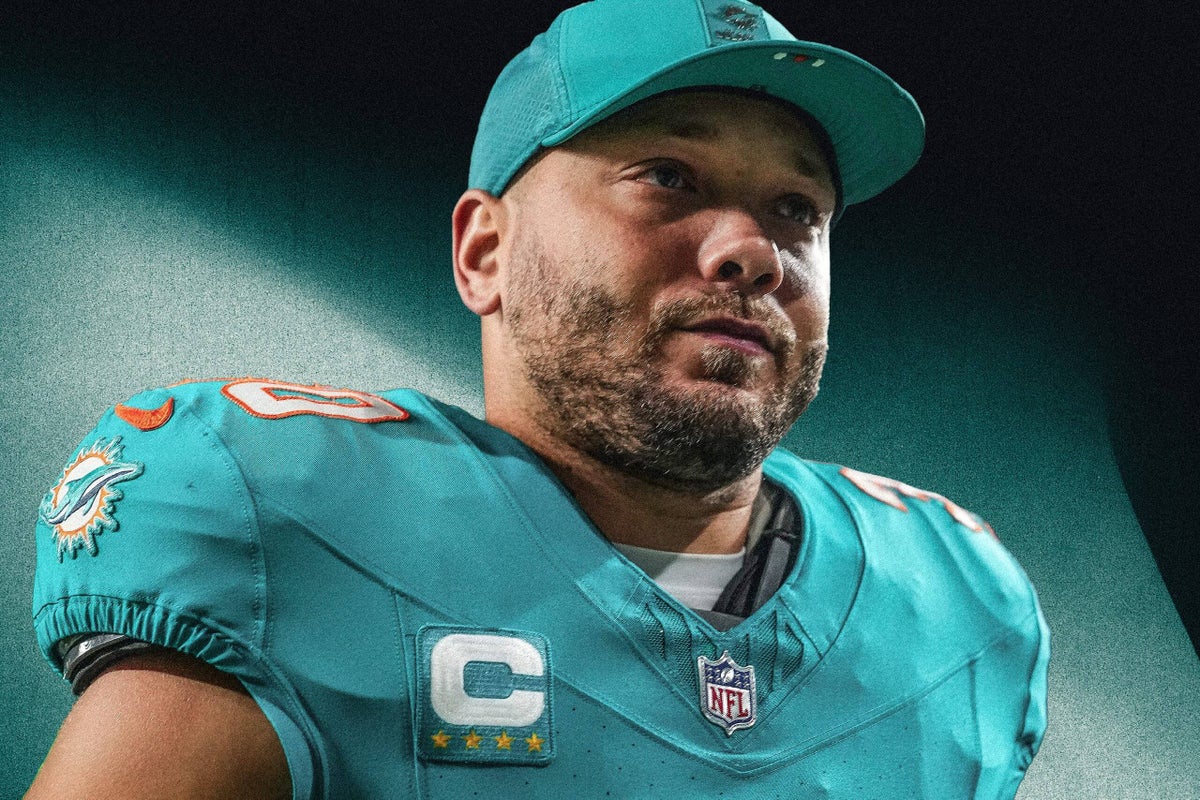
Alec Ingold is a fullback for the Los Angeles Chargers. He is in his eighth season in the NFL.
My offseason has been filled with change.
After being released by the Miami Dolphins and signing with the Los Angeles Chargers in March, my wife and I had to pack up our life, move across the country and walk into a completely new environment. It’s pretty easy to let your entire identity become tied to production in the NFL when facing this type of change — your body fat percentage, your film grade, your yards per carry. If you don’t perform, the machine moves on without you.
I thought I understood the limits of that pressure.
Then I hopped on a running series of morning phone calls with Tony Noel.
Tony was my first business manager, a veteran executive who spent more than three decades building teams, hitting metrics and navigating the hyper-competitive landscape of corporate America. I want to teach others the life lessons learned through sports, and Tony helped me. He was the guy who looked at the mindset framework I built for locker rooms — what I call in my book The 7 Crucibles— and told me I was thinking too small.
“Corporate America needs this more than the athletes do,” he would tell me over the phone. “Executives don’t know how to endure adversity; they only know how to manage stress.”
We were actively working on a project to scale those athletic principles into the corporate world when Tony went to an emergency room for a routine scan. The diagnosis was swift, brutal and seemingly final: stage III, potentially inoperable liver cancer.
The initial prognosis gave him six months to two years to live.
Every morning on my commute to “The Bolt,” the Chargers’ training facility, Tony’s voice filled my car speakers. On one end was an active athlete driving to practice; on the other was a veteran leader battling a terminal illness. Those introspective conversations — sometimes as short as 15 minutes, other times as long as 45 — reshaped my perspective.
These are the five lessons Tony and I figured out on those morning drives, and how a man looking death in the face ultimately rejuvenated my mindset and my purpose on the field.
1. The Marriott illusion
In the high-stakes world of elite performance, whether you are running routes or running a supply chain, there is a dangerous lie we all tell ourselves: Identity is tied to production.
Tony was a master of production. In our phone conversations detailing his three decades in business, he described a life built on relentless output. He accumulated over 500 nights in Marriott hotels, leaving his wife, Angie, to anchor the household as he chased performance plaques defining his identity as a corporate “star.”
“I looked back at those plaques on my wall recently,” Tony told me over the phone, his voice heavy but clear. “And I thought, ‘This is bullshit.’ You spend literally years of your life on the road to be looked at as a high performer, and you can never get that time back. The plaques don’t sit with you in this room. What I did with my kids, the moments I missed — that’s the stuff that actually matters.”
When the diagnosis hit, the corporate machinery did exactly what it always does: It kept moving. Tony went on medical disability. The torrential downpour of daily corporate emails slowed to a drizzle, then stopped completely. The meetings he used to lead were scheduled without him.
This is the hidden crisis facing thousands of corporate executives and athletes alike. We build our entire psyche around being indispensable to an organization, but organizations are built to last. When injury or illness sidelines you, you are forced to confront a terrifying reality: Who am I when I am no longer on the team?
It’s a terrifying question, yes — but it is also the only point in life where you are finally free to define yourself by who you are, rather than what you produce.
2. Trading the telescope for the microscope
When elite performers face a crisis, their default reflex is to outwork it. They extend their horizons. They look through a telescope, map out a five-year plan, and try to force the universe into compliance through sheer volume of effort. I’m guilty of putting together a vision board or two.
But when you are facing terminal liver cancer, you lose control of the telescope. You cannot control the long-term outcome. You cannot out-hustle cellular mutation.
Tony realized that to survive, he had to change his optical tool: He had to let go of his telescope and pick up a microscope.
“As a young professional, the goal is always to be unstoppable by keeping the end in mind,” Tony told me. “But right now, I don’t know what the end in mind is. The end is completely unknown. So the macro doesn’t matter anymore. We have to take one single day at a time and simply control the inches in front of us. The magic happens entirely in the microscope.”
Under the microscope, high performance looks completely different to Tony now. It isn’t about quarterly revenue or winning a championship ring. It is the discipline required to drink 100 ounces of water a day when his body rejects it. It is the mental warfare of forcing himself to walk slowly, shaking as he walks laps around a fourth-floor hospital hallway in a gown while tethered to an IV pole. It is choosing to eat a clean piece of fish and fresh vegetables when chemotherapy has stripped away his appetite entirely.
Athletes call this the “grindset.” It is the radical commitment to upholding a standard when there are no cameras, no fans clapping and your body is begging you to give up.
Tony didn’t surrender to his prognosis; he chose to compete.
He treated his oncologists as offensive coordinators designing an attack plan. He treated chemotherapy as his defensive line. He took ownership of his data, conducting his own medical “film study” on every blood report and biopsy. More importantly, he found a victory that no championship ring could match: the quiet, steady peace of being fully present for the people who mattered most.

Tony Noel, far left, and Alec Ingold, third from right, on the golf course. (Photo courtesy of Alec Ingold)
3. The reversal of support
Perhaps the hardest crucible for any high-achieving individual is not the output of energy, but the receiving of care. Leaders are hardwired to provide, to protect and to carry others. Asking for help feels like an admission of a cracked mask.
Tony’s daughter, Josie, told me that her dad had always been “horrible” at asking for or receiving support. He was the anchor; anchors don’t lean on the ship.
In fact, when the reality of the diagnosis settled, Tony did exactly what every elite manager does: He tried to organize his new game plan on a whiteboard. He sat down and mapped out a meticulous bucket list of 10 specific people he needed to help, protect or professionally stabilize before his time ran out.
“I wanted to check those boxes so I could look at the list and say, ‘OK, I can die now,’” Tony told me.
The irony was staggering. Here was a man facing an existential storm, entirely focused on executing a strategy to carry everyone else, missing the truth that resilience requires the vulnerability to let others support you when you need it.
The breakthrough didn’t happen because Tony checked a box on his list; it happened when he was forced to sit still. During a grueling chemotherapy session, the door to his sterile treatment room creaked open. Standing in the doorway was his lifelong friend, Mike. Mike hadn’t called ahead; he hadn’t asked for permission to help. He had simply driven 40 minutes across state lines to surprise Tony and stand silently next to his chemo bag.
“I looked up and saw Mike standing there, and I just started bawling my eyes out,” Tony whispered, the emotion in his voice raw.
For those few hours, the 10-person list evaporated. The strongest people aren’t the ones who carry the world alone; they’re the ones who realize their team is ready to help get the next first down.
4. The full growth spurt
As the days passed and our phone calls continued to dive deeper into Tony’s story, I became fascinated with his new perspective on life.
While playing for the Dolphins, I’d heard the phrase “momento mori” in team meetings. It’s a stoic philosophy calling us to maximize each and every day as we get one day closer to death. Now I was experiencing that with Tony in a profound way.
I spoke with Tony’s mother, Lois. She described a kid who, at 16 years old, stood just 4 foot 8 and weighed barely 80 pounds because of a severe, unchecked battle with Crohn’s disease. He was so small that he had to take his physical education classes at the very end of the day just to avoid being ridiculed by the bigger kids in the hallways.
Lois recalled driving Tony through the winding back roads of Harmony, Minn., on their way to the Mayo Clinic decades ago, begging doctors to find a way to help her son grow. A team of clinicians performed an aggressive bowel resection surgery, removing the diseased tissue and unlocking a massive, delayed growth spurt that eventually shot him up to a commanding 6-1.
Forty years later, Tony is walking through the exact same hallways of the Mayo Clinic, tracking cancer markers instead of growth plates.
The parallel is unmistakable.
So, for me, was the lesson: We’re all better because of the adversity we endure, not in avoidance of it.
5. Turning off the scoreboard
We live in a culture obsessed with optimization, longevity and winning. We measure our lives by the numbers on our contract, the balance in our bank accounts or the speed of our ascent up the corporate ladder.
Tony’s journey is a reminder that the scoreboard is an illusion.
“I no longer measure wealth in money, titles, or quotas,” Tony told me on our most recent phone call as I pulled into the Chargers’ parking lot. “I measure it entirely in moments, in peace, and in the people I love.
“I don’t know how much time I have left on this contract, but I know this: A meaningful life is never measured by how long you play the game. It’s measured by how deeply you love, how hard you fight, and how willing you are to keep walking through the fire for the people next to you.”
As I prepare for another NFL season, I carry Tony’s microscope with me. The stadium lights will eventually fade, the playbook will change, and the machinery of sports will substitute my jersey number for someone else’s. But the character forged in the invisible fights? That’s the real victory.
The scoreboard might turn off, but the life you build and the people you impact begins to mean everything.