
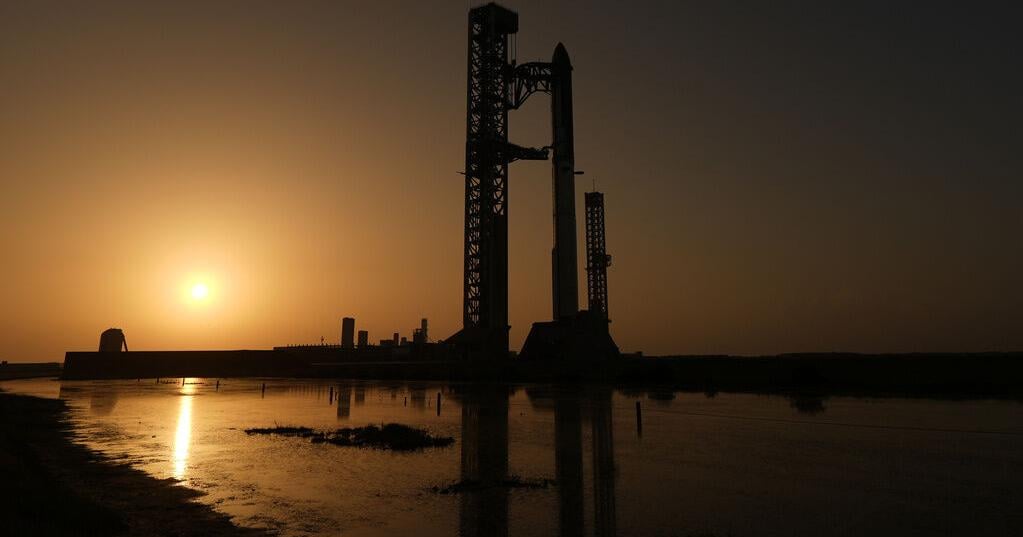
As Gov. Jeff Landry’s administration finalizes a deal with Elon Musk’s SpaceX to build a spaceport in coastal Vermilion Parish, residents of the remote area are trying to make sense of what the unprecedented project might mean for their community.
Recent comments from Musk and other SpaceX officials offer a sense of the company’s plans to expand their launch capabilities, and some close watchers of the aerospace industry say the Vermilion site likely aligns with those goals.
Additionally, there are two other areas that could serve as a guide for what the future holds: Boca Chica, Texas, where SpaceX has built its Starbase headquarters; and Florida’s “Space Coast,” the region around Cape Canaveral along the Atlantic Ocean that has been the site of NASA’s space launches since the Apollo program.
In Starbase, Texas, formerly Boca Chica Village, SpaceX incorporated its own municipality with about 5,000 residents. It has its own mayor. In less than a decade, the company has built rockets and launchpads there, as well as a company-run elementary school. And it is permitted to launch 25 rockets a year. Local elected officials say it has been a boon to the regional tax base.
But the frequency of rocket launches has increased with Musk’s growing quest to put more rockets carrying his Starlink satellites into orbit. Environmental groups have called attention to the impacts that those launches have had on nearby wildlife refuges.
In Florida, residents in Titusville and Cape Canaveral have lived near active launch sites for decades. Residents there say they have seen changes in recent decades as commercial space companies have increased the number of rockets launched.
“These people in that rural area in Louisiana, they better understand what’s coming,” said Rene Medrano, 66, who has lived in Brownsville, Texas, 15 miles from Starbase, since the launch site there was built.
SpaceX has declined to specify its plans for Louisiana, which according to sources familiar with the deal includes the state’s settlement of a coastal lawsuit against ExxonMobil that involves about 130,000 acres of land in Vermilion Parish, which could then be transferred to the commercial aerospace company. The Landry administration has also declined to comment.
Sources with knowledge of the deal say that the state is attempting to figure out how to streamline the permitting process for SpaceX to allow the company to move quickly when the deal with Louisiana is finalized, which could come as soon as this month.

SpaceX lat the Kennedy Space Center in Cape Canaveral, Fla. (AP Photo/David J. Phillip, File)
David J. Phillip
Lt. Gov. Billy Nungesser said he had no direct knowledge of the deal. But his office had been contacted about an archaeological review of the site.
“There’s going to have to be reviews of grave sites or Indian burial grounds,” Nungesser said. “And a call was made to our office.”
The ExxonMobil tract that is key to the state’s deal with SpaceX includes some 200 square miles in and around Pecan Island, a tiny community of hunting camps lining the two-lane rural La. Highway 82, and Freshwater City, a remote area about ten miles farther south.
Any launch site is unlikely to be located directly next to the hunting camps along Highway 82, but will likely be closer to the coast, according to those familiar with the site. The land there, surprisingly, is a couple of feet higher and more stable than further inland.
The site makes sense for other reasons, too. It’s immediately adjacent to a deep water bayou that runs from the Gulf and connects to the Intracoastal Waterway. And it has an abundance of natural gas.
“They can easily tap into the pipeline and put in a small LNG facility on site to power their rockets,” said Eric Smith, a director at Tulane University’s Energy Institute. “It’s a relatively easy, established technology.”
Accelerating space race
The number of launches in the U.S. has increased dramatically over the past decade as SpaceX and commercial aerospace companies have gotten into a business that once was the purview solely of NASA.
Last year, there were 181 orbital rocket launches in the U.S., more than 90% of which were conducted by SpaceX. The company is planning to ramp up its capacity so it needs more spaceports and launch pads.
SpaceX has said it aims to put data centers in space. Doing that will take millions of satellites, the company has said in federal regulatory filings.
SpaceX wants to perform “a launch every few hours somewhere,” said Jonathan McDowell, a retired astrophysicist who worked at the Harvard–Smithsonian Center for Astrophysics until earlier this year and tracks rocket launches worldwide. “Whether they can do that is a really open question, but that’s the kind of scale they’re talking about.”
More importantly, the site’s southward-facing location on the Gulf coast is an ideal spot from which to launch into polar orbit — an orbital path that circles the planet from north to south.
SpaceX wants to put its AI satellites into that kind of orbit because they could get continuous sunlight on their solar panels, providing a consistent source of power, according to regulatory filings. But right now, the company only has spaceports from which it can launch its Starship rockets east into an orbit that would have its satellites circle the Earth in a pathway parallel to the equator.
From the site in Vermilion Parish, “you’re not going to want to launch east because you’re going to fly right over New Orleans, and that will make you unpopular,” McDowell said. “But you’ve got a nice long stretch over the Gulf of Mexico to go south,” perfect for launching satellites into polar orbit.
McDowell said the site makes sense for SpaceX. “Given the market today, it’s a decent choice for a launch site,” he said.
It’s also at least as isolated from large human populations as the Boca Chica launch site in Texas or NASA’s Cape Canaveral launchpads in Florida.
McDowell said a spot along Freshwater Bayou is the likeliest spot for a SpaceX launch site, and the company could ship in rockets by barge. Most launch sites are right on the coast, so rocket stages can drop off into open water.
SpaceX itself has fueled speculation about that site, responding to a post on social media that included a map highlighting it. “It’s no secret that we intend to launch Starship a lot,” the company said on X, the social media site that Musk also owns.
‘A juggernaut’
In Texas, some local officials have been upbeat about SpaceX’s presence, noting that the company has brought in local revenue and a demand for skilled labor.
John Cowen, Jr., the mayor of Brownsville, Texas, near Starbase, called SpaceX “a juggernaut for economic growth,” according to the Rio Grande Guardian. He said the company had brought $13 billion in economic benefits, including 4,000 permanent jobs, and $99 million in tourism-related windfalls from visitors who come to see launches.
Local government leaders in Louisiana are also hopeful that SpaceX is considering their area for a spaceport.
But Medrano, who lives near SpaceX’s Boca Chica launch site, has grown to oppose it. He can watch the rockets rise over the tree line from his back deck, and while he was initially supportive of the company, traffic and other disruptions are now a burden, he says.
Republican presidential nominee Donald Trump, left, shakes hands with Tesla and SpaceX CEO Elon Musk after Musk speaks on stage at a Trump campaign event on Oct. 5, 2024.
Photo by Alex Brandon / AP Photo
“It rocks our house on all the launches,” he said. “We never thought it would get out of hand the way it is.”
On the other side of the Gulf, on Florida’s Space Coast, rocket launches have been taking place for decades. From Launch Complex 39A at the Kennedy Space Center at Cape Canaveral, NASA sent Americans to the moon in 1969.
“I grew up watching the rockets go up and loved it,” said Bill Fisk, 72, a retired funeral home director and later FEMA official who now serves as president of the Space Coast Audubon Society. “People here peacefully co-existed with NASA for years.”
Still, the commercial rockets SpaceX and others now launch from the Space Coast complexes are happening with greater frequency. The company’s Starship rocket is louder and more powerful than NASA’s historic Saturn V rocket, which carried astronauts to the moon.
“I can feel the rumbles now,” said Fisk, who lives nearly 60 miles from Kennedy in a community called Palm Bay and has worked to gather evidence of environmental harm caused by the launch activity.
McDowell said that within a one-mile radius of a launch site, the rocket blasts are likely to kill most birds. At five miles away, a launch is unlikely to break glass windows, he said — unless a rocket explodes on a launchpad, in which case it might.
The closest residential area in Pecan Island is about 10 miles away from the likely launch sites along the coast.
“You will definitely hear it from ten miles,” said McDowell. “It’s not deafening. It’s probably like when a jet goes overhead.”