
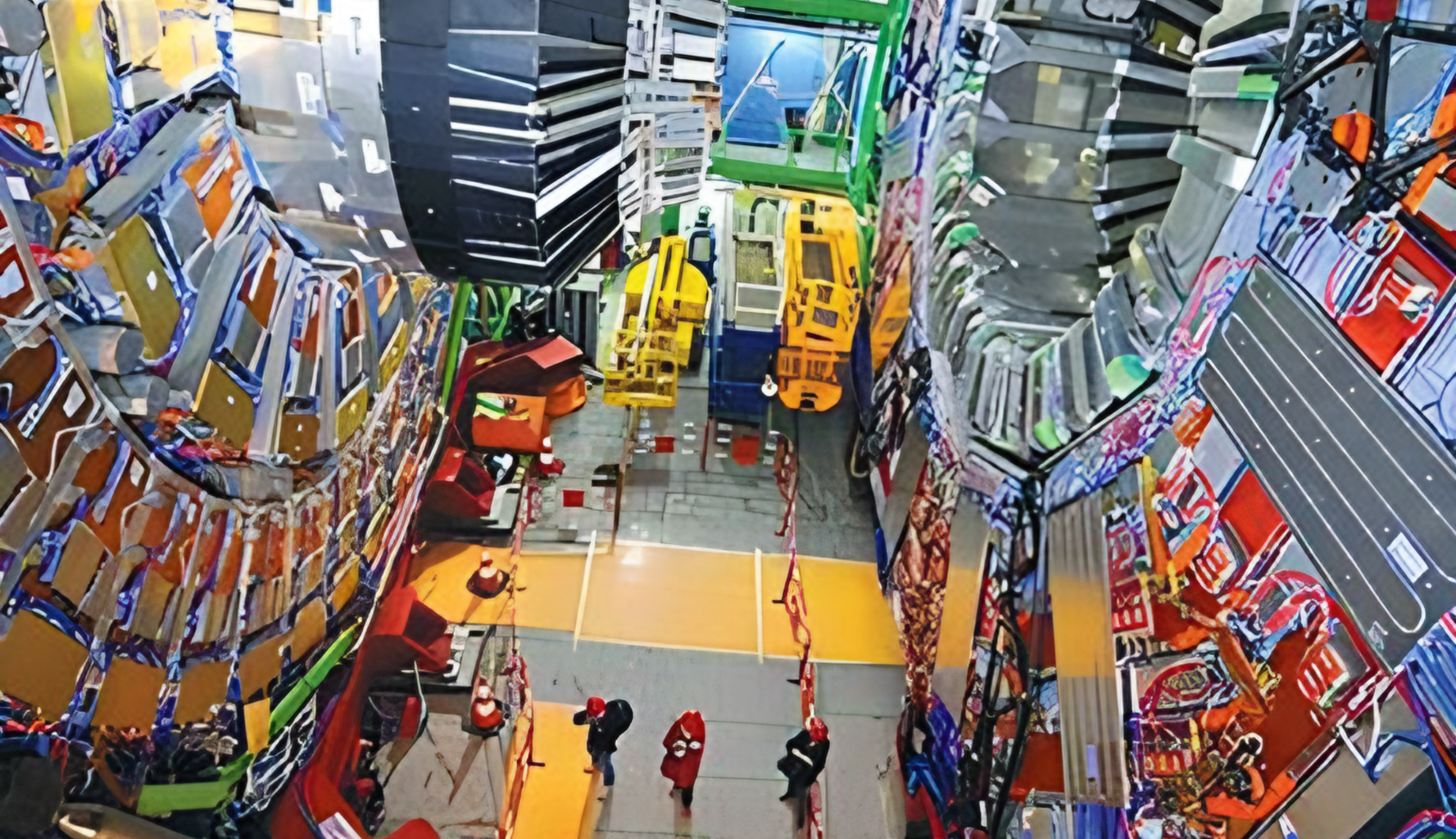
In a special plenary session at ICHEP 2026 — the world’s premier particle physics conference, held in Natal, Brazil — the international BESIII collaboration announced on Aug. 5, 2026, that it had established a complete experimental evidence chain confirming the existence of the glueball: the only particle in nature composed entirely of force-carriers, with no matter particles whatsoever. The confirmed particle, designated X(2370), is now recognized as the lightest pseudoscalar glueball — a class of matter that physicists have theorized must exist for nearly fifty years but had never definitively observed until now, as detailed in the IHEP official announcement and independently confirmed by the EurekAlert AAAS science wire.
What makes this announcement more than a naming ceremony is what the BESIII team actually measured. Every prior glueball candidate — f0(1500), f0(1710), iota(1440), and several others — failed to survive one or more rigorous experimental tests. X(2370) passed all three simultaneously: its mass of roughly 2.37 GeV/c² matches lattice quantum chromodynamics (QCD) predictions, its spin-parity quantum numbers of 0⁻⁺ were determined precisely in 2024 in Physical Review Letters, and — the decisive result announced at ICHEP — it has now been confirmed as a flavor-singlet state.
What Gluons Are — and Why They Can Stick to Each Other
To understand why this discovery matters, it helps to know what distinguishes gluons from every other force-carrying particle ever observed. In the Standard Model, four fundamental forces each have their own carrier particle: photons carry electromagnetism, W and Z bosons carry the weak force, and gluons carry the strong nuclear force — the interaction that binds quarks inside protons and neutrons and, at a larger scale, holds atomic nuclei together. Photons and the W/Z bosons interact with charged matter, but they do not interact strongly with each other. Gluons are categorically different.
The reason lies in the mathematical structure of quantum chromodynamics theory QCD. Unlike the electromagnetic force, which is described by an “Abelian” gauge theory where force-carriers carry no charge themselves, QCD is a “non-Abelian” gauge theory in which gluons carry the strong force’s charge — called color charge — directly. An Abelian theory’s force-carriers pass through one another like ships in the night; a non-Abelian theory’s carriers interact, tangle, and can bind. The discovery of asymptotic freedom — which shows that the strong force weakens at short distances — earned David Gross, Frank Wilczek, and H. David Politzer the 2004 Nobel Prize in Physics and cemented QCD as the correct theory of strong interactions at high energies. Gluon self-coupling, the same property that makes glueballs theoretically possible, is also the root cause of color confinement: why isolated quarks and gluons are never observed in nature.
A glueball, then, is what you get when gluons bind to each other without involving any quarks at all. Theorists working in QCD’s early years recognized that gluon self-coupling should make such bound states possible, and lattice QCD calculations — refined systematically since the foundational work of Morningstar and Peardon — have been refining predictions of the glueball spectrum ever since.
Why Nobody Could Pin One Down for Fifty Years
The glueball hunt is one of the longest-running detection problems in particle physics, and the reason it took so long has nothing to do with inadequate equipment. It has to do with mixing.
A glueball with pseudoscalar quantum numbers (0⁻⁺) exists in exactly the same mass region — around 2 to 2.6 GeV/c² — as several known quark-based mesons with identical quantum numbers. QCD predicts that such states will mix: a “pure” glueball is theoretically unstable against mixing with nearby mesons, so what actually exists in experiments is a series of states with varying degrees of glueball and meson character. Identifying a particle as predominantly a glueball requires disentangling that mixing — which is why mass alone, or quantum numbers alone, are never sufficient.
The second obstacle was luminosity. Glueballs are most efficiently produced in the radiative decay of the J/ψ particle — a bound state of a charm quark and its antiquark, with a mass of approximately 3.1 GeV/c². When J/ψ decays by emitting a photon, the remaining hadronic products emerge from a gluon-rich environment that preferentially produces gluonic excitations, making it the best “glueball factory” known. But to detect a rare glueball signal and resolve it from background, you need enormous numbers of J/ψ events — on the order of billions, as the IHEP announcement explains.
The Three-Part Evidence Chain That Closed the Case
The BESIII collaboration’s path to confirmation spanned fifteen years and three distinct experimental milestones, each closing a different dimension of the identification problem.
Step one — discovery (2011): BESIII first observed X(2370) as a statistically significant signal in the decay channel J/ψ → γπ⁺π⁻η’ using the Beijing Spectrometer III detector at the Beijing Electron Positron Collider II (BEPCII). The 2011 discovery and its context placed the particle’s mass near 2.37 GeV/c², consistent with lattice QCD predictions for a pseudoscalar glueball — but mass alone, as noted above, cannot distinguish a glueball from a quark-based meson.
Step two — quantum numbers (2024): Armed with a sample of 10 billion J/ψ decay events — the world’s largest collection of J/ψ data, assembled over years of continuous operation at BEPCII — the collaboration performed a sophisticated partial-wave analysis of the J/ψ → γK₀ˢK₀ˢη’ decay channel. This technique decomposes the angular distributions of decay products using interference patterns among multiple resonances to extract the underlying quantum numbers. For the first time, X(2370)’s spin-parity was measured as 0⁻⁺ — matching the lattice QCD prediction precisely. A 2019 lattice calculation had set the pseudoscalar glueball mass at 2.395 ± 0.014 GeV/c², and X(2370) sits squarely within that range.
Step three — flavor singlet (2026): The decisive result, announced at ICHEP 2026, is the most theoretically demanding of the three. A glueball must be a “flavor-singlet particle definition” — because gluons couple equally to all quark flavors, a particle made purely of gluons should decay democratically across all flavor channels and show no preference for strange quarks over up or down quarks. The BESIII team searched explicitly for the decay X(2370) → K*(892)⁰K̄⁰ — a mode that quark-based mesons in this mass range readily use — and found no evidence of it, setting the branching fraction at less than 2.7 × 10⁻⁶ at the 90% confidence level. That suppression is the flavor-singlet signal: X(2370) does not know what strange quarks are, because it contains none. The paper is available as arXiv:2607.20366 [hep-ex] and is published in Nuclear Physics B.
Together, these three results — mass, quantum numbers, and flavor-singlet behavior — constitute what the IHEP calls “a complete chain of experimental evidence.” X(2370) is the first confirmed flavor-singlet hadron observed above 1 GeV/c².
Why This Validates QCD at Its Most Difficult Frontier
The 2004 Nobel Prize in Physics went to Gross, Wilczek, and Politzer for proving that QCD works beautifully at high energies, where the strong coupling constant becomes small and perturbative calculations converge quickly. But QCD at low energies — where quarks are confined inside hadrons and the coupling is large — remains computationally brutal. Perturbative methods fail entirely below about 1–2 GeV, requiring numerical approximations through lattice QCD simulation methods: simulations that divide spacetime into a discrete grid and solve the equations numerically, using enormous computing resources.
The glueball is the most stringent test lattice QCD has ever faced. Unlike ordinary mesons and baryons, which are easier to model because they contain valence quarks to anchor the calculation, a glueball has no valence quarks: it is entirely a creature of the gluon field. Confirming that a glueball exists with the mass, quantum numbers, and flavor properties that lattice QCD predicts is a validation of the theory in precisely the regime where it has been most difficult to verify. The IHEP announcement describes this as “decisive validation of the theory at low energies” — a claim that would not have been possible to make before the flavor-singlet result.
A Fifteen-Year Experiment at Scale
The BESIII collaboration comprises approximately 700 scientists from roughly 96 research institutions across 15 countries. The experiment has been central to BEPCII’s physics program since the collider’s major upgrade was completed in 2008, with hadron spectroscopy — the systematic mapping of exotic particles — as one of its primary scientific goals.
The 10 billion J/ψ event dataset is not a one-year acquisition; it represents more than a decade of continuous data taking and is more than 100 times larger than any comparable sample previously available. This scale was essential to the flavor-singlet determination, because identifying the suppression of a rare decay mode requires observing enough events to distinguish genuine suppression from statistical fluctuation.
The discovery was formally presented on Aug. 5, 2026, in a special plenary address at ICHEP 2026 — the 43rd edition of the conference, running from July 30 to Aug. 5 at the Natal Convention Center in Natal, Brazil, and described as the world’s flagship biennial event in high-energy physics.
What Comes Next in the Glueball Spectrum
Confirming X(2370) as the lightest pseudoscalar glueball opens several immediate lines of investigation. Theorists will want to measure the degree to which X(2370) mixes with nearby meson states — because “dominant constituent” is not the same as “pure glueball,” and characterizing that mixing is itself a quantitative test of the glueball-meson interaction in QCD.
Two other glueball types remain unsettled. The scalar glueball (0⁺⁺), predicted by lattice QCD to be lighter — in the 1.5–1.7 GeV range — has several candidates including f0(1710), but none have assembled a comparable evidence chain. The tensor glueball (2⁺⁺) is predicted near 2.2 GeV and has never had a serious candidate. Both now sit at the top of the remaining glueball search agenda.
Experimentally, BESIII will continue. The proposed Super Tau-Charm Facility (STCF) in China, if built, would deliver collision rates up to 100 times higher than BEPCII and open still-larger J/ψ datasets for even more precise measurements. In the United States, the Electron-Ion Collider under construction at Brookhaven National Laboratory will probe QCD from a complementary angle — examining the gluon content of protons at high energies — potentially providing independent constraints on the glueball spectrum.
For now, the physics community is absorbing a result that closes one of the Standard Model’s longest-running open cases: a particle that lived for decades only in the equations has finally been confirmed to exist in the laboratory.
Frequently Asked QuestionsWhat exactly is a glueball, and why was it so hard to detect?
A glueball is a particle composed entirely of gluons — the carriers of the strong nuclear force — with no quarks of any kind. Gluons are unique among force-carrying particles because they carry the strong force’s charge (called color charge) themselves, which allows them to attract and bind to each other. This makes glueballs theoretically possible, but detecting one is extraordinarily difficult because glueballs have the same quantum numbers as ordinary quark-based mesons in the same mass region, causing them to mix together. Identifying a particle as predominantly a glueball requires measuring its mass, spin-parity quantum numbers, and its flavor-singlet decay behavior all at once — a task that required fifteen years and 10 billion J/ψ events at the world’s most capable facility in this energy range.
What is a flavor-singlet state, and why does its confirmation matter?
A flavor-singlet particle is one that has no preference for any quark flavor — it couples equally to up, down, and strange quarks. Because gluons interact with all quark flavors identically, a particle made only of gluons must be a flavor singlet. The BESIII team confirmed X(2370) is a flavor singlet by searching for a specific decay mode — X(2370) → K*(892)⁰K̄⁰ — that quark-containing particles use readily. They found the decay suppressed to below 2.7 millionths of one percent of J/ψ decays. That absence is the smoking gun: X(2370) does not decay through strange-quark channels because it has no quarks to decay through.
Does this discovery have any practical applications?
Not directly — glueballs are extraordinarily short-lived particles that exist only in high-energy collisions and have no engineering applications. But the confirmation validates quantum chromodynamics at low energies, where the theory is hardest to test. That validation strengthens confidence in lattice QCD calculations that describe nuclear forces, the internal structure of neutron stars, and processes involved in the formation of heavy elements in supernovae. In other words, the glueball is a precision test of the theory; passing that test raises confidence in every other prediction the same theory makes about matter at the nuclear scale.
What glueball searches are still open after this discovery?
The pseudoscalar glueball (0⁻⁺) found in X(2370) is only one predicted variety. Lattice QCD calculations predict at least two lighter glueball types whose experimental status remains unresolved: the scalar glueball (0⁺⁺), predicted in the 1.5–1.7 GeV mass range, with f0(1710) as a long-standing candidate but no confirmed evidence chain; and the tensor glueball (2⁺⁺), predicted near 2.2 GeV. Upcoming facilities including the proposed Super Tau-Charm Facility in China and the Electron-Ion Collider in the United States will continue probing the remaining glueball spectrum searches.