
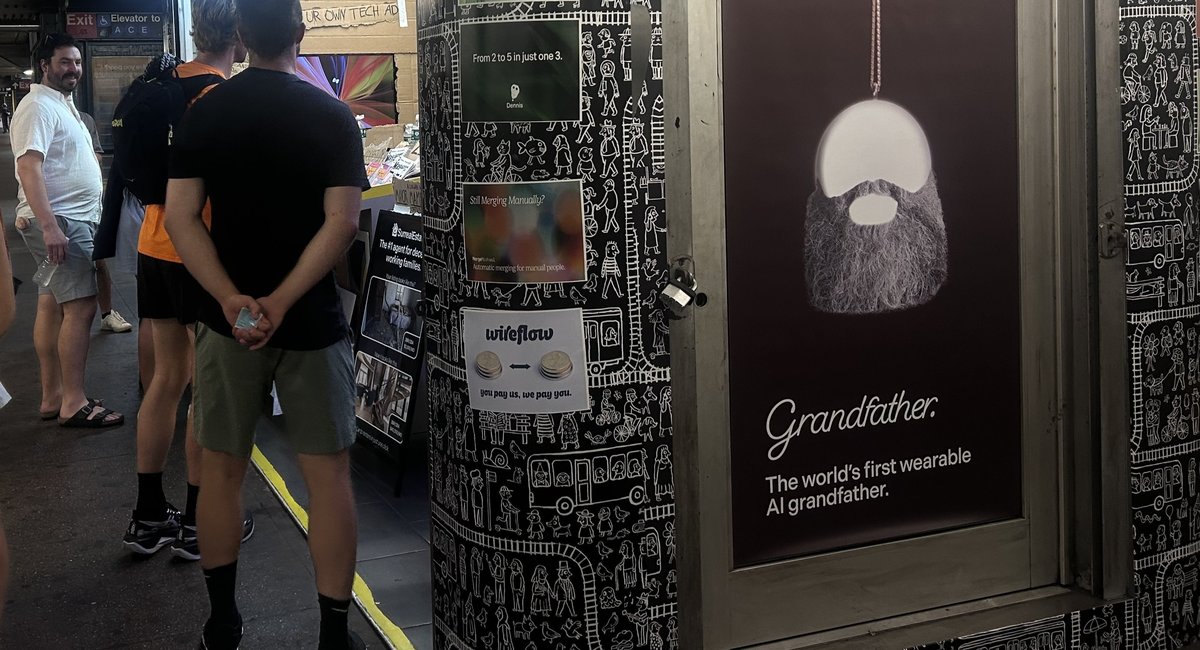
In June, an Instagram reel of fake tech advertisements being put up on Subway station walls went viral, gathering 5 million views and more than 250,000 likes. The faux ads were made by Harris Alterman and Dave Ross, two comedians whose usual content caters to the meta-ironic and absurdist appetites of the internet.
One ad read, “What if forks were spoons?” by the fake company, “cutlery.ai.”
Another said, “1 + 1 = _____. Dennis can tell you.”
And another, “Thinking just got a big upgrade” from “thoughts.com.”
Despite the products being made-up, if you’ve spent time in the subway system of New York City, these slogans may have a familiar ring to them. They follow a loose formula of combining corporate jargon and snappy sentences to create the proverbial nonsense seen in real tech ads. For Alterman and Ross, these ad campaigns seemed ridiculous.
“Riding the subway, all I would see were AI ads that made me confused and angry,” Alterman said. “I wanted to know if other people felt the same way.”
The two created 10 nonexistent tech companies advertising enigmatic products, crafted ads and printed them onto vinyl banners that they put up in subways. Ross said it only took the pair 30 minutes to compose the parody ads with their vapid marketing-speech and hollow commentary.
“I think these companies have successfully gotten this stuff into our brains,” Ross said.
In the first quarter of 2026, tech companies made up 15% of the ads in New York City subways and buses, according to Outfront Media, which owns and sells advertising space for the MTA. Of that percentage, tech ads on the subway are up by 50% this year from a year ago according to Semafor. While Alterman and Ross removed the fake ads immediately after the video was filmed, the popularity of their post proved to them that many shared their annoyance towards these ads.
“A lot of people are noticing the absurdity of it, and it brings us together,” Alterman said.
Nearly two months after their video was released online, the comedians were offered an opportunity to showcase the fake ads at W4 Newstand, a new initiative by artist All Mullen alongside the MTA, revitalizing an unused subway newsstand as a transit-themed art space. This past Saturday, the comedians displayed their fake ads across the train platforms inside West 4th station.
In addition to the ads, they displayed faux products, including Kool-Aid pouches with OpenAI CEO Sam Altman’s face Photoshopped over the Kool-Aid mascot’s face.
“The AI industry has tried to make us ‘drink their Kool-Aid,’ so we thought it made sense to have Sam Altman’s face on the Kool-Aid man,” Alterman said.
There were signs written on cardboard with Sharpie and taped to walls, promoting local-made zines and free merchandise.
“We figured that if tech ads look crisp but tear the soul out of our city and ourselves, then our signage should look arguably human,” Ross explained.
In a separate corner, an iPad was setup for visitors to create their own egregious interpretations of a tech ad, with categories for design, clipart graphics for logo creation, and another with arbitrary words like “turbo,” “spark” or “ninja” to help you scramble a fake company name.
“There is a sense of absurdity with all the tech ads in the city,” said Luke Miller, a designer at a tech company who was in attendance. “So many people are pushing for different products that feel over-inflated in value, and this shows how the ideas are sometimes kind of silly.”
“Businesses keep trying to simplify parts of our lives and make it fun and trendy so that we become socially isolated and reliant on AI,” said an attendee named Woodlief McCabe. “I think this really resonates with people who are tired of this fake familiarity.”
Since the viral video, Alterman and Ross have launched a new Instagram account called ai.conglomerate, an “ultra-evil” parent company which all these fake tech companies could live under. Their hope is to continue to poke fun with tech-based jokes and to pursue larger projects under this idea, according to Alterman.
“Advertising can make you feel as if you’re not up to snuff, like you’re not dressed the right way, or you’re not as savvy as you could be,” attendee Grai St. Clair Rice said. “I think this installation kind of turns it back into a more reflexive community experience.”
Many visitors were “downright elated and complimentary,” according to Ross. One interaction, though, stood-out to Alterman, who described speaking to a Palantir employee wearing a Palantir hat. Palantir is a software company that consolidates data for large businesses and government agencies. It’s been wildly criticized for its defense contracts.
“They came up to me and said everyone at Palantir is talking about these fake tech ads,” recalled Alterman. “Then they said, ‘I don’t work on the evil stuff at Palantir. I do something else.’”