

Key Takeaways
About 30% of U.S. households led by someone 65 or older have no retirement savings or pension.
Roughly 20% of older households have less than $10,000 in financial assets and no retirement savings.
Single older adults are far less likely than married couples to have retirement savings.
Americans often tell surveyors they’re afraid of not having enough money to last their lifetime. The reality is that millions of Americans retire with no savings at all.
How Many Older Households Have No Retirement Savings?
About three in 10 households headed by someone 65 or older—11.6 million in all—have no retirement account or pension, according to an Investopedia analysis of the Federal Reserve’s 2022 Survey of Consumer Finances, the government’s most detailed inventory of household wealth and the latest available.
The typical household headed by someone 65 or older has about $88,000 in financial assets. But among households with no retirement account or pension, median financial holdings are just $2,600.
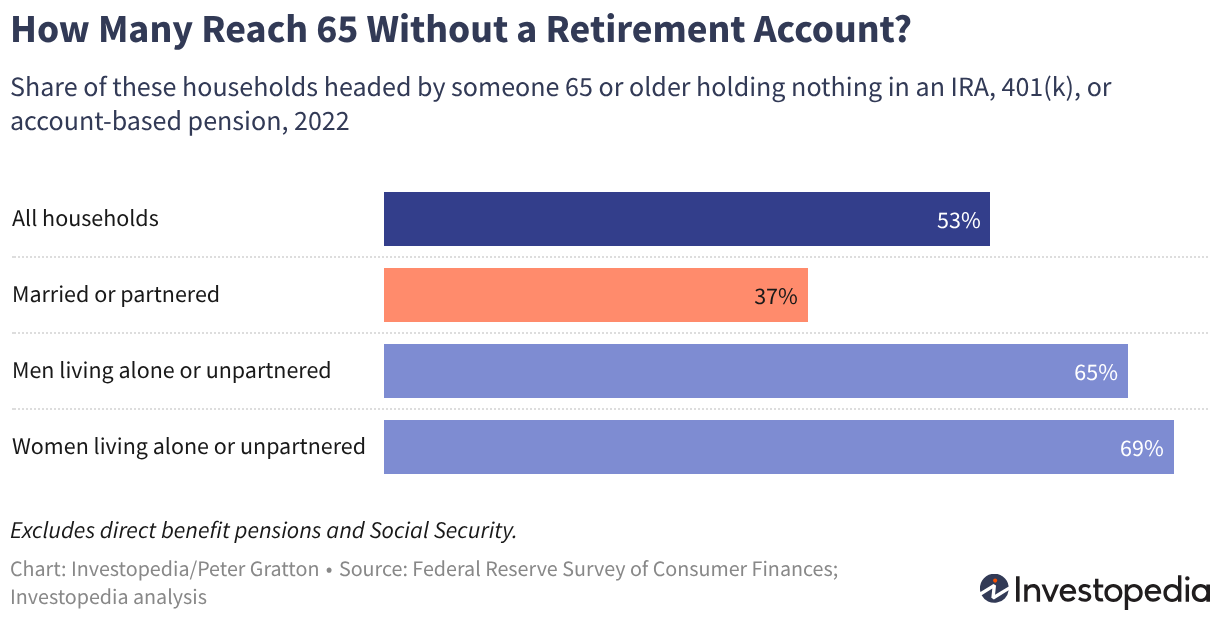
Looking only at retirement accounts, about 19.6 million older households—roughly 53%—have no money. in an IRA, 401(k), or other retirement account.
That doesn’t mean all of them lack retirement resources. A little more than half have a traditional pension, while others hold money in brokerage accounts, savings accounts, or certificates of deposit.
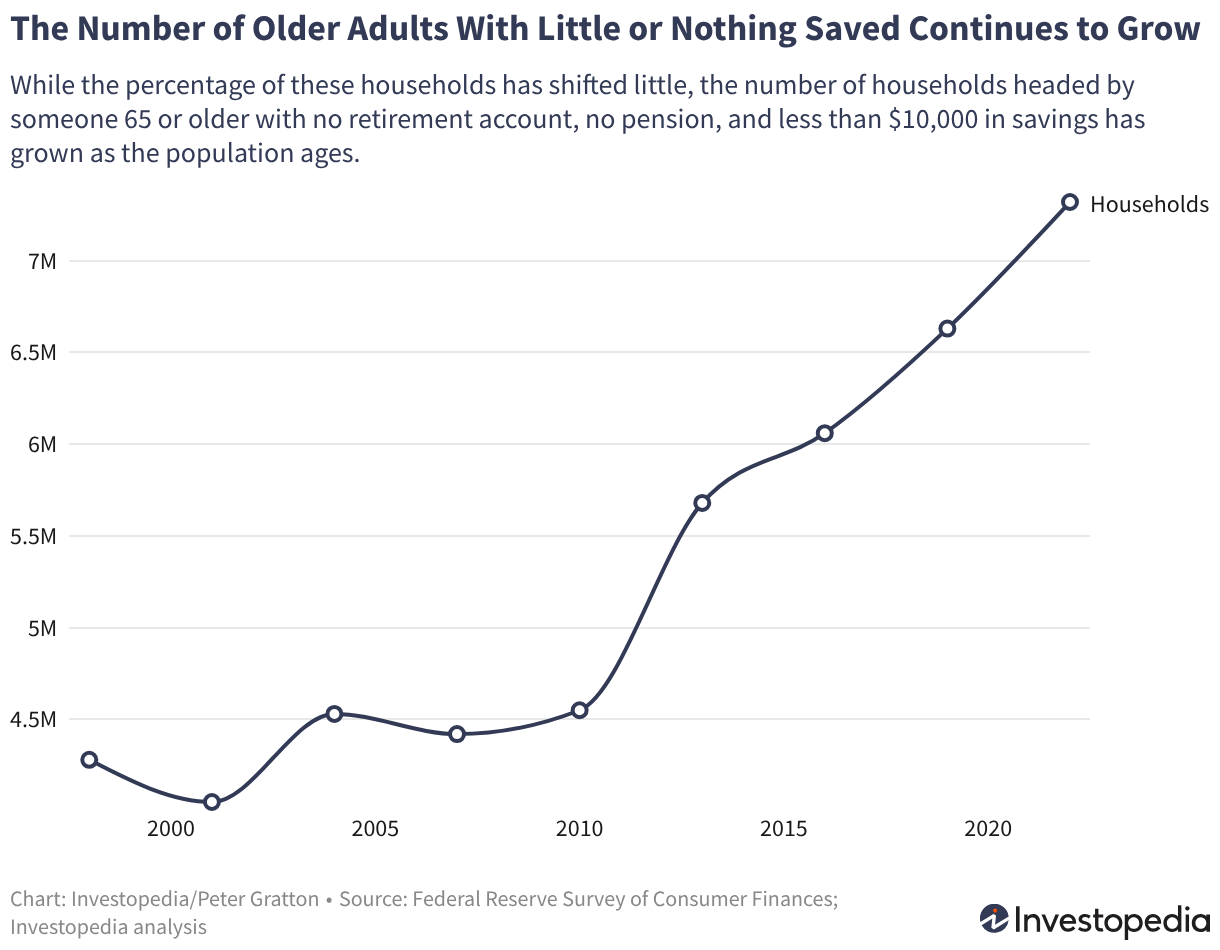
Within the 11.6 million households with no retirement account or pension, 7.3 million—about 20% of all older households—also have less than $10,000 in financial assets. About 14% of older households meet all three criteria and also do not own their home, leaving them largely dependent on Social Security, working wages, and whatever they have in checking.
Why This Matters To You
Retirement accounts are only part of the picture, but going into retirement without one—or a pension—can leave little cushion beyond Social Security, wages, and other limited assets.
The Number With Little or Nothing Saved Keeps Growing
The share of older households with little or nothing saved has barely changed in a quarter century. In 1998, 19.5% had no retirement account, no pension, and less than $10,000 in financial assets. In 2022, the figure was 19.8%.
But the number of households in that group rose sharply, from 4.3 million to 7.3 million—a 71% increase—as the population of older households grew 68% over the same period.
 Single Older Adults Face a Much Bigger Savings Gap
Whether someone is single or partnered also makes a big difference. Among Americans 65 or older, 69% of single women and 65% of single men hold nothing in an IRA, 401(k), or other retirement account, compared with 37% of married or partnered households.
These figures exclude traditional pensions and Social Security, so they do not necessarily mean those households have no retirement income. Still, they show how much less likely single older adults are to have savings in a retirement account.
The outlook does not appear much better for younger generations. Median retirement savings among working adults ages 21 to 64 were just $955 in 2022, according to a National Institute on Retirement Security analysis of Census data.
The group said the finding points to the fragility of the nation’s retirement system and workers’ retirement preparedness.
Read the original article on Investopedia