
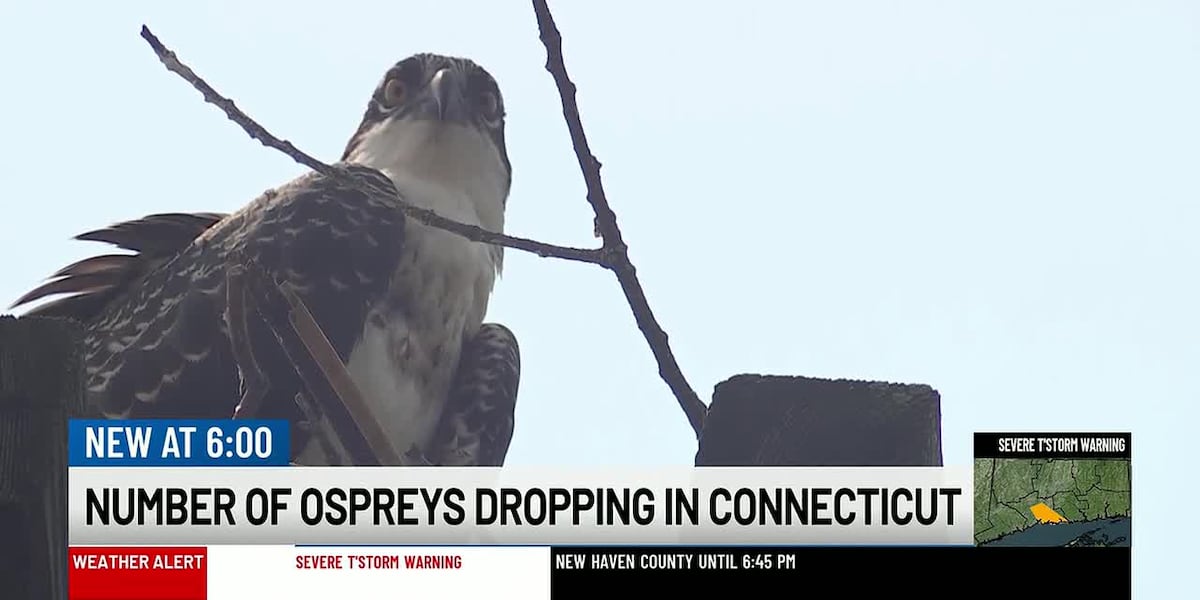
MILFORD, Conn. (WFSB) – Connecticut ospreys are hatching for the season, but their numbers are at some of the lowest levels in over a decade — and conservationists say a shortage of their primary food source is to blame.
The Connecticut Audubon Society, which has hundreds of volunteers monitoring roughly 1,000 osprey nests across the state, tracked 800 fledglings last year — averaging just over one per nest. It is the lowest number since the monitoring project began in 2014.
“We are already seeing much lower numbers in that range of fledglings,” said Matthew Joyce, Conservation Science and Coastal Center Manager for the Connecticut Audubon Society. “And we are also seeing a greater number of nests that have failed outright relative to last year.”
Menhaden shortage driving the decline
Ospreys typically nest near salt water — in man-made nests and atop telephone poles near the coast. They prey primarily on menhaden, a fish species that is in shorter supply this year. Less food means fewer surviving chicks.
A nest in Milford hatched four chicks this year. Only three survived.
Joyce said the situation is already worse in other regions and is moving north.
“Other areas like the Chesapeake Bay have seen massive die offs of osprey already and they’ve made pretty good links with the lack of menhaden and those die offs,” Joyce said.
Public comment period open
The Atlantic Fisheries Commission is currently accepting public comment about menhaden harvesting — specifically in Virginia, where the situation has been most severe. Joyce is encouraging Connecticut residents to submit comments to the commission to help protect the osprey population along the Connecticut coast.
A link to submit public comment will be added when available.
What’s next for Connecticut ospreys
Connecticut ospreys typically remain in the state through October and into November before beginning their migration south.
“We’ve been keeping a close eye on the population,” Joyce said.
Copyright 2026 WFSB. All rights reserved.