
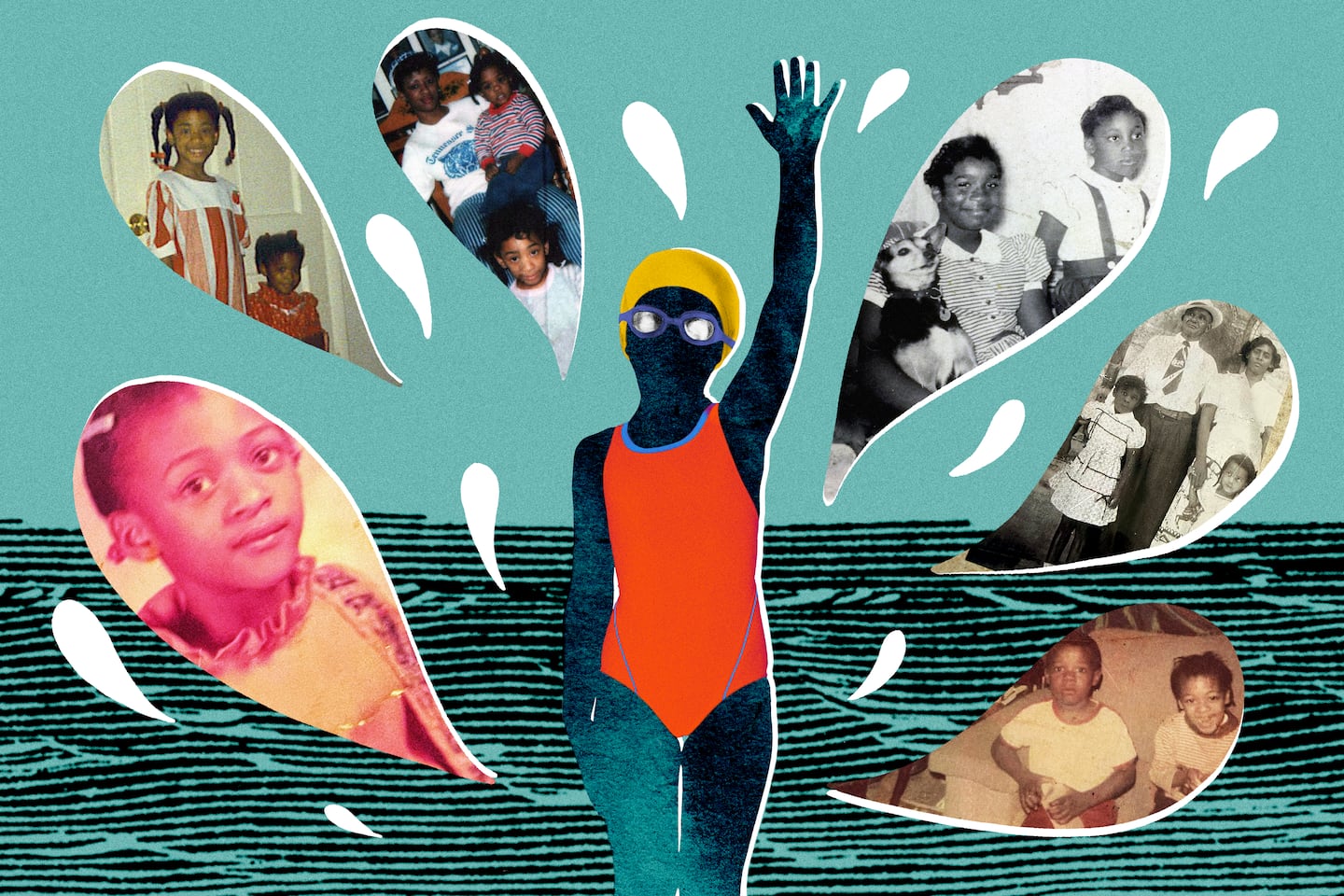
It was the summer before first grade, and, until that point, swimming lessons at my neighbor’s backyard pool in Goodlettsville, Tennessee, had been the highlight of my week. I loved pulling on my red swimsuit and running my fingers across its blue-and-silver rhinestones. After each lesson, I got a piece of Dubble Bubble as a reward.
This day, however, presented a threshold I wasn’t ready to cross. Standing in the shallow end, the teacher wanted me to float and kick my legs. I refused to try without the promise that her hands would guide me. Using herself as an example, she tried to show me that swimming alone was possible. Still, I would not budge.
The instructor, my neighbor’s daughter, concocted a plan. She propped my small frame into a back floating position, and then, without warning, let go.
Get Starting Point
A guide through the most important stories of the morning, delivered Monday through Friday.
I would not attempt swimming again for more than two decades. I skirted past opportunities at pool birthday parties and school trips, using my period or chemically relaxed hair as excuses. I just couldn’t face that feeling of helplessness.
Then, my best friend’s family invited me to join an eight-night cruise across the Mediterranean Sea this fall. Scrolling through photos of Greek, Maltese, and Turkish waterfronts on the cruise website, I knew I had to confront my fears. Because just dipping my French tip toes in Mykonos’s crystal-clear water felt like the coward’s way out.
I signed up for adult swim lessons at my local YMCA. Knowing I needed some motivation — and people to hold me accountable if I chickened out — I reached out to close family members. They were eager to cheer me on, but more than that, I found out through our conversations I was far from alone in having a complicated relationship with water.
I realized that each relative’s ability or inability to swim was impacted by more than their freestyle technique or comfort floating on their back. While studies show that race often affects a person’s access to safe swimming opportunities, my family’s outcomes were also determined by their hometowns, economic statuses, and family dynamics.
And to understand how I learned to fear water, I needed to understand how my family got here.
As I enter the YMCA aquatic center on a Saturday afternoon, tears well in my eyes and threaten to spill over — again.
My black-and-teal one-piece squeezes my torso, and bile rises to the back of my throat. My swim cap feels too tight, but it leaves enough room for thoughts to spiral in my head. Among them are the words my mom and my boyfriend gave me over the phone moments ago.
To be brave, you must first be afraid, my boyfriend told me.
Damn straight, I think. I am afraid!
In the Y’s two pools, experienced swimmers bob back and forth across the lanes, toddlers sprint through sprinklers, and adolescents propel their bodies across the shallow end.
Despite my anxiety, I manage to squish in my Crocs over to where my class is gathering. I find my place by locating another Black person with the same confused, fish-out-of-water look as me.
Black Americans’ dislike for swimming is more than a stereotype. During Jim Crow, the exclusion of Black people from public pools created disparities that permeate today. Black Americans drown more often than their white counterparts, according to the US Centers for Disease Control and Prevention, and the gaps are even larger between Black and white children.
As cities across America began building public pools, they also introduced policies to shut Black people out. My hometown of Nashville wasn’t an exception.
Before integration, Black Nashvillians could swim only at seven of the metropolitan’s 20-plus municipal pools. And Black people were clamoring to swim. A 1935 newspaper clipping from The Nashville Banner shows a photo of dozens of children filling a public pool for swim lessons offered by the local Y and the American Red Cross. Tens of thousands of Black Nashvillians packed Hadley Park’s public pool each summer after its opening in 1947.
When several civil rights activists tried to swim at the city’s Centennial Park pool one sweltering day in 1961, Nashville closed all its pools two days later. The city later filled the pool with concrete, and it never reopened.
Even in its cruelty, Nashville was far ahead of the rural towns surrounding it.
Growing up in Dixon Springs, Tennessee, safe swimming opportunities weren’t a reality for my mother. It was the sort of Middle Tennessee town where tractors joined cars on the road and everything on the dinner table came from the backyard.
Her parents fended for themselves from an early age, affected by family deaths, poverty, and the endless cycle of debt caused by tobacco sharecropping. What is leisure to a sharecropper? There was simply no time or opportunity for them to learn to swim, let alone teach my mother and her eight siblings.
If a Black person wanted to swim in Dixon Springs, they learned in the creek.
Before integration, “We weren’t allowed to go to swimming pools,” my aunt recalls. “We didn’t have the same privilege as white kids. We couldn’t even go to the restaurant to eat.”
My mom experienced the beauty of that winding stream: She remembers feeling its steady current tickle her toes while resting on the bank after picking blackberries and poke sallet with my maternal grandmother.
She also remembers the terror of its depths. One day, when she was watching the neighborhood boys play by one of the creek’s deep holes, a childhood friend — unaware that my mom couldn’t swim — shoved her into the water.
“I don’t remember coming back up, I don’t remember the wet clothes, I don’t even remember coming back home,” my mom says. “Maybe it was the shock.”
My mother never learned to swim. She showed up for the first few swimming classes as a freshman at Tennessee State University, but didn’t finish.
Just an hour west in Nashville, my paternal grandmother was ushered into an entirely different world of swimming.
My grandmother came of age in ’50s North Nashville, the heartbeat of the capital’s Black community. According to stories handed down to me, her family was the first on her street to install indoor plumbing and get a car. Her dad juggled jobs as a City Hall porter, post office worker, and laborer at chemical and coal plants.
She would slip on her blue one-piece, exchange empty Coke bottles for pocket change, and pay 10 cents to enter the newly installed swimming pool of Hadley Park, one of the few Nashville public parks open to Black people before integration.
Undoubtedly, the access my father’s side of the family had to safe, controlled swimming environments influenced their ability to learn. My dad taught himself at the Wave Country waterpark as a teen. His younger sisters learned through a mixture of shadowing older family members and lessons at public pools across the area.
“The neighborhood kids that could swim good would help you swim,” my grandmother says. “Once you learn to lay on that water without going down, that’s half the battle.”
Some from my mother’s side of the family who didn’t learn to swim are encouraging it in the next generation.
I consider my cousin Marilyn— who grew up in the predominantly white Nashville suburb of Hendersonville — my big sister. She “is not fearful of the water,” she says, “but respectful.” She didn’t advance past the guppy swim class at her local community center, but has deemed her money and resources better spent on her 17-year-old son’s burgeoning relationship with water.
“Even though I can’t swim, I’ll still take him here,” she says.
Similarly, my mom supported her children’s early introduction to the water without getting involved herself. She would watch my dad and brothers play rough in the pool, and I’d feel comfortable enough to join as long as a noodle or floatie supported my chubby frame. On the rare occasions we persuaded her to join, my dad would force my brothers and I to freeze until she got situated. Any water zones with my mother inside were off-limits; splashing her with water or knocking her off-balance risked losing pool privileges for the rest of summer break.
“I probably need to learn, but I’m just not interested in it,” my mom admitted recently.
She paused. “Maybe one day before I leave this earth, my daughter can teach me.”
But before I could teach anyone else, I had to reestablish my relationship with water. During my first lesson at the Y, the act of peeling my toes from the pool floor and entering a back float made me cry.
I knew four classes wouldn’t be enough to overcome my fears, so I returned to the pool after the first lesson to expedite this exposure therapy of sorts. I went in the early hours, when few people would be around. Leaning into a back float felt like a trust fall. How could something I’d feared for two decades be harmless? I had to train my brain to rely on physics.
Repetition was key. I would inhale, fall back, and try to fend off the fight-or-flight impulse to stand. I can float, I reminded myself. I pried my toes from my pool bottom one by one, and allowed the water to lift my body.
I’m floating. I can’t believe this is what I feared for 22 years.
By the second lesson, I was giving other students pointers on how to enter a dead man’s float or back float with ease.
After the course and several weekday mornings spent practicing laps on my own, the water and I have reconciled. Now, a morning without a quick swim feels incomplete.
Each day, I swim for my grandmother, who was taught by a loving, close knit community. I swim for the Woodards who will come after me, whom I hope will accept the water’s invitation for wellness, leisure, and relaxation earlier than I did. And I swim for a little Dixon Springs girl, pulled from the creek’s steady current.
Most of all, I swim for the woman who will visit the Mediterranean Sea for the first time, and do what for 22 years she thought was impossible.
Tiana Woodard is a former Black Communities reporter for The Boston Globe, and currently a researcher at Monticello. Send comments to magazine@globe.com.