

http://www.bozemandailychronicle.com offers audio versions of articles using Instaread. Some words may be mispronounced.


View of the Bridger Range from the BRR.
With the Bridger Range shrouded in wildfire smoke in recent weeks, 250 racers are nearing their home stretch of training for the 40th annual Ed Anacker Bridger Ridge Run on Saturday. The roughly 20-mile course takes racers up and across the Bridger ridgeline with about 6,800 feet of elevation gain.
Wildfires like the Sand Creek and Bobcat Lakes fires in Beaverhead County, as well as large blazes in Oregon and Washington, continue to burn and send smoke across the state. In response, athletes and organizers are contemplating what the degraded air quality could mean for the BRR.
“The safety of the people is always the main concern,” said Darryl Baker, a BRR director who has been involved in the race for 24 years.
Earlier this week, the Big Sky Wind Drinkers, the group organizing the Ridge Run, released an air quality protocol for the BRR. If the Air Quality Index — a scale used by the Environmental Protection Agency to measure outdoor air quality — is projected to surpass 150 on Saturday, the protocol states that the race will be cancelled.
The decision will be made 24 hours ahead of start time, on Friday morning at 6:30 a.m.
The EPA classifies AQI levels of 101–150 as “Unhealthy for Sensitive Groups” and 151–200 as “Unhealthy.”
If the AQI is between 101-149, the protocol grants participants a choice to either continue with the race or roll their registration over to next year.
“If it’s above 100, I don’t think I’ll run,” said Megan Gorsky, who is registered for the BRR. “I have other races in the next few months and would prefer not to damage my lungs.”
Megan Gorsky ran the BRR for the first time in 2025. While she didn’t train last year, she developed a training plan this year, which has been interrupted by the smoke.
“I haven’t run outside for over a week, so I’m constrained to the gym and running on the treadmill,” Gorsky said.


Megan Gorsky runs down a saddle on Sacajawea Peak during the 2025 BRR.
Last year, Gorsky ran the BRR in six hours and three minutes. Initially, she hoped to run this year’s race in under five and a half hours.
However, she said the smoke has impacted her goal.
“I’m going to go off how my lungs feel more than anything else,” Gorsky said. “I’ll be happy to just finish the race or defer to next year.”
Beyond the impact the diminished air quality may pose to racers’ times and cardiovascular health, Gorsky said the prevalence of wildfires raises deeper concerns.
“It makes me really sad,” Gorsky said. “I’m hoping people understand that climate change exists. Granted, fires would exist without imminent climate change, but the impacts of them would be less severe than they currently are.”
The National Aeronautics and Space Administration has identified human-caused climate change as the main cause for increasing fire weather in the American West. In an article titled “Wildfires and Climate Change,” NASA lists “hotter weather, earlier melting of winter snow, warmer nighttime temperatures and decreasing summer rainfall” as contributing factors to increased fire activity.
Since it’s inception in 1985, the BRR has run annually, with the exception of 2020 when it was cancelled due to the Covid pandemic. While lightning, extreme heat and cold have threatened to deter the race, the elements have never prevailed.
“The weather is looking positive with the rain in the forecast; the AQI is looking positive,” Baker said on Wednesday. “But, at the same time, I’ve been watching the AQI in the evenings and boy, sometimes it’ll look good for the following morning only to rise by 60 points.”
As of Wednesday, Baker said the forecast is uncertain but he’s remaining optimistic. For some racers, like lifelong Bozeman resident Alex Moore, it’s this optimism that fuels the race.
“You’re out on the ridgeline the whole time; it’s just unreal panoramic views,” said Moore. “It has a local vibe, and you see a lot of familiar faces on the start line.”
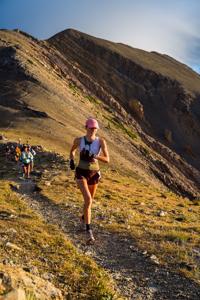

Alex Moore runs across Sacagawea Pass approaching Sacagawea Peak during the Ridge Run in 2025.
The course takes racers from the Fairy Lake parking area to the top of Sacagawea Peak. From there, racers navigate technical terrain, continuing to Naya Nuki Peak and Ross Pass before climbing the ridge to the Bridger ski lift atop Bridger Bowl Ski Area, Saddle Peak, Baldy Mountain and Baldy Peak. The course then descends to the M parking area before racers travel through the Drinking Horse trailhead access tunnel to the finish line at the Bozeman Fish Technology Center.
“A lot of us have a connection to the Bridgers, and it’s an emotional experience, stringing all of those peaks together and traversing across the ridge,” Moore said.
Moore grew up in Bozeman, where she ran track and cross country for Bozeman High School before running collegiately at Montana State University. Last year, on her inaugural BRR, she put up a time of four hours and eight minutes. She was the third female and 15th racer overall to complete the 2025 course.
She said she initially wanted to run this year’s race in under three hours and 50 minutes, but has adjusted her goal to sub-four hours due to the wildfire smoke.
“With the smoke, I don’t totally know how it’s going to affect me long term,” Moore said. “It’s a long time to be hard.”
Last year, she said smoke was a non-issue.
“I could not have asked for better conditions last year. It was overcast, kind of cold. The whole time I barely drank water,” Moore said.
If the race is cancelled, runner entrance fees will not be refunded according to the air quality protocol. Rather, they will be used to cover the cost of race setup, to donate to local nonprofits and to develop an AQI monitoring station at Bridger Bowl.
“This year really kicked us into gear. These last couple of weeks we’ve been talking about ways to monitor AQI in a last-minute way,” Baker said.
As the days tick away, both the smoke and uncertainty weigh heavily in the air.
“It’s weird not to know what’s safe and what’s not; we’re in this weird place of the unknown,” Moore said.