
Since the beginning of the salary cap era, the Pittsburgh Penguins have been up against the cap limit. The annual dance to find a winger for Sidney Crosby or Evgeni Malkin was a constant purge of draft picks and an embrace of hope that the next contract would be the missing piece.
But management was always dancing around the cap.
Who could forget the Penguins playing with only five defensemen late in 2014-15 because there were fewer than 10 games remaining, meaning they were unable to get LTIR cap relief. Their cap situation was effectively a jail cell.
Of course, as GMs Ray Shero and Jim Rutherford found those pieces, the Penguins’ extraordinary core won Stanley Cups (2009, 2016, 2017). As they missed, they were handcuffed to do anything further, the team sitting pennies shy of the cap.
The perilous situation also harshly punished mistakes. See also: Final contracts for Chris Kunitz, Jeff Carter, Rob Scuderi part II.
The summer of 2026 has also introduced a new peril. Instead of one more contract for veterans that might tax the cap, teams are now spending big on young players, some of whom are unproven.
For example, it is believed Penguins prospect Ville Koivunen is the first forward to graduate from an entry-level deal to a $4 million average annual value after a mere seven-point season with a .18 points-per-game average.
It’s a new world, and perhaps in a few years, Koivunen will appear on either the best contracts or the worst list.
For the purpose of finding the worst Penguins contracts in the cap era, we again compiled two lists. A subjective list based on performance, cost, comparative value to peers, and expectations. And we dug deep across 20 years of stats and contracts to cross-reference the worst, excluding ELCs (Sorry, no Sergei Plotnikov, who had just two points in 36 in 32 games)
10 Penguins Worst Contracts
10, 9, 8: Ziggy Palffy, John LeClair, Jocelyn Thibault, 2005-06
All of them. GM Craig Patrick reacted to losing the shackles of financial instability that dogged the Penguins for a decade by embracing the league revenue sharing and salary cap by going wild on the free agent market following the lockout-lost season of 2004-05.
After drafting Sidney Crosby first overall (by virtue of winning the league-wide lottery), Patrick couldn’t hide his smile with some of the biggest names in hockey joining Crosby and 40-year-old Mario Lemieux.
However, the penthouse soon smelled like the outhouse.
Palffy abruptly left the team at mid-season to return home to Slovakia, forfeiting the remaining 2.5 years of his three-year, $13.5 million deal. Until he packed up and left town, Palffy was the Penguins’ second-leading scorer with 42 points in 42 games, but he cited a bad shoulder—which surprised the team—leaving them in the lurch. Palffy resumed his career in 2007-08 and played five more seasons in Slovakia.
Thibault signed a two-year, $3 million deal but never truly recovered from hip surgery and, including 2005-06, played only 50 more NHL games.
We’ll also lump Mark Recchi into this mix, though he later made amends with the team. LeClair was cast aside by the Philadelphia Flyers, but signed a two-year, $1.5 million deal with the Penguins, and Recchi inked a one-year, $2.28 million deal.
However, Recchi and LeClair didn’t treat the young phenom Crosby well, had confrontations with coach Eddie Olczyk over the matter, and while they produced 57 and 51 points, respectively, the team was little more than a phone call away from being declared a disaster area … or appearing on Dr. Phil.
The Penguins waived LeClair in December 2006, while Recchi was traded to the Carolina Hurricanes near the 2006 trade deadline.
7. 2018-19 Riley Sheahan $2.1 million
Sheahan was Rutherford’s target for months. It was almost assumed that Sheahan was the heir apparent to the departed Nick Bonino as the Penguins’ offensively competent and defensively responsible third-line center.
However, Rutherford ignored Sheahan’s previous season with the Detroit Red Wings, in which he was goalless until scoring two in Game 82, at his peril. Sheahan was a bust with the Penguins, notching 19 points in his first season before tanking to just two goals and seven assists through 49 games in his second before being gifted to the Florida Panthers in the great Derrick Brassard purge of Feb. 1, 2019.
6. 2021-22 Kasperi Kapanen $3.2 million
Another apple of Rutherford’s eye, but an acquisition that went splat. After an unremarkable 2021-22 season in which he accumulated just 30 points, the Penguins dished a two-year, $6.4 million deal.
Kapanen, then 26, quickly found himself in timeout with coach Mike Sullivan, and the team waived him in February. Fortunately, St. Louis saw value in the talented but unproductive player and snatched him off waivers, thus absorbing the remainder of the contract. However, his deal remains one of the more misguided contracts in the cap era. Had St. Louis not claimed him, Kapanen’s deal might rank near the top of the list.
5. 2021-22 Brock McGinn $2.75 million
Former GM Ron Hextall saw value in the depth player who was losing his spot in the Carolina Hurricanes’ lineup. The Penguins signed McGinn to an ill-advised four-year, $11 million deal as a cost-effective alternative to the departed Brandon Tanev as a speedy fourth-liner.
McGinn was vanilla ice cream. Bland. And the Penguins waived, then traded him in the middle of the following season to the Anaheim Ducks.
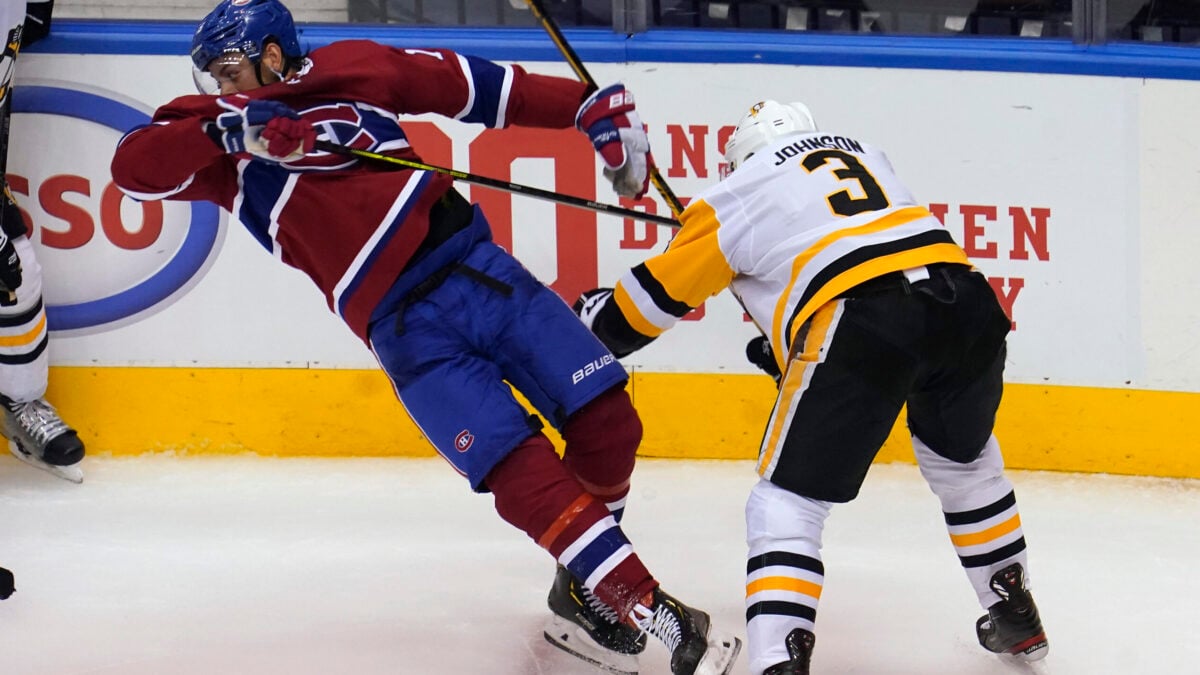
4. Jack Johnson, $3.25 million AAV 2018-2020
At the intersection of public outcry and a coaching staff’s appreciation for having at least one defensive defenseman lived Johnson. Within minutes of his free-agent signing to a five-year, $16.25 million deal, the analytics portion and other parts of the Penguins’ fan base suddenly cried out in terror as if they were living on Alderaan. And things only got worse.
Johnson was an analytics bomb, but a defensive stalwart. However, he was also well overpaid for a third-pairing defenseman, and Rutherford had to execute a buyout just two years into the deal on Oct. 5, 2020 (a delayed offseason due to the COVID stoppage). The Penguins finally rid themselves of Johnson’s lingering buyout cap hit on June 30, 2026.
3. Jeff Carter, $3.125 million 2022-2024
After resurrecting his career with the Penguins after being acquired via trade with the LA Kings in 2021, Hextall not only protected the 37-year-old in the expansion draft at the expense of Jared McCann, but also signed Carter to a two-year deal.
Ouch. That decision sequence belongs in the Penguins’ Hall of Shame right beside trading Markus Naslund to Alex Stoyanovich in 1994.
Carter’s legs were gone, and his play rapidly fell off under his new deal, but the cap-strapped Penguins and Sullivan had few options but to keep Carter in the lineup for most of two more seasons. Carter wasn’t a healthy scratch until later in the 2023-24 season, after which he quietly retired. Carter scored just 44 points in 151 games over his final two seasons.
2. Tristan Jarry, $5.38 million, 2023-2025
No one really wanted the free agent deal that Jarry signed on July 1, 2023. Jarry wanted to test the market to go elsewhere, and new Penguins GM Kyle Dubas was happy to shop around for a new goalie. However, both sides realized later in the day that they were stuck with each other.
Things went from troubled to calamitous, and Jarry’s play faltered in 2023-24 before he hit rock bottom in 2024-25. The Penguins waived Jarry in January of 2025 but quickly realized prospect goalie Joel Blomqvist wasn’t ready for primetime and recalled Jarry a month later.
Dubas capitalized on Jarry’s rebound to begin the 2025-26 season and miraculously recouped defenseman Brett Kulak, goalie Stuart Skinner, and a second-round pick from the Edmonton Oilers for Jarry … before Jarry’s play reached new levels of rock bottom later in the season.
1. Ryan Graves, $4.5 million, 2023-Present
July 1, 2023, was not a good day for Dubas. Before signing Jarry, Dubas also signed the then 26-year-old Graves to a six-year deal.
While Johnson was a serviceable defenseman despite an inflated cost, the Penguins and Graves have been a mismatch for three years running. Sullivan and staff did their best to camouflage Graves for two seasons; hope was eternal that the team would get the big defenseman for which they paid. However, Graves has been a bust and spent most of last season in the AHL. Even Dubas has referred to signing Graves as a mistake, though not specifically by name.
Graves has three years remaining on his contract, and unless Dubas is willing to part with a significant asset to facilitate a trade, there are no palatable options for a split.
Objective
List parameters: Minimum 25 GP: ELCs excluded. Ryan Reaves, Eric Godard and Andre Roy were also excluded as enforcers. Hey, their job wasn’t about the puck. Also, Jason Zucker and Matt Nieto were excluded due to injury-shortened seasons.
Also, in the interest of accurate representations, we’ve made a few judgement calls.
Players who were traded during the season were also excluded, despite a couple of clear cases of being traded due to unproductive seasons, specifically, Riley Sheeahan in 2018-19, who had just nine points in 49 games. Under that principle, PHN considered removing Brock McGinn in 2022-23, who had just 16 points in 60 games, but he was waived before being traded, and his time with the Penguins was over, one way or the other. So, he counts.
The same waivers caveat applies to Kapanen, who didn’t complete a full season with the Penguins because he was lost via waivers. So, even though McGinn and Kapanen’s cost per point isn’t proportionally accurate, they are legitimate in the abstract since their tenure ended due to performance.
We also removed Shane Endicott despite just two points over 41 games in the 2005-06 season, primarily because he was a minor league player for the organization who was pressed into duty, and that just didn’t seem fair. And we bounced Kevin Porter’s 2015-16 season because he was on a two-way deal.
And, for the ultra detailed, PHN adjusted Tanner Glass’s cost per point to reflect the proportionality of the lockout shortened 2012-13 season. Yet, he still ranked as the worst.
RankPlayerSeasonGPPTSPIT Cap HitAdjusted Cost/Point1Tanner Glass2012-13482$1,100,000$321,951*2Noel Acciari2023-24557$2,000,000$285,7143Jansen Harkins2023-24454$850,000$212,5004Jeff Carter2023-247215$3,125,000$208,3335Carl Hagelin2016-176122$4,000,000$181,8186Brock McGinn2022-236016$2,750,000$171,8757Noel Acciari2024-257912$2,000,000$166,6678Kasperi Kapanen2022-234320$3,200,000$160,0009Kevin Hayes2024-256423$3,571,429$155,28010Eric Fehr2015-165514$2,000,000$142,857
Tags:Penguins History Penguins salary cap Pittsburgh Penguins
Categorized:Pittsburgh Penguins