
ALTERNATIVE:
The device stimulates the vagus nerve through the ear, activating the parasympathetic nervous system, helping to regulate areas of the brain, ITRI said
By Shelley Shan / Staff Reporter, with CNA
The Industrial Technology Research Institute (ITRI) has developed Taiwan’s first digital therapeutic technology for generalized anxiety disorder (GAD), which combines noninvasive micro-electrical stimulation of the vagus nerve through the ear with physiological data analysis.
The Taiwan-based applied research and technology development organization said it aims to offer an alternative treatment option to medication for GAD and is applying for clinical trials, with the goal of being practically applied within three to five years.
A study by the Ministry of Health and Welfare showed that 25 to 27 percent of people in Taiwan experience psychological stress, said Hu Chang-lin (胡長霖), a project manager at ITRI’s Biomedical Technology and Device Research Laboratories.
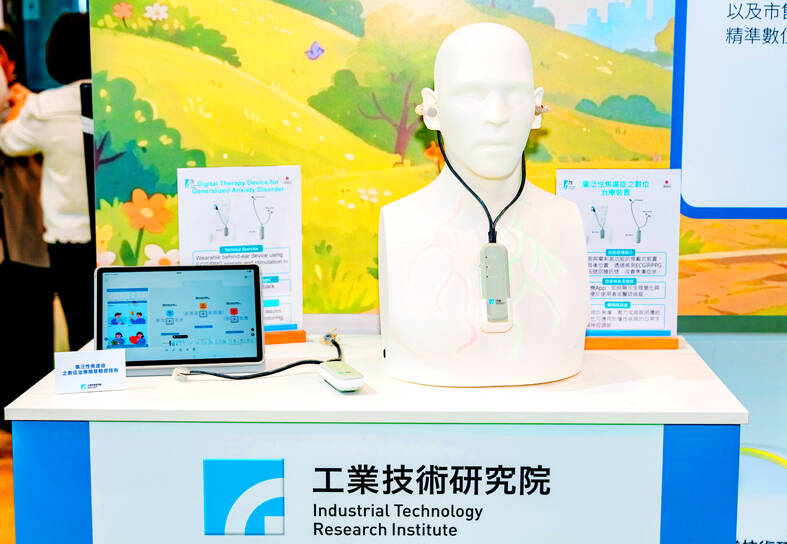
Photo courtesy of the institute
More than 2 million people have sought medical attention because of mental illness, but only 1 to 7 percent paid for mental health treatment using the National Health Insurance system, Hu said.
“There remains a significant unmet need for treatment,” he said.
Most psychological diseases are treated with medication, but long-term use could generate side effects, dependence and tolerance, Hu said.
As many people with anxiety disorders are often reluctant to seek medical help, a significant number miss the optimal window for treatment, he added.
The therapeutic technology was developed to provide a third treatment option for GAD beyond medication and psychotherapy, Hu said, adding that the technology could potentially help patients gradually reduce their reliance on drugs.
People with anxiety disorders often experience an imbalance in autonomic nervous system regulation, characterized by heightened sympathetic nervous activity and reduced parasympathetic activity, Hu said.
They can remain in a prolonged state of tension and worry and have difficulty relaxing, he said.
The device developed by ITRI stimulates the vagus nerve through the ear, activating the parasympathetic nervous system, Hu said.
This not only helps relieve emotional distress, but can also influence emotional regulation areas of the brain, including the brainstem and prefrontal cortex, through neural signaling, improving patients’ ability to regulate their emotions, he added.
Although non-invasive vagus nerve stimulation (nVNS) technology has been in development in North America and Europe for years, most products are only equipped with the function of unidirectional electrical stimulation, Hu said.
No nVNS-related products have received regulatory approval for marketing in Taiwan, Hu said.
The key breakthrough achieved by the ITRI-developed technology platform is to integrate heart rate variability (HRV), photoplethysmography and other physiological signal measurements. Data can be uploaded to the cloud for doctors to conduct real-time analyses, he said.
Users can also use the device to monitor patients’ biodata before the clinic visits and help doctors produce more accurate diagnoses, he said.
The institute is applying for a clinical trial for the device, and the application review could take up to 1.5 years, he said.
“We hope that this device can be purchased at an affordable price to facilitate home-based care for more patients,” Hu said.