
I recently came across a social media post confidently declaring that entrepreneurs are the one class of people with absolutely nothing to fear from artificial intelligence.
Naturally, because I am that sort of person, I asked AI what it thought. This was probably unwise.
The machine diplomatically informed me that the claim was “not entirely true”. Entrepreneurs, it explained, may not fear AI taking their jobs in the traditional sense, but they face “unique systemic and strategic anxieties”.
In other words, congratulations, your job is safe. However, your entire industry may not be.
AI apparently sees entrepreneurship as fundamentally different from employment. Entrepreneurs do not have fixed job descriptions or repetitive tasks. They identify opportunities, manage risks and build things from nothing.
Which is reassuring, because ‘managing risks’ sounds exactly like something humans should continue doing.
There is also, apparently, an ‘irreplaceable human edge’: vision, emotional intelligence, moral reasoning, trust and the ability to build relationships. Humanity has finally found its competitive advantage: feelings.
AI, meanwhile, becomes the entrepreneur’s ‘digital co-founder’, analysing data, writing content and automating workflows, while the human founder does the uniquely human work of staring into the middle distance and wondering whether payroll will clear.
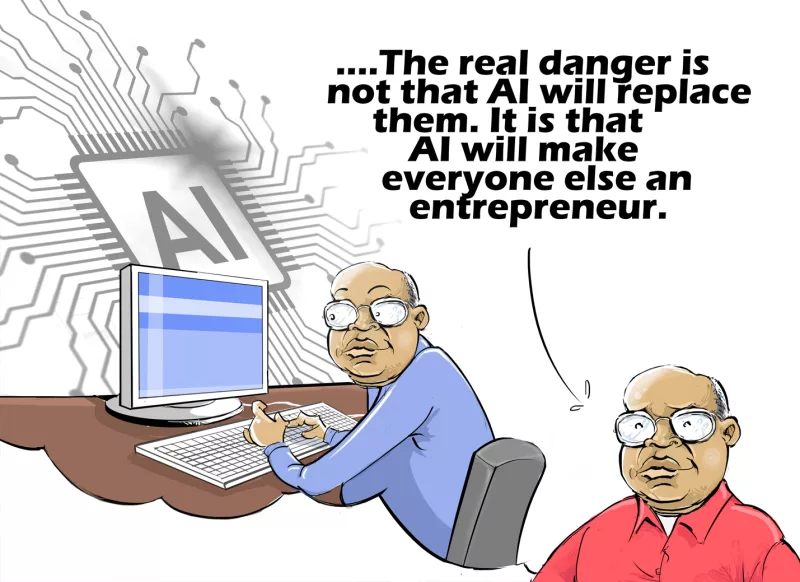
The real danger is not that AI will replace them. It is that AI will make everyone else an entrepreneur. AI dramatically lowers the cost and technical difficulty of starting a business. Suddenly, the person who could not code, design, analyse data or write marketing copy can do all four before their morning uji.
The result could be millions of businesses launching at extraordinary speed, all selling something suspiciously similar.
Then there is business model obsolescence. Imagine spending five years building a company only for an AI breakthrough on Tuesday afternoon to make your product unnecessary by Wednesday morning. Some will call this “disruption”. You will call it “the worst Wednesday of my life”.
Then come AI hallucinations, security problems, privacy risks and errors. Apparently, the future of business involves handing increasingly important decisions to systems that occasionally invent facts with the confidence of a drunk uncle at a family gathering.
The really interesting question is: What happens if AI does not merely assist entrepreneurs but eventually replaces them, too?
An autonomous AI spots a market opportunity, analyses the competition, writes the business plan, builds the software, launches the advertising and acquires its first million customers before a human has finished saying, “I have an idea.”
Capital becomes equally efficient. AI venture funds invest in AI startups without pitch decks, meetings or awkward networking events.
Companies could be created, scaled and killed in days because algorithms have decided efficiency demands it. At that point, human labour undergoes its final transformation.
For centuries, we were valuable because we could execute: write code, design graphics, analyse information, draft contracts and produce content. AI turns execution into a commodity.
What remains valuable is intent: knowing what to ask for, what matters and which answer is not complete nonsense. Then comes expertise, knowing whether the AI’s output is actually correct. Finally, there is original insight, ideas that are not merely statistical rearrangements of everything already available.
The great economic irony of AI is that the better machines become at creating things, the less valuable those things may become. When everything is available, everything becomes cheap.
Soon, every company will have a beautiful website, flawless copy, competent software and a logo that looks vaguely like every other logo. Everything is professional. Nothing is memorable, and this is where the Creative Rebellion begins.
Humans, exhausted by an ocean of synthetic perfection, start paying a premium for imperfection. ‘Made without AI’ becomes the new ‘organic’. The real competitive advantage becomes something machines struggle to manufacture convincingly: trust, community, reputation and genuine human connection.
So perhaps entrepreneurs really are safe from AI. Not because they are irreplaceable, but because the definition of entrepreneurship is about to change.
The entrepreneurs who survive will not necessarily be the people who use AI to produce the most. They will be the ones who use AI to eliminate the boring stuff, while spending their increasingly valuable human time figuring out what is actually worth doing.
And if that fails? Do not worry. I am sure the autonomous AI founder will be happy to acquire your company. It will probably offer you a position in customer support.