
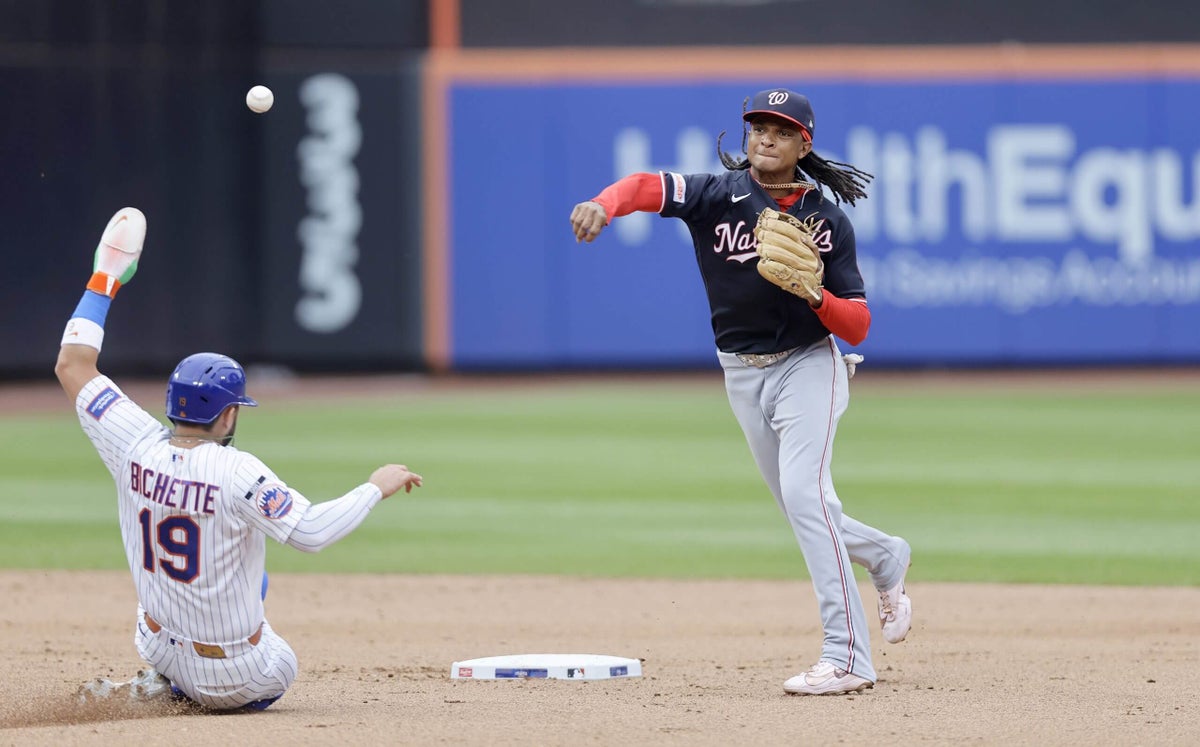
The agent of two-time All-Star CJ Abrams said his client remains uneasy about the Washington Nationals’ decision to move him from shortstop to second base, a change that could have repercussions on the diamond, in the clubhouse and at the negotiating table.
But three days after the announcement, both Abrams’ camp and the Nationals’ front office praised each other as strong partners in the decision, signaling a desire to find common ground despite lingering disagreement about the timing and the necessity of the position change.
“I think, first, CJ was not thrilled about the decision to move him off shortstop at this time,” Abrams’ agent, Mike Sanders of Roc Nation Sports, told The Athletic. “But his priority is to win games for the Nationals and to be a team-first player, so that is what he’s going to do.”
Abrams is well-aware that he needs to improve defensively. Still, there are some chasms to close.
Sanders doubled down on Abrams’ assertion that he views himself as a shortstop long-term, and indicated that his client intends to spend the winter focused on improving his defense at his preferred position. Sanders believes Abrams has earned an offseason to prove that he can stick at short.
“He’s always viewed himself as a shortstop short-term and long-term, and would love to have the offseason under this front office to be able to work on that,” Sanders said. “I believe CJ can be a very good shortstop, and without having an offseason to specifically train at the position using the information and feedback this staff has given him, I don’t think we have a full evaluation yet of how good he can truly be there.”
Nationals president of baseball operations Paul Toboni said the team is trying to be considerate of Abrams, who remains a franchise pillar on the field and in the clubhouse. Sanders, like others who have dealt with the organization this year, appreciated Toboni’s transparency.
But while the Nationals hope to serve their All-Star as best they can — they spent a ton of time mulling the possibility before discussing it at length with Abrams, then the public — they will ultimately prioritize what they feel is best for the team, even without a guarantee it will shake out as the right move in the end.
“If I’m CJ, of course I’m upset,” Toboni told The Athletic. “It’d be weird if he wasn’t. CJ has been a shortstop for his whole life, and it’s a huge part of his baseball identity. If I didn’t sense he was upset, I’d be worried that he wasn’t being real with us.”
Toboni praised Abrams’ willingness to roll with the change, while also acknowledging the strong feelings in the aftermath of what he termed a “difficult conversation.”
“This isn’t a place where we just think through what is best for the team, then we do it without considering other factors,” Toboni said. “No, we think about CJ and how this impacts him personally because he’s a huge part of this org. And it’s our job to consider all these factors, decide the best path possible, and do our best to communicate to CJ, Mike and everyone else.”
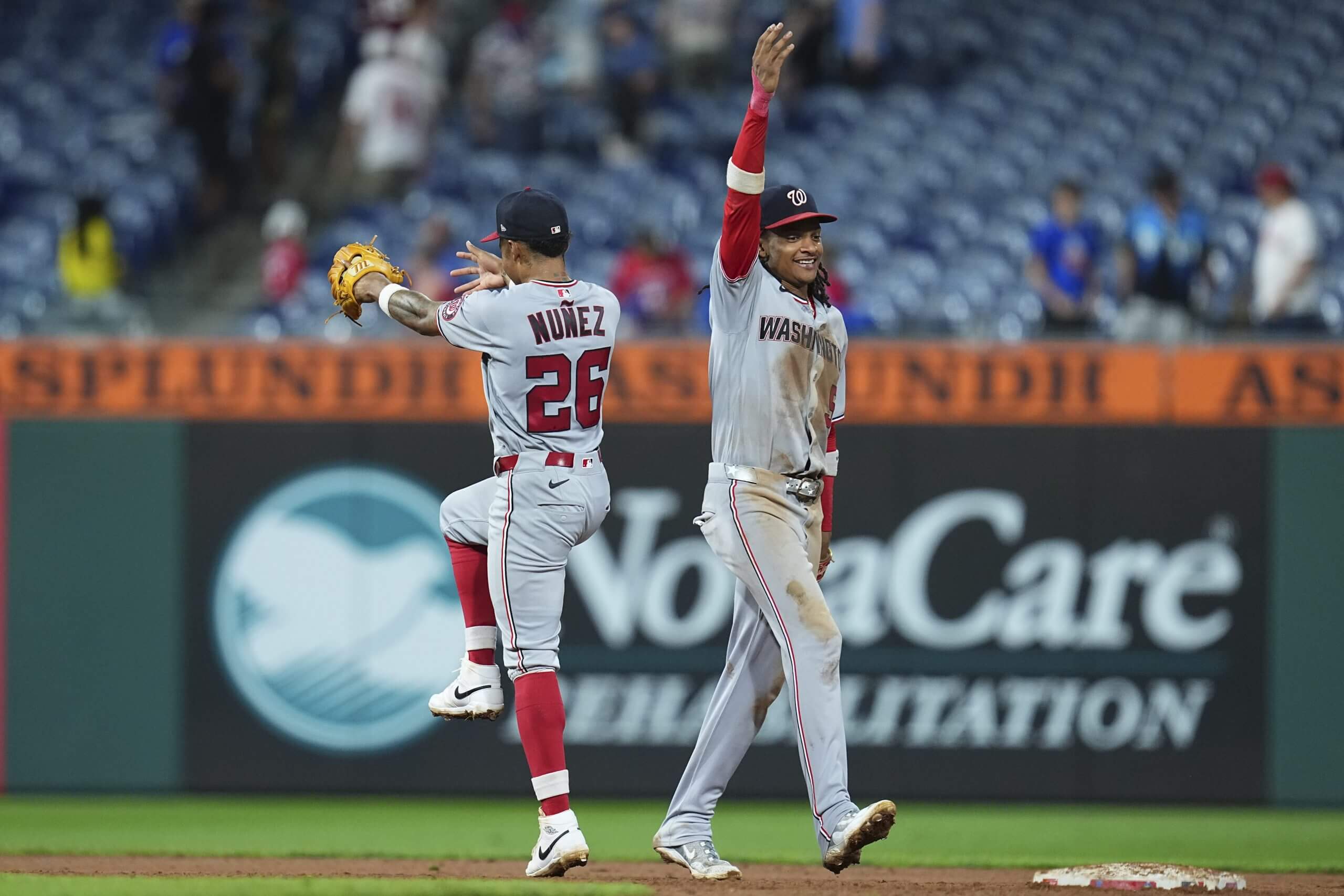
Nasim Nuñez grades out as the better defender at shortstop compared to CJ Abrams, who ranks last in MLB in several defensive metrics this season and has graded poorly in recent years. (Mitchell Leff / Getty Images)
The timing of this move — after the trade deadline, but before free agency — remains a preeminent curiosity and point of contention.
Consider Abrams’ season for a moment: the 25-year-old is in the middle of an offensive breakout, trailing only Yordan Alvarez, Shohei Ohtani, James Wood, Pete Crow-Armstrong and Junior Caminero in FanGraphs’ offensive value this year.
He also ranks last in MLB in several defensive metrics and has also graded poorly in recent seasons despite his athleticism, which led to the team’s decision to move him to second base, a less demanding position. Nasim Nuñez, a stellar defender with a career .605 OPS, will make the switch from second to short.
Abrams is a player who is both imperfect and essential to a team that has far exceeded its gloomy preseason projections. His clubhouse presence and offensive output have carried the Nats thus far, and if the decision goes awry, both could be disrupted by the public nature of the in-season move.
Toboni acknowledged that the timing would have been imperfect no matter when they made the decision, which Sanders conceded as well, but the new president of baseball operations ultimately thought it offered the best balance of helping the team in 2026 and giving Abrams a “good sample of games” to develop and see how he performs at second base.
Beyond that, Toboni said, “it also allows us to see what makes the most sense for CJ and the team in 2027 and beyond.”
Though the Nationals have not explicitly or publicly defined Abrams’ future defensive home — and why would they after this switch — Sanders said he believes Abrams can still become a very good defensive shortstop, pointing to his athleticism and his consistent improvement in other aspects of his game, including the work he did this winter to fuel his offensive breakout.
“That’s just where I’ve been playing my whole life,” Abrams said on Friday, as he largely opted to shelter his feelings on the matter. “I believe I can be a great shortstop.”
For Abrams, a free agent after the 2028 season, the position change comes with financial consequences. All else being equal, shortstops are more valuable than second basemen in the field and on the market. Though the Nationals are teeming with shortstop depth in the minor leagues, they also sport one of MLB’s smallest payrolls, which arouses interest around a possible contract extension.
Sanders declined to talk about the prospect of an extension and whether this move impacts the possibility in the future, but painted Abrams as pleased to be in Washington, an assertion that the shortstop has similarly indicated over the course of this season.
“CJ’s enjoyed his time in D.C. and, as long as he’s with the Nationals, his focus is going to be on being the very best player he can be and winning as many games with the Nationals as he can,” Sanders said. “The very best player and teammate he can be.”
On the subject of finances: There is an impulse to look at the high end of the salary spectrum and note that the number of shortstops making big-time money is much larger than the number of second basemen doing the same. Though $300 million deals for shortstops are possible, they are without precedent for second baseman.
These are relevant data points for Abrams, who is tracking toward playing in the deep end of the financial pool if he maintains his production before hitting free agency or signing an extension.
Position changes haven’t always been damaging for guys like Abrams who came up as shortstops. Alex Rodriguez signed his first mega-deal as a shortstop, then opted out and signed a bigger one as a third baseman with the Yankees. Marcus Semien is another example. And last winter, Bo Bichette signed for more than $40 million per year to move off short with the Mets.
Fortunately for Abrams, he could very well be “incredible” at second base over the final six weeks, as his manager, Blake Butera, said on Friday. Even given the challenges that come with a mid-season switch, Abrams’ current defensive strengths — his lateral movement, in particular — suggest he could handle second base down the stretch.
Questions will remain as to whether his offense can hold up or his defense can improve.
The overarching curiosity, though, will be how this defines a key relationship for the club. When Abrams stayed out too late at a casino in 2024, the former front office responded by demoting him through the end of the season. That the Nationals’ new front office is handling this now, and out in the open, indicates that they are at least confident in their ability to manage it.
“In the meetings with Blake and I, CJ was very forward with the following: it’s all about the Nats,” Toboni said. “It’s all about the team. That’s a huge part of why we have huge love for CJ, even through these difficult conversations.”
— The Athletic’s Tim Britton contributed to this report.