
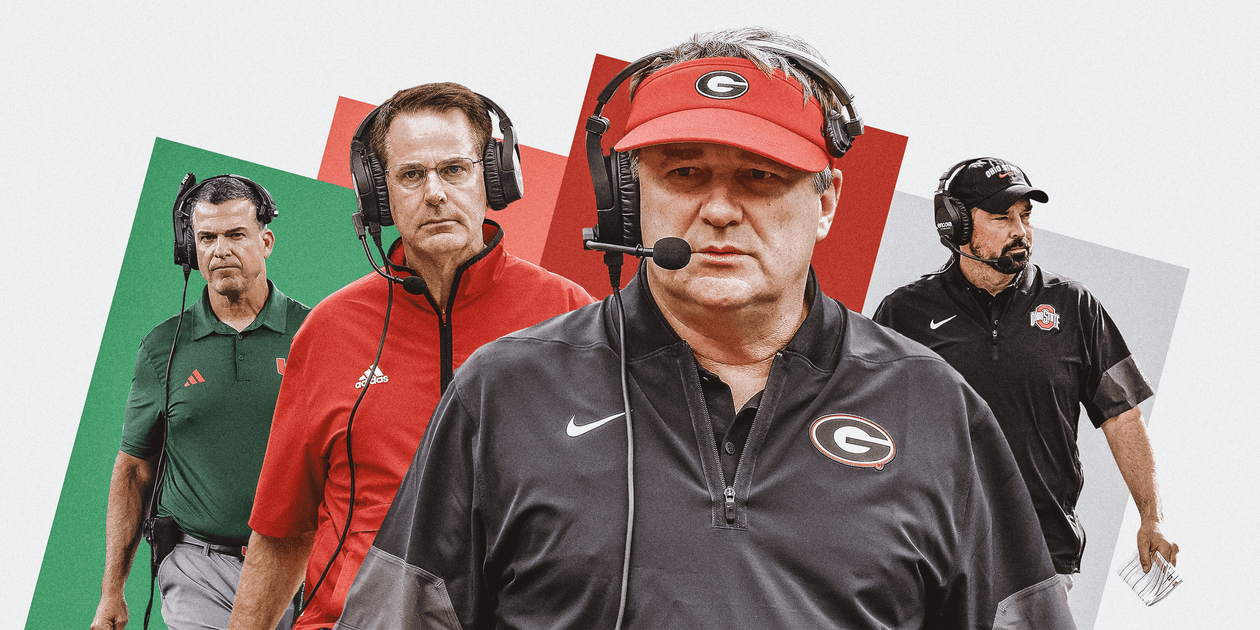
The job of a college football coach changes by the month and by the court ruling, and wins and losses on the field don’t always tell the whole story.
With general managers handling personnel and starting lineups earning tens of millions of dollars, the head coach’s responsibilities have become more like those of his NFL counterparts. But with no enforceable salary cap and unlimited player movement, every year can be wildly different. No matter what, the face of a program takes the credit and the blame.
For the fifth consecutive year, The Athletic has ranked the head coaches of the Football Bowl Subdivision into eight tiers, weighing everything from resume to resources to longevity and more.
This is about a coach’s complete body of work as the head man (assistant stints are not included). Has he sustained success? Has he won at multiple schools? What resources does he have relative to the competition, and does he maximize them? Recent results carry more weight, but this isn’t a projection into the future.
Why Oregon is Ralph Russo’s No. 1 team in the AP poll
Ralph D. Russo
Coaches entering their first full year as an FBS head coach are not eligible, even if they have experience at other levels of football. Coaches entering their second year in charge, including Bill Belichick, make their debut on this list.
To supplement our research, we consulted with coaches, administrators, agents and search firms for their views. They spoke on condition of anonymity to protect relationships in the industry, but agents were not permitted to comment on coaches they or their employers represent.
Note: Each tier’s coaches are listed in alphabetical order.
Everyone agrees these are the two best head coaches in the college game. Curt Cignetti unfathomably took Indiana to a national championship and consecutive Playoff appearances, and he’s never had a losing season in 15 years as a head coach, with 11 top-25 finishes (nine of which came below the FBS level).
Since winning consecutive national championships, Kirby Smart’s Bulldogs have gone three seasons without a CFP semifinal appearance, but those three years still include back-to-back SEC titles and another SEC title game appearance.
This group is almost always in the mix at the top. Ryan Day has a national championship, but he’s not in the top tier because Ohio State’s expectations and resources are so, so high. His two predecessors also won national titles, and Jim Tressel played for three. Day has done what is expected of him. A second title to match Smart would move him into the top tier.
The rest of this group has been close. Kalen DeBoer and Marcus Freeman each have title game appearances, but DeBoer is shouldering the weight of following Nick Saban at Alabama and has seen his stock trend slightly downward the last two years. Steve Sarkisian has two semifinals and has finally elevated the Texas program, but 2026 needs to be a breakthrough year. Mario Cristobal moves up into Tier 2 after last year’s run to the national championship game; he also nearly made the 2024 CFP and had a top-five finish and a Rose Bowl win with Oregon. Speaking of the Ducks, Dan Lanning already has a semifinal appearance and a separate undefeated regular season in four years as a head coach, and six of his eight losses have come against teams that played for the national title. Can he get over the hump?
Kyle Whittingham is the only one here without a CFP appearance, but he has three top-15 finishes in the last five years while working with far less than most of the other programs in this group. He also has an undefeated season in 2008 and two recent Pac-12 titles. Now he controls one of the best-resourced programs, but the Michigan job comes with much higher expectations and scrutiny for this list. His hire was one many in the industry will watch closely.
“Whittingham’s never been in the CFP, but the consistency and longevity gives him a bump,” one agent said.
“I’m sort of 50-50 on Whittingham,” a second agent said. “I think that’s still a very strange hire. You bought a short-term solution to your problem, but that’s not a long-term solution.”
Dabo Swinney drops out of the top tier for the first time since this exercise began. He has two national titles, but the last one was eight years ago. The Tigers have one CFP appearance in the last five years, and last season’s 7-6 record was Swinney’s worst since 2010. You can’t deny the highs, but the Tigers aren’t close to the bar he set and are trending downward.
The toughest coach to place was James Franklin, who was just fired at Penn State. I generally won’t knock a coach with a strong resume down a tier for one bad season. In 2024, Franklin was eight minutes away from playing for the national title, and he had five top-10 finishes in nine years. So he stays here for now, though I understand any pushback. It was time to move on at Penn State. Let’s see how things go at Virginia Tech.
Bret Bielema is coming off the first consecutive nine-win seasons in Illinois’ history. Matt Campbell took Iowa State on its best run in a century before moving to Penn State, where he’ll have the pressure of living up to the expectations Franklin set.
“I’m really bullish on Matt Campbell this year,” the second agent said. “It’s a fascinating story to see how Penn State does.”
Elsewhere in the Big Ten, Bob Chesney jumps up two tiers as he takes over UCLA after guiding James Madison to the CFP. Chesney has a Cignetti-like 15 winning seasons in 16 years as a head coach, with eight conference titles at various levels.
Kenny Dillingham continues to rise, following up a Big 12 championship with a sneaky-impressive eight-win season while battling a rash of injuries last year. He was a Tier 7 coach just two years ago. Vanderbilt’s Clark Lea is the biggest riser of the season. At this time a year ago, I didn’t put a ton of stock into his 7-6 record in 2024 coming off three consecutive losing seasons, but to go 10-3 and finish in the CFP mix was something I never thought possible. Lea was a Tier 8 coach two years ago. However, we will need to see if he can continue that success without quarterback Diego Pavia, 2025’s Heisman runner-up.
Dan Mullen returned to the sideline and took UNLV to the Mountain West Championship Game in his first season. With three New Year’s Six bowl trips at Florida and a long, successful run at Mississippi State, he might not get enough credit because of how his tenure ended in Gainesville. It proved to be much better than Billy Napier’s follow-up job.
“Dan’s resume at Florida has aged well, there’s no other way to put it,” the first agent said. “I’d put him at a 2.5 Tier. He’s had outstanding success at three different places.”
Texas A&M’s Mike Elko also moves up after guiding the Aggies to the CFP. Joey McGuire jumps two tiers after Texas Tech’s first conference title in decades. Yes, the recent increase in roster spending at Texas Tech factors into this, but McGuire had posted three consecutive winning seasons before last year, the second Tech coach ever to begin a tenure with such a run. Teams with resources also have to clear a higher bar, and Tech beat every Big 12 opponent by double-digits last season.
It was tough to move Lincoln Riley down a tier, but as with Swinney, we’re getting further from the Oklahoma CFP appearances that had propped him up. Riley hasn’t had a team finish in the top 10 since 2020, and although USC got back to the top 25 last year, the ceiling of this program should be much higher. This upcoming season is a big one for the Trojans.
BYU fans will point out Kalani Sitake’s three consecutive wins over Whittingham, who is one tier higher. I cannot refute that point, nor his consecutive seasons with at least 11 wins. Sitake is a great coach, and I was very close to moving him up, but Whittingham still has higher highs. A breakthrough moment like a conference championship or CFP appearance is the only thing missing.
“Sitake doesn’t get enough credit,” a third agent said. “He was going to get the Penn State job and now they’re set up for two more really good years of high-level success (at BYU). They consistently find good quarterbacks. He’s done a better job than just about anyone for the situation he’s in.”
This group’s occasional downside potential knocks it below Tier 3. Luke Fickell is the most notable name here, dropping a rung for the second consecutive year. His run at Cincinnati, including a four-team CFP appearance in 2021, was remarkable. But he has posted three straight subpar seasons at Wisconsin and trended downward each year (though I do predict a bounceback this season).
Eric Morris is this tier’s big riser, up three tiers after coming one game away from taking North Texas to the CFP. He’s now at Oklahoma State with most of his best Mean Green players, and he previously turned Incarnate Word into a top-15 FCS program. Navy’s Brian Newberry, up two tiers, might be the most underrated head coach in the country, with a 21-5 record over the last two years — the first consecutive 10-win seasons in program history — including wins against Oklahoma, Memphis twice, South Florida twice and Army twice. All three service academy coaches enter 2026 in Tier 4.
“When Navy let (Ken) Niumatalolo go, I think most people thought it’d be impossible to replicate that success, but Newberry might exceed it,” the first agent said.
Duke head coach Manny Diaz also hasn’t gotten enough credit for preserving the Blue Devils’ momentum following Mike Elko’s departure for Texas A&M (which coincided with star quarterback Riley Leonard’s departure for Notre Dame). Diaz won an ACC title in Year 2 but will now have to show he can withstand the loss of quarterback Darian Mensah, who transferred to Miami. Pat Fitzgerald rejoins the field after landing the Michigan State job. His five AP Top 25 finishes over 17 years, including a top-10 finish in 2020, brought Northwestern sustained success for the first time in ages, but he went 4-20 over the next two seasons before being forced out amid a hazing scandal. Can he adjust to modern college football and fix a Spartans program nearing rock bottom?
Brent Venables moves up one group, but his position is precarious. He has two 6-7 seasons and two 10-win seasons as a head coach. The Sooners made the CFP last year but lost at home. He hasn’t gotten close to Lincoln Riley’s highs at Oklahoma, but the sport (not to mention the Sooners’ conference) has changed since Riley left for USC. Year 5 should tell us whether Venables finally has his program in place.
Florida State’s Mike Norvell drops after his fourth losing season out of six in Tallahassee. The undefeated 2023 regular season at FSU and 2019 conference title at Memphis keep him from dropping lower, though he enters 2026 on one of the hottest seats in college football. Boston College’s Bill O’Brien and Colorado’s Deion Sanders also drop into this group.
Moving upward, however, is Virginia’s Tony Elliott, who started his fourth season in Charlottesville in Tier 8 but led the Cavaliers to the ACC Championship Game. The school has begun to invest in the roster, and Elliott has made the most of it. Western Michigan’s Lance Taylor is up two spots after a MAC championship capped his second consecutive winning season. The Broncos are one of the MAC favorites again this year.
Wake Forest’s Jake Dickert also moves up after turning in an impressive 9-4 debut season when many people thought the Demon Deacons could be the worst team in the Power 4. That followed a solid run at Washington State. Although he didn’t move tiers, Texas State’s GJ Kinne has trended upward with the first three bowl appearances in school history.
Kennesaw State’s Jerry Mack debuts in Tier 5 after winning Conference USA in his first season, bringing his total to four conference titles in five seasons as a head coach, including his 2014-17 run at FCS North Carolina Central. It’s a similar case for New Mexico’s Jason Eck, who took the Lobos to 9-4 and a tie atop the Mountain West standings in his first season, after building Idaho into a top-10 FCS program. Fresno State’s Matt Entz quietly won nine games in his first year, and his resume includes two FCS national titles at North Dakota State.
Several coaches debut in this group. Jacksonville State’s Charles Kelly reached the CUSA Championship Game in Year 1, Central Michigan’s Matt Drinkall produced a MAC contender in Year 1, and Troy’s Gerad Parker reached the Sun Belt title game in Year 2. Delaware’s Ryan Carty and Coastal Carolina’s Ryan Beard (previously at Missouri State) made bowl appearances in their first year post-FBS transition.
Willie Simmons won seven games in Year 1 at an FIU program coming off six consecutive losing seasons, and Jimmy Rogers navigated a complete roster turnover at Washington State to reach a bowl game, though Rogers then jumped to Iowa State. Even Timmy Chang at Hawaii went 9-4 after three consecutive losing seasons following a program reset. The vibes at all of these places are strong. All that’s missing is more experience.
“This whole group could move up a tier next year,” the first agent said.
This is mostly a group of coaches who had a rough debut season, headlined by the greatest coach in NFL history. Bill Belichick took over a solid UNC program from Mack Brown and went 4-8, so there’s no other basis to put him any higher. Expectations aren’t high for 2026, either. We’ll see whether new coordinator Bobby Petrino can spark an offense that was dreadful last year.
Other coaches debuting in this group include Bowling Green’s Eddie George, Rice’s Scott Abell, Marshall’s Tony Gibson, App State’s Dowell Loggains, FAU’s Zach Kittley and Tulsa’s Tre Lamb. None had a winning record in Year 1, but none had a terrible year, either. Plenty of room and time to turn things around.
Maryland’s Mike Locksley enters 2026 on the hot seat after consecutive 4-8 seasons but hopes some really talented players are even better as sophomores than they were as freshmen. Will Hall returns to the list after his promotion to Tulane head coach, but he was fired at Southern Miss in October 2024 amid a third losing season in four years. Hall says he’s learned from that experience, and Tulane’s superior resources should help, but he also takes over a program that just played in the CFP and still has high expectations.
This is the group of hot-seat coaches who don’t yet have any success at their current school to stand on. Other coaches felt Jeff Choate would turn a low-resourced Nevada program into a tougher out after he built up Montana State, though some think the Wolf Pack could improve this year. Joe Harasymiak won 10 games at Maine in 2018 but just went 0-12 in Year 1 at UMass.
Dell McGee has recruited well at Georgia State, but it hasn’t translated into success. Tony Sanchez told me he feels good about the potential of this New Mexico State team, but constant roster turnover makes success at any of these jobs hard to come by.
“Tough to win at all these places,” the first agent said.