
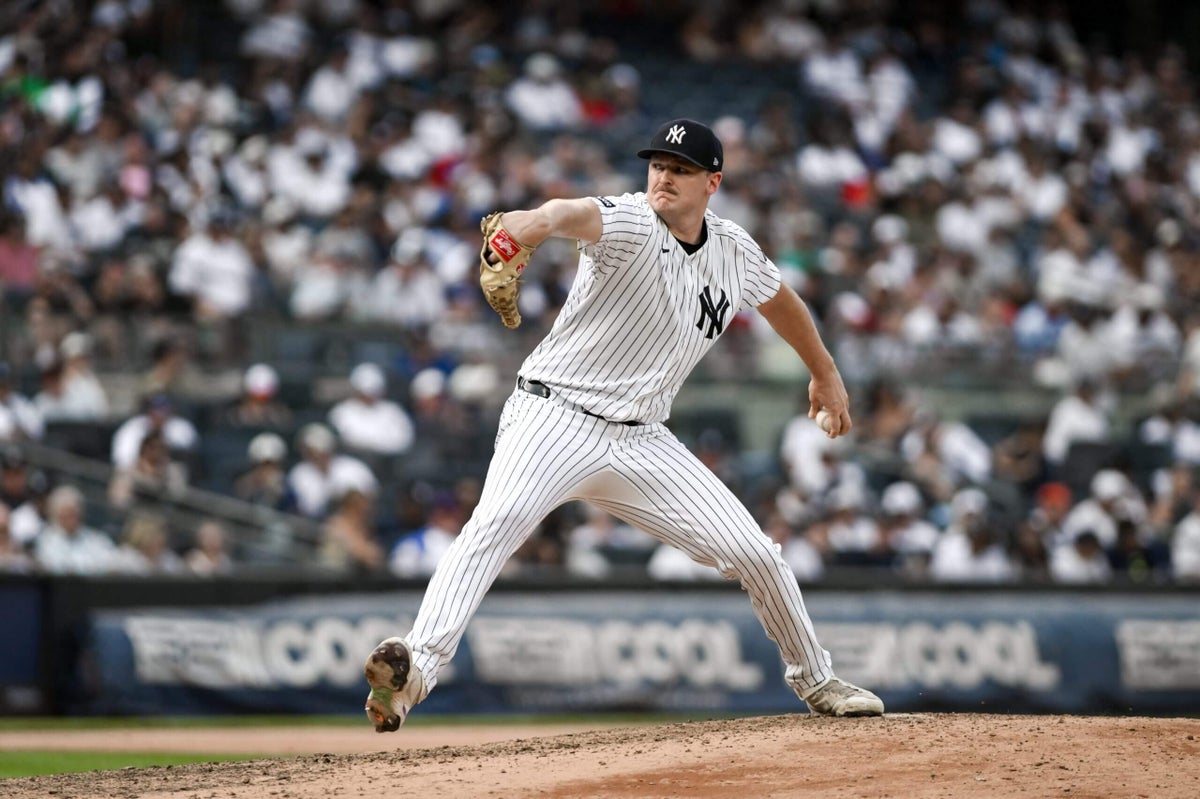
If you had told New York Yankees lefty Brent Headrick in spring training that he would be second in MLB in games pitched at this point in the season, he wouldn’t have believed you.
“The amount of appearances would have shocked me,” he said, “for sure.”
The Yankees have needed every one of Headrick’s 64 outings, especially since he’s used them to establish himself as one of the game’s most surprising and best bullpen options, with a 1.57 ERA over 63 innings.
But the Yankees’ ability to rely on Headrick has been a blessing for so long that it’s started to become a problem.
Headrick, a starting pitcher until late 2024, has never approached this many appearances in a season, and he’s on pace to pitch in 82 games. No Yankees reliever has worked as many as 80 games since Boone Logan in 2012. Only the Toronto Blue Jays’ Mason Fluharty (66 games) has pitched in more games this season than Headrick.
If the Yankees want the 28-year-old to remain the foundation of a bridge to closer David Bednar in October, they may need to take their foot off the gas.
“Obviously,” pitching coach Matt Blake said, “it’s a concern when you get to this volume of work. But it’s something we’ve just got to monitor down the stretch and be smart about trying to win every game versus trying to set ourselves up for October.”
Where old Yankee Stadium once stood, a decrepit park remains
Sam Blum and Johnny Sweet
It isn’t just Headrick, either.
Headrick is among four Yankees relievers with at least 50 appearances (Fernando Cruz, 58; Tim Hill, 56; Bednar, 51). Paul Blackburn, a starter for nine years until last season, is at 47 appearances and 69 innings.
The Yankees, however, may feel like they haven’t had a choice but to ride their most trusted arms — especially lately.
Their starting pitching has been excellent (an MLB-best 3.37 ERA on the season), but their offense has been bottom five in runs scored in the majors without Aaron Judge (first right rib stress fracture) in the starting lineup since June 2. Since that date, they are 34-31, and have played many close games.
“That’s the reality of our situation the last couple of months, where we have been playing these nip-and-tuck games every single day,” manager Aaron Boone said over the weekend in Toronto. “But obviously, you’ve got to balance that with the long-term health and potential success of your club, too. We’re on top of it as best we can be, communicating with them and trying to do what’s right in the here and now and keep the big picture in mind, too.”
Headrick is well aware of his workload. He said he feels great, though his recent numbers haven’t been sterling. In eight August appearances entering Tuesday’s 3-1 road win over the Baltimore Orioles, his 3.86 ERA was his highest in any month of this season. Against the Orioles, Headrick allowed the first two batters to reach base in the seventh inning. Then he recovered for two straight outs before Cruz rescued him, recording the final out of the frame.
Headrick attributed his ability to work so often to several factors. Bullpen coach Preston Claiborne and assistant pitching coach Desi Druschel have monitored his throwing between outings and often ask how he’s feeling.
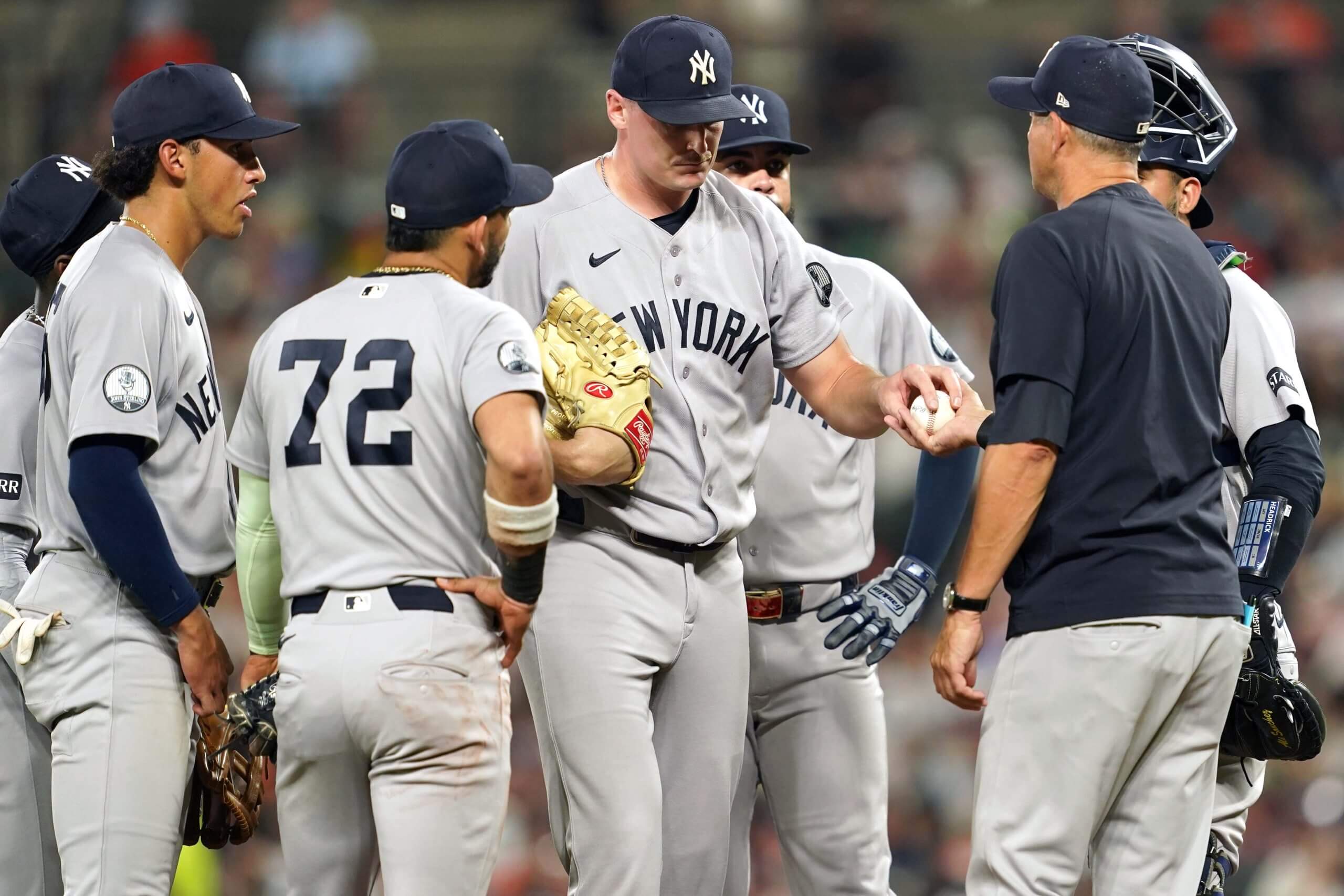
Manager Aaron Boone takes the ball from Brent Headrick in the seventh inning Tuesday. The lefty is on pace to make 82 appearances. (Mitch Stringer / Imagn Images)
The Yankees also don’t believe in pitchers simply keeping their arms loose with mindless throwing. They track everything.
“We monitor not only how much they throw,” Claiborne said, “but we incorporate the off days. Guys who have gone back to back may take a full day off (and) get full recovery, so they don’t throw as often — even in catch play, which has been a huge help to the health of our bullpen and keeping guys fresh.”
During pregame warmups, the Yankees arrange iPhones around the group of relievers playing catch to record and track the particulars of every throw, including velocity, using an app called Pocket Radar. That information then gets fed into a data model that advises pitchers on how much effort they should exert on a given day.
Headrick said he’ll often throw very little between outings, “eliminating the extra stressors outside of it as much as possible. All of my workload is coming from the game. But I’m still able to be built up and go out there with as close to the best version of myself as I can.”
“But no matter what the data says,” Headrick said, “it always comes down to how I feel.”
That was welcome news years ago to longtime MLB reliever Scott Proctor, who in 2007 was told by Yankees general manager Brian Cashman that he needed to be honest with then-manager Joe Torre about when he was too exhausted to pitch instead of just throwing on fumes.
Proctor pitched in 83 games with a 3.52 ERA for the Yankees in 2006. He pitched in 83 games again the following season, but the Yankees traded him at the deadline after 52 appearances to the Los Angeles Dodgers. Proctor made another 41 appearances for the Dodgers in 2008 but needed Tommy John surgery that wiped out his 2009 season. He retired after 2011.
“We didn’t grow up wanting to be an every-fifth-day guy,” said Proctor, now a 49-year-old private wealth advisor. “We grew up wanting to be an impactful guy. Your guys are on the field fighting every day to win, and you want to help.”
Blake said Headrick has been “amazing” for the Yankees this season and credited how the lefty “believes in himself and has gone out there and attacked.” He’s come a long way from when the Yankees claimed him off waivers from the Minnesota Twins in February 2025.
Headrick wants to pitch as often as he can the rest of the way, but he’s not oblivious.
“It’s crazy to think about how many appearances it’s been,” he said. “But nothing (in the past) matters. That’s all over with. Today matters, and when tomorrow comes, that’s what I’ll worry about.”
It’s up to the Yankees, though, to worry about all of it if they want Headrick to help them win a World Series.