
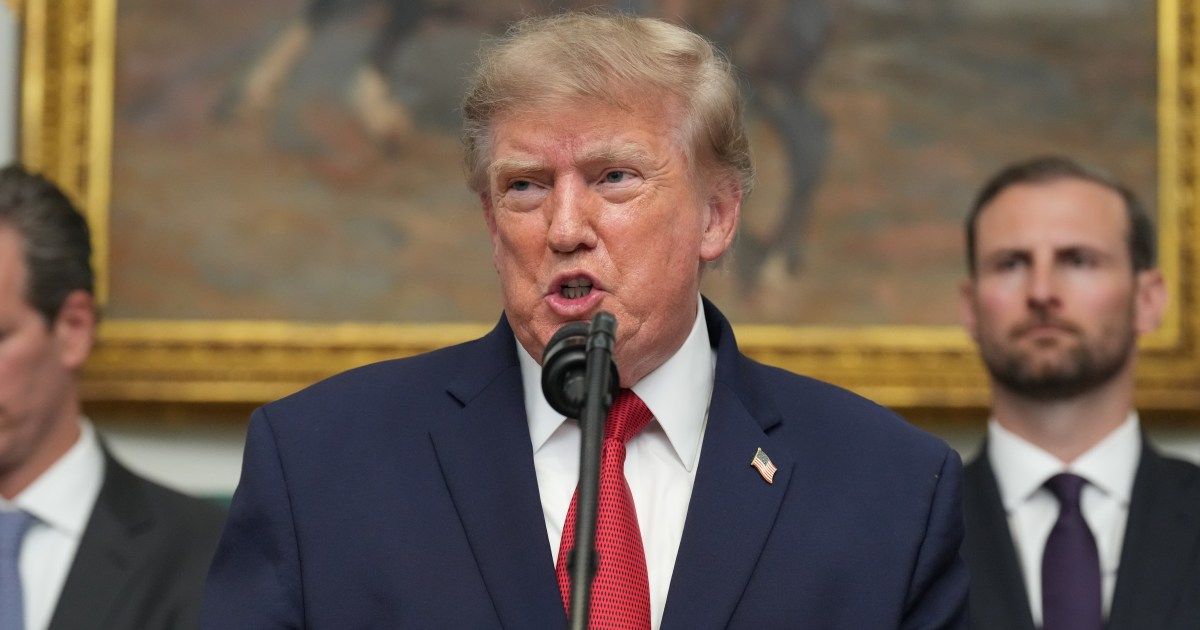
United States President Donald Trump has announced the “most crushing economic operation” against Iran, as talks aimed at ending the more than five-month war between the two countries remain deadlocked.
In a post on Truth Social on Wednesday, Trump said Iran has “failed to take” the opportunity to make a deal, and will be finished with “economic warfare and isolation on an unprecedented scale”.
Recommended Stories list of 4 itemsend of list
He also threatened sanctions against any country that does business with Iran.
“ANY country that allows its financial institutions, businesses, airports, or government entities to provide any type of lifeline to Iran will itself face TREMENDOUS Economic Consequences. Oil smuggling, swap lines, cash transfers, exchange houses, ship registries, front companies — it all needs to stop NOW. You know who you are. This will be an ECONOMIC D-DAY, and we need all of our Allies to stand with the United States of America to isolate, and defeat, the Iran threat,” he wrote.
This is not the first time that Trump has threatened Iran with economic sanctions.
His administration has waged a pressure campaign against Iran since April under the banner of Operation Economic Fury, designed to isolate Tehran and block its revenue streams.
The US has already imposed sweeping sanctions on Iran’s oil, shipping and financial sectors, seeking to cut off the revenue Tehran earns from energy exports. It has also imposed a naval blockade on Iranian ports and targeted companies, brokers and tankers accused of helping Iran sell its oil abroad.
‘Frustration’
There was no immediate response from Iranian officials, but Iranian media dismissed Trump’s announcement as nothing new.
The IRIB state broadcaster said it followed “the failure of military aggression” while the semi-official Tasnim news agency said the announcement was “not a new development, as the United States has been trying for years to block any financial and economic ties with Iran”. Iran, however, had “learned how to circumvent these restrictions and has become very skilled at doing so”, it said.
The semi-official Fars news agency also dismissed Trump’s claims as “delusional”, saying that the US had repeatedly voiced assertions of Iran’s “imminent collapse” and military destruction without delivering concrete results.
Al Jazeera’s Mike Hanna, reporting from Washington, DC, said Trump’s latest move showed “a degree of frustration” over the deadlock in the conflict, which began in February.
He said the first question is what economic pressures could Trump exert on Iran that are already not being exerted and said it may look like “another shouting threat” to the Iranian officials.
“But perhaps his target audience is an American public that continues to oppose this ongoing conflict,” Hanna said. “He is now taking what he hopes will be seen in the public forum as a very strong stance, regardless of the fact that we do not have specific details on which to judge the possible efficacy of this particular move to strengthen economic action against Iran.
The China challenge
Trump’s announcement came hours after the United Arab Emirates, a critical trade partner for Iran, suspended all financial ties with the country, accusing it of launching two ballistic missiles toward its waters.
Tehran denied the claim, calling it a “false-flag operation”.
Analysts said other Iran’s trade partners that Trump could target include China, as well as Iraq and Turkiye.
In China, “he can target the financial institutions that provide services to independent teapot refineries” that are “are the last group still purchasing Iranian oil,” said Nader Habibi, a Middle East economics professor at Brandeis University.
But, “the challenge is that the Chinese government has warned Chinese entities not to cooperate with US sanctions,” he noted. “Given that trade negotiations are under way between the United States and China, it will be interesting to see how China reacts if, in the next few days, the United States announces specific targets or institutions that cooperate with those teapot refineries.”
Habibi added that it would also be difficult for the US to fully enforce restrictions on Iran’s overland trade with Turkiye, Iraq and central Asia.
Brett Erickson, managing principal at Obsidian Risk Advisor, said the fact that the measures currently threatened by Trump had not already been used showed the risks involved.
“If they offered a risk-reward profile that was favourable for the Trump administration, they would have already been implemented,” he said.
Erickson said Chinese banks were “far and away the most consequential lever that Trump could pull”.
“On their own, I am skeptical that they would be able to snatch victory from the jaws of defeat, but combined with real enforcement of the UAE’s claim to cutting off business with Iran yesterday, that combination could become truly potent,” he said.
“The biggest constraint to all of this remains time. Economic warfare on Iran not only needs to produce results, they need to produce said results in an expeditious manner,” he added.