
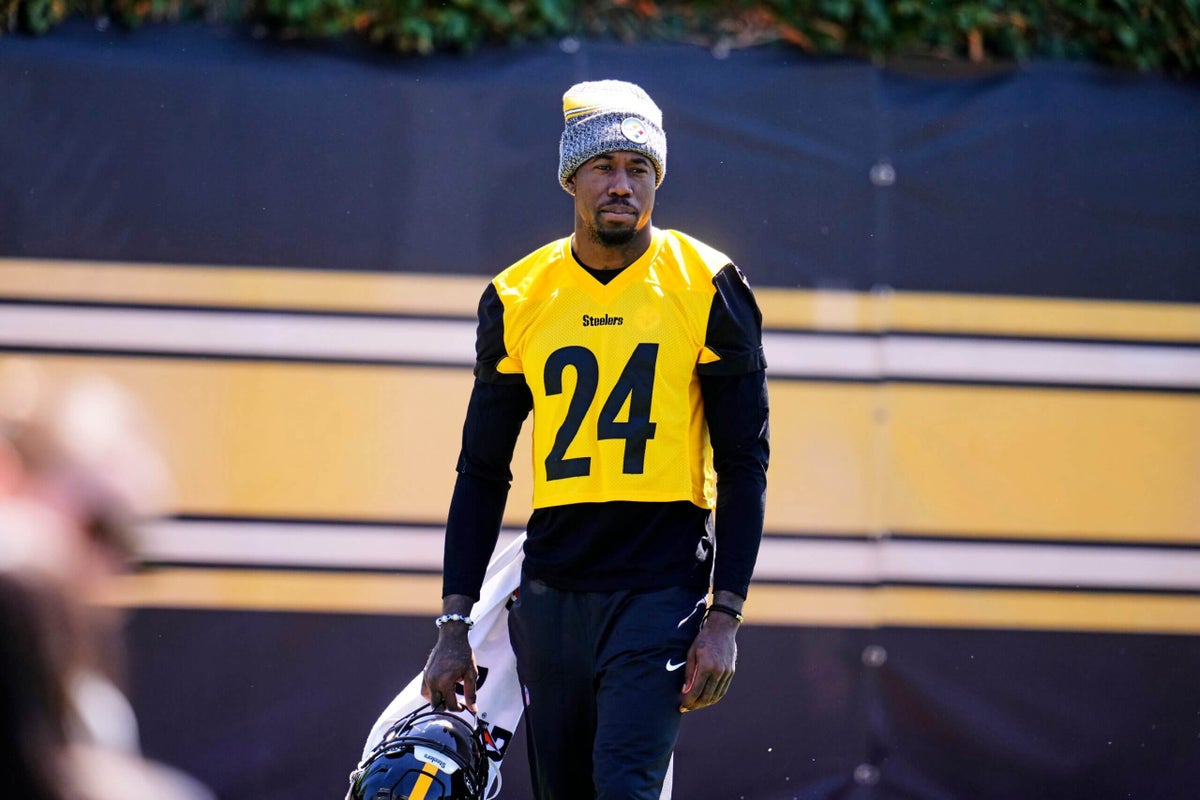
PITTSBURGH — Joey Porter Jr. may be on the physically unable to perform list, but Pittsburgh Steelers coach Mike McCarthy said the quiet part out loud Monday: It’s an unresolved contract dispute that has kept the cornerback off the field.
“We’re at an impasse right here, and you’ve got to respect that,” McCarthy said. “Every one of us has a contract. The organization, they have beliefs, and so forth. That’s just kind of where we are.”
Porter is entering the fourth and final year of his rookie deal. He began to bring attention to his contract situation by “holding in” during OTAs and mandatory minicamp. He was still present and involved in all meetings but chose to sit out the majority of drills. Porter reported to training camp, before which general manager Omar Khan did not identify him as a player who would start practices on the PUP list. Hours after Khan spoke, the team announced via social media that Porter had been added to the list.
“We need the whole secondary out there. They’ve got to pay Joey Porter,” said Jalen Ramsey, the seventh-highest-paid corner in the NFL with a yearly value of more than $24 million. “Joey needs to get compensated for being a valuable part of this secondary and a valuable part of this defense and team.”
The Steelers have already re-signed three members of their 2023 NFL Draft class — outside linebacker Nick Herbig (four years, $100 million), tight end Darnell Washington (four years, $42 million) and defensive tackle Keeanu Benton (four years, $72 million). Porter’s performance arguably makes him the member of that class most deserving of a new deal. That’s also part of what has made it a challenge to bring the two sides together amid a booming market for cornerbacks.
The salaries for top cornerbacks have skyrocketed recently. In September 2024, Denver’s Patrick Surtain II became the highest-paid defensive back in the NFL with a $24 million per year deal, just a few months before he was named Defensive Player of the Year. Over the past two seasons, seven other players have surpassed him. That includes five who now make more than $30 million per season: Seattle’s Devon Witherspoon ($33 million per season), Cleveland’s Denzel Ward ($31.1 million), the Los Angeles Rams’ Trent McDuffie ($31 million), Indianapolis’ Sauce Gardner ($30.1 million) and Houston’s Derek Stingley Jr. ($30 million). The market grew so rapidly that the Broncos had to add a sweetener to Surtain’s deal this offseason.
It seems like the market is getting pushed higher almost weekly. That will probably only continue. The New England Patriots have already expressed a desire to make Christian Gonzalez the NFL’s highest-paid cornerback.
Porter said during OTAs that he feels he has been an “elite” corner since he came into the league. His progress has been steady, but not always linear. In 2024, Porter was the NFL’s most-penalized defensive player, according to NFL Penalties, drawing 17 flags (three declined, two offsetting and 12 accepted). He cut the infractions nearly in half (nine flags, with six accepted) last year, and hasn’t allowed a touchdown in coverage since Week 8 of the 2023 season, according to Pro Football Focus, a span of more than 1,000 snaps in coverage. That’s by far the longest active streak in the league. Now he wants to be compensated like an elite corner.
The Steelers have some leverage as the negotiations hit a stalemate. Porter still has one more season left on his rookie contract. The team can also use the franchise tag next year to retain Porter’s rights in 2027 — a tool that is especially team-friendly given the rapidly changing market.
The cost of placing the franchise tag on a player for the first time is calculated using the average salary cap percentage for the top five salaries at that position over the past five years, scaled to the current cap. Because the cornerback market grew so precipitously and recently, the value of the franchise tag has lagged considerably behind the market for top corners. Over The Cap projects it would cost $23,119,000 to franchise-tag a corner in 2027. Even if the market hadn’t grown so rapidly, franchising Porter would have been more palatable because he has played at or near the top end of the pay scale.
The other part that makes this negotiation challenging is the new Steelers staff. Other than a handful of walk-through speed reps during OTAs, Porter has yet to practice for McCarthy’s staff, and never in pads.
“This is a challenge for both Joey and us, because we’re a first-year staff,” McCarthy said. “We’ve seen him play. I’ve competed against Joey. I would love the opportunity to coach Joey Porter. I know our defensive guys would love the opportunity.”
The Steelers have a long-standing policy that they do not negotiate contracts during the season, which adds a natural deadline. They do not negotiate with players who hold out. However, in the new world where players “hold in,” reporting to camp but not participating, the team has been unable to establish clear precedent. Outside linebacker T.J. Watt, wide receiver Diontae Johnson and defensive tackle Cameron Heyward all received new contracts while engaging in “hold-ins” or shortly afterward. Porter is following that established playbook. (Herbig also held in for a day during OTAs, but the Steelers gave him his money before it became an issue.)
The question is whether Porter will be another player who benefits from this tactic, or whether the new coaching staff and Khan will dig in their heels, knowing they can control Porter beyond this year with the franchise tag.