
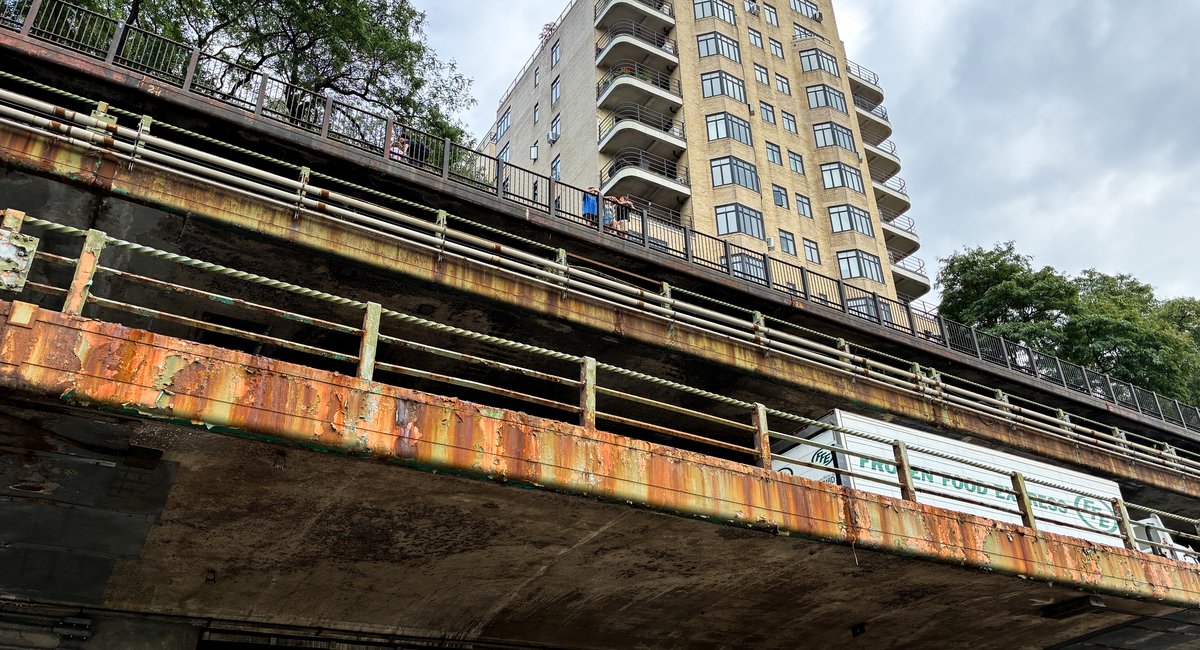
Mayor Zohran Mamdani’s plan to fix a crumbling stretch of the Brooklyn-Queens Expressway is already hitting some bumps in the road.
The mayor on Monday said the city will repair the highway’s dilapidated triple-cantilever structure in Brooklyn Heights by fully closing the roadway. But in order to handle the 130,000 vehicles that use the corridor each day, he plans to build a temporary highway on Furman Street that will run along the edge of Brooklyn Bridge Park.
Some community groups worried how the temporary highway would affect the waterfront park, which was just completed over the last decade. Others wanted the city to dismantle the triple-cantilever altogether.
”There’s nothing in this plan that moves us as a city away from the kind of long-discredited now, Robert Moses era status quo of these urban highways [like] the BQE, that continues to poison New Yorkers and really at the end of the day, privileges trucks and cars avoiding tolls on the New Jersey Turnpike,” said Lara Birnback, executive director of the Brooklyn Heights Association. She called the plan “depressing.”
Portions of the Brooklyn Heights promenade would be closed for construction of the temporary highway.
Stephen Nessen/Gothamist
Back in 2018, the Brooklyn Heights Association protested a plan pushed by then-Mayor Bill de Blasio to build a temporary highway along the promenade, which would have closed the sightseeing destination for six years. Deputy Mayor Julia Kerson on Monday said “this proposal does lessen the community impacts of prior proposals” because it would not require the full closure of the promenade.
Mamdani’s plan is expected to cost $4 billion and be completed by 2040.
Many Brooklyn Heights residents were willing to bite the bullet on a decade of disruptions if it meant the triple-cantilever were no longer filled with crumbling concrete and rusted rebar.
“ Have you seen lately when it rains, how bad the flooding is? I think someone has to do something. If you just leave it, it’s just gonna get worse, and you might lose the promenade and park access anyway,” said Jules Briody, 36, who has lived in Brooklyn Heights for three years. “I think it’s kind of necessary.”
Standing above the BQE on the promenade, other longtime residents like Colleen Boyeen, 43, said Mamdani’s plan sounded better than the 2018 version that would’ve closed the promenade.
“ Sure, the people in this neighborhood aren’t gonna like whatever happens, right? Because it’s gonna disrupt their life,” she said. “It’s a disgrace down there that’s crumbling. It’s patched up with wire. You can’t just cater to the people in the neighborhood as much as I would like it.”
In the coming months, the city transportation department will hold public meetings as it finalizes its plans. One of the biggest unanswered questions in the city’s plan is how Brooklyn Bridge Park will be affected by the temporary highway.
“Before this proposal moves forward, the city should be transparent about the full footprint and duration of construction, any proposed use of parkland, and the impacts on park access, noise, air quality, light, animal habitats and the berms,” Kathy Park Price, director of the advoacy group New Yorkers for Parks, wrote in a statement. “We urge the administration to work with communities to revise the construction approach so that we can safely rehabilitate the BQE while protecting, and ultimately improving, access to and the quality of our public parks.”
A previous plan to repair the BQE was torpedoed amid complaints that it would have closed the promenade entirely for an extended period.
Stephen Nessen/Gothamist
In 2023, the Brooklyn Bridge Park board warned the city against considering a plan to build a temporary roadway above Furman Street because it would alienate the parkland.
“The space between the existing highway and the park is still just the two lanes of Furman Street and one of those lanes is covered by the existing roadway,” the letter stated. “You have correctly described the challenge as being comparable to “threading a needle”, but the DOT has not yet shown any recognition of this constraint.”
The letter notes that the “basic geography has not changed” and that the community already widely rejected the de Blasio plan for a temporary highway during construction.
Local elected officials like City Councilmember Lincoln Restler, Assemblymember Jo Anne Simon and state Sen. Andrew Gounardes blamed former Mayor Eric Adams for not advancing the work, and said any more delay to repairs is “not an option.” They hoped the roadway could one day be taken down, but said that’s not feasible in the short term.
“Our hope is that this rehabilitation project will be an interim step that allows us to plan for a post-BQE era and create a real timeframe to finally retire this Robert Moses relic,” the lawmakers wrote in a joint statement.
The City Council will need to sign off on the project’s land use application — and seizing parkland for the work would require approval from the state legislature.
Birnback, who organizes Brooklyn Heights residents, criticized a video Mamdani published Monday to promote the project. In it, he literally picks up a can and says, “We’re done kicking the can down the road.” But Birnback said that’s exactly what the mayor is doing because the repairs are only expected to extend the roadway’s life by another 40 years.
”Does anybody really wanna see the BQE in the way it is now in our city in 2080?” she said. “That is a really long way into the future, and the idea that, you know, our grandkids, our great grandkids are going to be suffering under the same pollution and environmental degradation and economic, disadvantages that cutting our neighborhoods off from the waterfront brings in 2080, it’s really kind of depressing.”
This story was updated with additional responses from community members.