
By Crystal Hsu /
Staff reporter
Taiwan’s manufacturing confidence rose to a more than four-year high last month as the global artificial intelligence (AI) boom continued to drive orders for chips and related hardware, providing momentum for the export-reliant economy, the Taiwan Institute of Economic Research (TIER, 台灣經濟研究院) said yesterday.
The manufacturing climate index rose 2.48 points to 101.09 from the previous month, hitting the highest level in more than four years, the institute said in its monthly survey.
“Demand for AI, high-performance computing and new smartphone models boosted semiconductor shipments,” TIER Economic Forecasting Center director Gordon Sun (孫明德) told a news conference in Taipei.
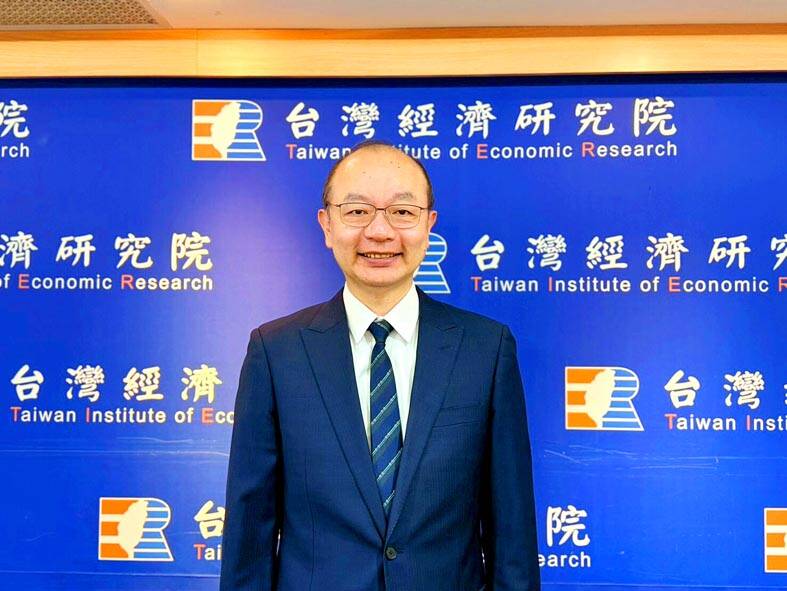
Photo courtesy of the Taiwan Institute of Economic Research
Exports and overseas orders also improved from the previous month, prompting more manufacturers to expect business conditions to improve, while the share anticipating deterioration declined, Sun said.
Electronics and machinery companies continued to benefit from global demand for AI chips and infrastructure, as well as preparations for new smartphone launches, he said.
Capacity utilization was high at advanced-process fabs, advanced-packaging facilities and high-end testing operations, Sun said.
Demand was also improving for power-management chips, high-speed transmission components, memory and silicon photonics, supporting mature-node manufacturing as well as testing and packaging businesses, he said.
The survey showed that more than 40 percent of electronics and machinery firms were optimistic about their outlook, he said.
Chemical producers also expect conditions to improve, helped by higher oil prices, inventory restocking by downstream customers and the resumption of some production lines, Sun said.
The improvement in the manufacturing sector contrasted with weaker sentiment in the services sector, with the services climate index falling 1.29 points to 98.2, ending a four-month run of gains.
Financial market volatility was a major drag on the sector, Sun said.
Securities firms were hurt by corrections in stock markets and trading volumes, while banks remained relatively steady as lending, wealth-management and credit-card businesses held up, he said.
Retailers provided some offset, benefiting from travel, hot weather and demand for daily necessities ahead of typhoons, he added.
The climate index for the construction sector rose 2.96 points to 110.55, extending its advance to a fourth consecutive month despite higher costs for construction waste disposal and building materials, the survey showed.
Demand from AI and information and communications technology companies continued to bolster the sector, TIER Taiwan Industry Economics Database director Arisa Liu (劉佩真) said.
“The overall momentum is strong,” Liu said, adding that construction activity is expected to continue growing over the next six months.