
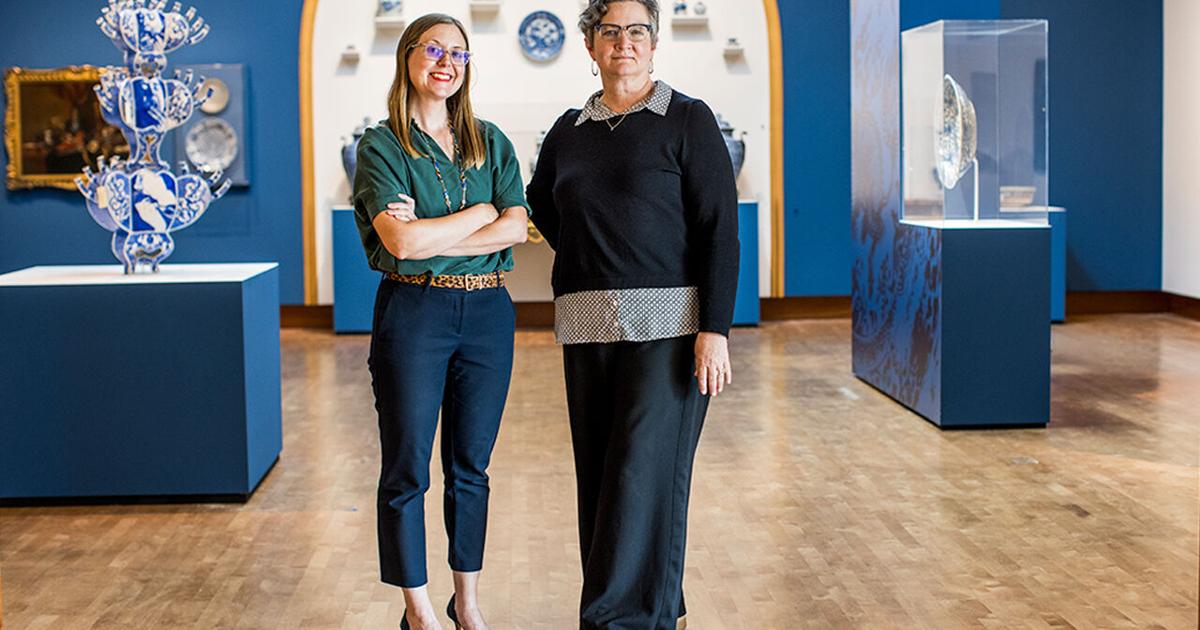
Katherine Alcauskas was riding her bike on Madison’s Cannonball Path a few years ago when inspiration hit.
Alcauskas, chief curator at Madison’s Chazen Museum of Art since 2019, had been working with Amy Gilman, the museum’s director, on finding a new and innovative way to present its collection.
They were frustrated by the familiar. The playbook for arranging museum galleries often calls for chronological order or thematic unity. As pandemic-era restrictions lifted, Alcauskas saw an opportunity to capitalize on the excitement around in-person museum visits. Now was the time for something entirely different. But what?
That day on her bike, the answer came to her. She texted Gilman: “I figured it out.”
“I was out there on my bike, and I just had this moment of letting go,” says Alcauskas. “Let’s focus on the artwork. Let’s make every gallery center on one of the wonderful pieces from our collection and unpack it over the course of the gallery.”
After three years of planning, Alcauskas and Gilman’s vision is becoming reality. The Chazen closed in May for a comprehensive reinstallation of its permanent collection. This fall, the museum will unveil its new look with a variety of celebratory events.

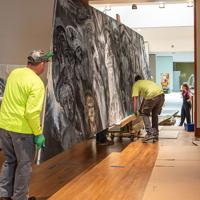
Photo courtesy of the Chazen
The reinstallation will feature 24 gallery spaces with an anchor object in each. The rest of the art in each gallery will connect to the centerpieces — and each other — in ways large or small, expected or not.
“A hub and spoke approach,” The New York Times noted in April, in a lengthy and admiring article on the Chazen’s new direction.
When I spoke with Alcauskas in May, the Chazen had just begun work on its first gallery reinstallation. The focus object is a John Steuart Curry painting titled “Wisconsin Farm Scene.”
“For that gallery,” Alcauskas says of the ancillary pieces, “we mainly focused on artists who were depicting Wisconsin or were residents of Wisconsin. It’s really a celebration of the multifaceted nature of the state and its different aspects.”
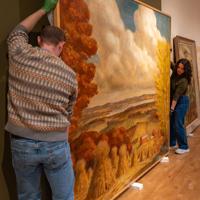
Photo courtesy of the Chazen
It wasn’t just Alcauskas’ bike ride epiphany that prompted the Chazen’s new approach. In 2020, in the wake of the murder of George Floyd, the city of Boston removed a public-facing sculpture by Thomas Ball depicting a formerly enslaved individual kneeling at the feet of Abraham Lincoln.
Ball made several versions of the statue, and the Chazen had one. Rather than remove it, the museum — working with artists, including New York-based interdisciplinary artist Sanford Biggers — chose to provide contemporary context with a new exhibit called “re:mancipation.”
It opened in 2023.
“Part of that exhibition,” Alcauskas says, “took the sculpture itself and broke it down into its pieces: What are the different things you’re actually seeing in the artwork?
“That was really the impetus,” she continues, “for this idea of why don’t we do a really deep dive into these individual objects and relate them to other things in the collection? ”
Another gallery in the redesigned Chazen will be anchored by “Vertical Beyond the Horizontal,” a mobile made by Alexander Calder, a sculptor known for his innovative mobiles and kinetic sculptures. The piece had previously been exhibited at ceiling height in the Chazen.
In the reinstallation, she says, “We’re going to install it quite a bit lower, so it’s in front of people, and they can really interact with it and see it in a new way. This is what the entire installation is trying to do: take pieces that have been on view before but present them in a different light so people might see them anew for a second time.”
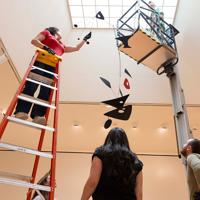
Photo courtesy of the Chazen
It’s been a season of change for the museum: The Chazen welcomed a new curator, Erica DiBenedetto, who arrived in April from the Museum of Modern Art (MoMA) in New York City.
DiBenedetto was acquainted with Alcauskas. Both women attended Williams College in Massachusetts, and Alcauskas had previously worked at the MoMA.
They would see each other at professional events, and at an art history conference in 2025, Alcauskas mentioned the Chazen’s long-standing commitment to contemporary African art, the museum having launched a major exhibition, “Insistent Presence: Contemporary African Art,” in fall 2023.
In DiBenedetto’s recent work for MoMA, she traveled to Africa several times to interview artists and examine archives and collections. Something clicked.
“It really put the Chazen on my radar,” DiBenedetto says. “When the job posting went public and it crossed my desk, so to speak, I thought this could be a really interesting place.”
At the Chazen, DiBenedetto will oversee art that is not on paper.
“My purview is painting, sculpture and decorative arts,” she says.
DiBenedetto is expected to guide student research and hire and mentor undergraduate and graduate students at UW–Madison.
In The New York Times article from earlier this year, the writer noted, “University museums, with their built-in audiences and collegiate context, may have a certain measure of freedom that helps enable the Chazen’s project.”
DiBenedetto is excited about the Chazen’s bold reimagining of its collection.
“It allows for a dynamic way of thinking,” she says, “about how you bring together the objects that you have in your collection and tell stories or histories or delve into themes. I think it also really encourages a kind of deep looking.”
That searching, DiBenedetto says, will benefit everyone.
“It’s critical for students as they encounter art, but also for anyone who comes through the Chazen. To really spend time discovering how one work can lead to all these potential connections to other ones that we have. There’s something really meaningful in that.”
Doug Moe is a Madison writer and a former editor of Madison Magazine. Find more by Moe in his web-exclusive blog at madisonmagazine.com/dougmoe. @dougmoemadison
COPYRIGHT 2026 BY MADISON MAGAZINE. ALL RIGHTS RESERVED. THIS MATERIAL MAY NOT BE PUBLISHED, BROADCAST, REWRITTEN OR REDISTRIBUTED.