
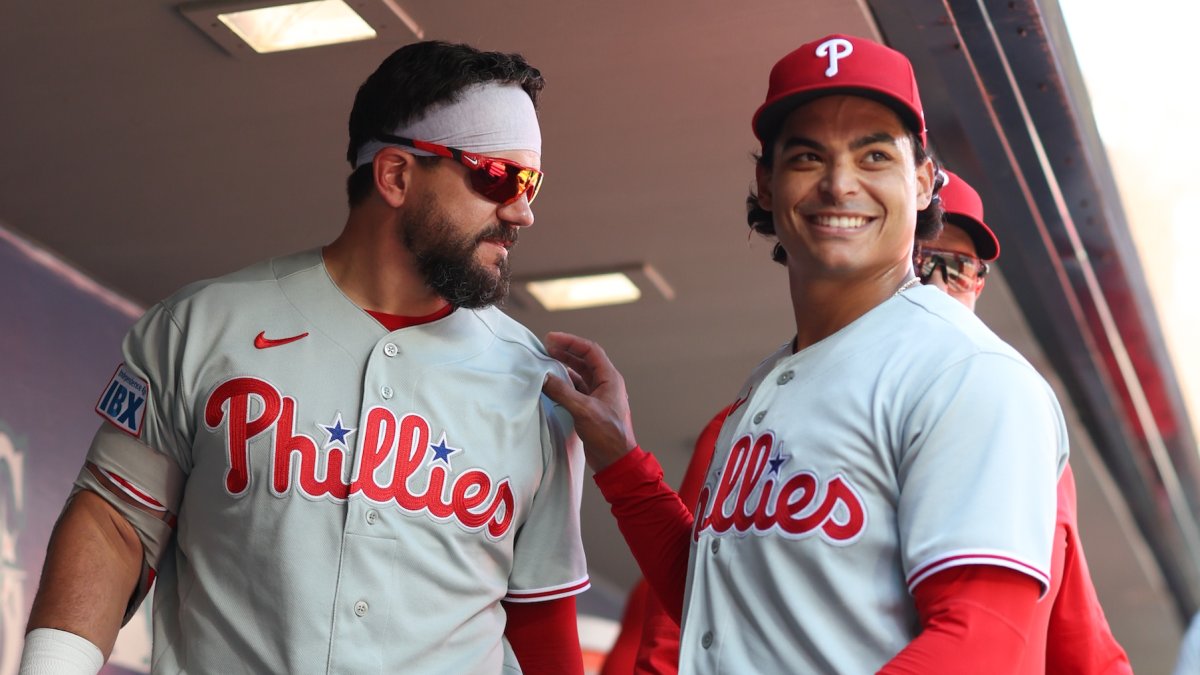
SEATTLE — Wednesday was a stamp on how important two Phillies are to the current state of the team, and to where it goes from here.
It was a benchmark afternoon against the Mariners.
Kyle Schwarber crushed his 40th homer of the season, the first by any hitter in the majors. Jesús Luzardo’s sixth strikeout in a nine-strikeout performance was his 200th of the season.
Both were central figures in an offseason built around a phrase that followed the Phillies for months:
“Running it back.”
There were always going to be changes, but the core was going to look similar. After two straight division titles and two other postseason runs, that should not have been viewed as a problem on its own.
But October exits bring fatigue. The same group can start to feel stale. The Phillies still believed there was enough here to keep investing, instead of watching either walk to another team either this year or next.
Schwarber signed a five-year, $150 million deal after reaching free agency following a 56-homer season. Luzardo signed a five-year, $135 million extension at the end of spring training, one year after the Phillies acquired him from the Miami Marlins.
For most of the late fall and early winter, there were rumblings that Schwarber would consider signing with his hometown Cincinnati Reds, among others, including the Boston Red Sox.
But the Phillies were going to do what it took to keep the slugger, who had already hit 40 homers in three of his first four seasons with the club.
“Splurging” on a designated hitter was warranted after they landed one of the better bargain deals in recent baseball history, signing Schwarber before the 2022 season for four years and $79 million.
Another 40-homer season in 2026 has validated not only the raise in average annual value, but also the willingness to lock up the designated hitter spot for years around an aging core.
The Phillies could have opened their checkbook for another bat, someone like Pete Alonso, who is now in Baltimore and having a strong season of his own, in Baltimore, with 32 homers, 91 RBIs and an .881 OPS.
But there were no guarantees.
With Schwarber, the Phillies knew the person, the production and the fit. And with Mattingly recently moving him back into the leadoff spot, where he hit so well during the Phillies’ 2022 pennant run, the lineup has a familiar jolt at the top.
Schwarber has 191 strikeouts this season, and how often do you even hear about that?
Sure, that is part of the evolution of the game. But he is almost the same exact player he was last year, which is hard to fathom for a 33-year-old slugger. That is why people say he has aged like fine wine.
In some ways, he is a better hitter now than he has ever been. If that aging curve holds, the path to 500 homers and a potential Hall of Fame resume is not crazy to discuss.
Schwarber’s 40th homer Wednesday was the 380th of his career.
Dick Allen, who was inducted into the Hall of Fame last year, became the first Phillies player to go in as a Phillie since Jim Bunning in 1996. Schwarber is not there yet, but the conversation is not as far-fetched as it once may have sounded.
He also understands what this is all supposed to lead toward. He was part of the 2016 Cubs team that ended a 108-year championship drought. In Philadelphia, an 18-year drought can feel like 50. That encapsulates the passion of this fan base.
Had Schwarber never gone to the Nationals in 2021, had he never carried that breakout into Boston later that year, maybe he would not have been as high-profile of a target when the Phillies were trying to rebuild their outfield around him and Nick Castellanos.
Maybe the Phillies would not have pushed to sign him before the lockout.
Now, he is tied to this window, and to Luzardo, through the end of the decade.
The Luzardo move was different.
The Phillies traded for him from a division rival last offseason, sending a package to the Marlins that included Starlyn Caba. It was a bet on power stuff, age and upside, but also on the idea that the best version of Luzardo was still coming.
Then they doubled down after a 32-start first season, instead of bringing back fan-favorite Ranger Suarez, who was far from durable.
Keeping Luzardo under a $30 million average annual value looked smart at the time. It looks even better now. If a salary floor is implemented in the next CBA, and Luzardo had reached free agency after his final year of team control, even smaller-market teams could have heavily been in the mix.
Especially with the way he is pitching right now.
Luzardo is 12-5 with a 3.09 ERA, the fifth-lowest mark among left-handed starters. What makes the full line more impressive is how uneven parts of the season have been. He has allowed five or more earned runs in six starts, giving up 35 earned runs in 31 1/3 innings.
Take those out?
A 1.44 ERA in his other 21 starts.
That is the type of pitcher the Phillies believed they were getting. And lately, they have gotten even more than that.
And Phillies’ interim skipper Don Mattingly has seen a different version of Luzardo before. He managed him in Miami, when the raw ingredients were obvious, but the consistency was not.
Now, the growth is clear.
“That was our main thing in Miami, was get him in the strike zone,” Mattingly said. “Stuff was kind of the same then as it is now. Obviously, more experienced, more polished, but it was just getting him in the strike zone. We knew if we got him in the strike zone, the swing-and-miss would be there. Everything would be there.”
Everything has been there for a while.
The biggest separator has been the sweeper, the pitch Luzardo worked with Caleb Cotham to add before the 2025 season.
This year, opponents are batting .117 against it, the second-lowest average in baseball against any qualified pitch. Its 47.9 percent whiff rate is the highest of any pitch thrown by a left-handed starter.
Schwarber got a pretty good look at it during the Phillies’ Red October intrasquad game last year.
It did not go well.
“People were letting me hear it for punching out off him, I’m like, ‘Yeah, it’s hard,’” Schwarber laughed. “It’s such a unique pitch for him. It doesn’t really feel like a traditional kind of sweeper. It just looks like a ball coming at you, and you don’t really see much spin. You don’t really see an indicator to let you know that it’s a breaking ball. And it just kind of hits another gear and goes off.”
That pitch has changed everything.
It has given Luzardo a true swing-and-miss weapon, one that can change how teams prepare for him. It also opens the door for the rest of his arsenal when hitters start hunting it.
“I feel like the execution’s almost gone up to another level for him,” Schwarber said. “He’s not just out there trying to feel his way through. I feel like he knows what he wants to do out there, and he’s executing it.”
That is the difference between having stuff and having command of a game.
Luzardo has always had the stuff. The Phillies paid for what they believed it could become. Now, he looks like one of the left-handed starters who can shape October, not just survive it.
And that is the larger point.
None of this means much to Schwarber or Luzardo if the Phillies do not finish this season with a World Series championship. They are not paid to reach milestones in August. They are paid to carry the club when the games get heavy.
But it is too narrow to think the Phillies’ window closes after this season.
Part of that is payroll. Part of that is the remaining core. Part of it is also the work Dave Dombrowski did before and after the last few postseason exits.
The original Schwarber signing helped open the door to a pennant run. The Luzardo trade gave the rotation another power arm.
The extensions made both long-term Phillies and more shots at a championship.