
The Necklace Nebula: A Cosmic Jewel in the Arrow
Dear readers, faithful companions of the lantern and the basketball,
Before I tell you of a jewel lost in the immensity, allow me to introduce you to my most beautiful stars. You already know my tribe a little, but tonight I want to tell you about them with the pride of a happy man. Jocelyne, my wife, my childhood love, is the most beautiful of constellations. Her gentleness, her strength, her light brighten every one of my days. Jessica, our eldest daughter, dances classical dance with a grace that takes my breath away. She is elegance itself, a living arabesque. Wendy, for her part, is a brown belt in karate. A warrior, a little volcano of determination, who backs down from nothing, and whom I must be careful not to provoke (lol). And then there is Charly, my boy. He has resumed training to prepare for the 2026-2027 season, hoping one day to wear the colours of the HC Bienne / Biel next generation. He is studious, very athletic, and he dreams of becoming a professional player. I am very proud of him, just as I am proud of each of my daughters and of the woman who shares my life.
 Private foto
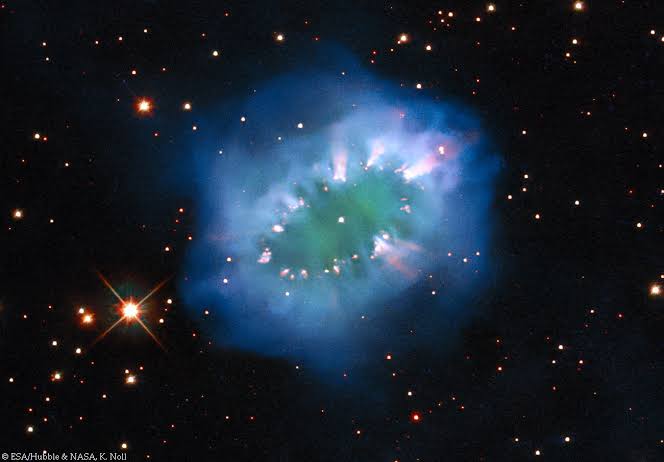
Now that you know my stars, let me show you the one shining fifteen thousand light-years away. There are nights when the sky shows us flowers, bubbles, pillars. And there are nights when it shows us a jewel. Tonight, I want to speak to you of a gem lost in the immensity, a ring of light delicately laid upon the black velvet of the cosmos. A necklace. Not one worn by queens and princesses, but one shaped by a dying star, sculpted by gravity and stellar wind. Tonight, we speak of the Necklace Nebula.
1. A Jewel in the Constellation of the Arrow
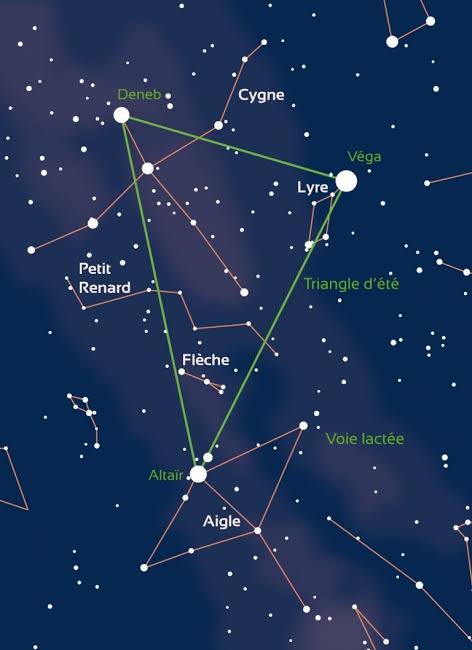
It hides in the small constellation of Sagitta, the Arrow, not far from Aquila and Cygnus. A modest, discreet constellation, unknown to many gazes, yet it holds this treasure. The Necklace Nebula, catalogued as PN G054.2-03.4, is a planetary nebula, a bubble of gas and dust blown by a star at the end of its life. But unlike most of its sisters, it is neither round nor elliptical. It is an almost perfect ring, a circle of fire and light, dotted with bright knots like pearls.
 ESO.org
Its distance is estimated at about 15,000 light-years. Its apparent size is tiny: barely a few arcseconds. It takes the sharp eyes of the Hubble Space Telescope, or ground-based instruments equipped with adaptive optics, to reveal its structure. And when you see it, you understand why it bears this romantic name. It is a necklace of cosmic diamonds, suspended in the void.
2. The Tragic Dance of Two Stars
But this jewel was born of a drama. At the heart of the Necklace Nebula hides a pair of stars, so close to one another that they orbit each other in just over a day. They are two solar-type stars, or nearly so, sharing an infernal existence. One of them, nearing the end of its life, swelled into a red giant. As it swelled, it engulfed its companion, or at least drew so close that the two stars began to orbit within a common envelope of gas.
This close dance had a spectacular consequence. The matter of the red giant was ejected into a dense ring, a torus of expanding gas. Within that torus, instabilities condensed into knots, clumps of denser gas that shine more brightly than the rest. It is these knots that trace the pearls of the necklace. Each pearl is a fragment of the dying giant, frozen in space, illuminated by the ultraviolet radiation of the two central stars.
It is a rare phenomenon. Binary planetary nebulae like this one are laboratories of choice for understanding how stars interact at the end of their lives. They show us that the death of a star is not always solitary. Sometimes, it is danced by two.
3. The Image That Moved Astronomers
The first detailed image of the Necklace Nebula was taken by the Hubble Space Telescope in 2011, as part of a survey of binary planetary nebulae. Astronomers were struck by the regularity of the ring and the sharpness of the knots. It is one of those images that remind us that the universe can craft jewels without a jeweller, sculptures without a sculptor.
Hubble’s images show an almost perfect ring, slightly tilted, with bright knots arranged along its perimeter. The whole is bathed in red and blue light, depending on the filters used. It is a lacework of gas, a fragile treasure, that will dissipate in a few tens of thousands of years.
4. The Watchman’s Lesson
Dear readers, the Necklace Nebula teaches us that beauty is sometimes born of the most violent encounters. Two stars, trapped in a deadly embrace, gave rise to one of the most delicate ornaments in the sky. It is a story of love and destruction, of closeness and loss.
It also reminds us that the universe is a goldsmith. It shapes rings, spirals, pillars, flowers, bubbles. And we, with our telescopes, discover these jewels one by one, like children opening an infinite jewellery box.
I set down my lantern. It flickers gently, like a pearl of light on an invisible thread. The basketball is in its place. And I think of those two stars, out there in the Arrow, still dancing their suffocating dance, entwined for better and for worse. Their necklace still shines. We are lucky enough to see it.
5. Observing Guide
For amateur astronomers equipped with large telescopes, the Necklace Nebula is a challenge. Its apparent magnitude is very faint, around 16, and its small size makes it difficult to distinguish from nearby stars. But with a 400-millimetre instrument, a perfectly dark sky, and an OIII filter, it is possible to glimpse it as a small blurry patch.
Constellation: Sagitta (the Arrow)
Right ascension: 19h 43m 59s
Declination: +17° 09′ 00″
Apparent magnitude: around 16
Distance: about 15,000 light-years
Recommended filter: OIII
The Necklace Nebula, that jewel so fragile and so distant, still shines for us. The lantern is full, and the sky never ceases to amaze us.
François
he Most beautiful Nebulae of UniversesThe Most Beautiful Galaxies:Various StoryA Prayer for Mercy and JusticeEpisode 1: The Crab NebulaEpisode 1, The Milky Way, Our Island of LightOnce upon a time: The Birth of a StarBlack Holes, Sagittarius A*, Multiverses and Time Travel: The Truth Behind the MythEpisode 2: The Eagle Nebula and The Pillars of CreationEpisode 2. Andromeda, The Great Sister Coming Toward UsThe Mirage of MarsIf the Yankee Weren’t thereEpisode 3 : The Carina NebulaFrascati neat Roma, Death from the SkyThe Grand Tour and the Three-Body Problem — Journey to NeptuneEpisode 4: The Helix NebulaDefending Earth Against Asteroids and Fascists, When Ignorance Has Its Finger on the Nuclear ButtonHistory of Astronomy and Obscurantism Ancient and ModernEpisode 5: The Horsehead NebulaOnce Upon a Time: The Death of a StarThe Idiotic Trumpian War on ScienceEpisode 6: The Veil NebulaThe size of The UniverseRenewable energy, The Sun and Nuclear FusionLetter to a Climate SkepticOf Stars and Bombs: Why Trump’s Fascism Threatens My Profession, My Employer, and My CountryClimate Skeptics: Letter to ObsidiaThe Time of CreationThe Lantern and the Ruler: How we Measured the UniverseWhy the Universe Cannot Be an AccidentExoplanetThe Lantern at the Edge of Infinity, Gravitational Lenses, Dark Energy and the Mystery of ExpansionCold: A Symptom of Global WarmingBlaming Biden? Enough is Enough!Whe the Universe opened hits Eyes