
Nancy Grace Roman Space Telescope to launch from Florida’s Space Coast
 MERRITT ISLAND, Fla. —
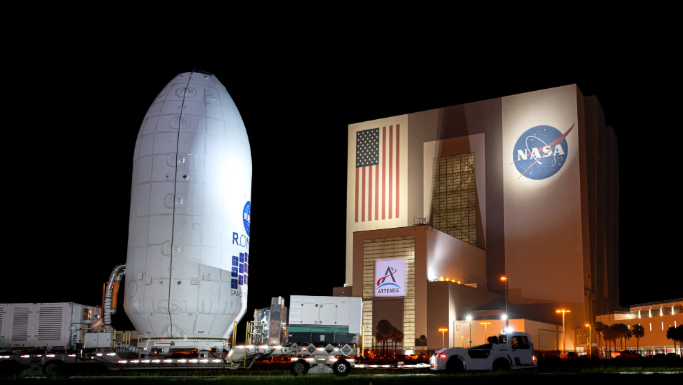
The Nancy Grace Roman Space Telescope is set to launch from Kennedy Space Center on Florida’s Space Coast at 7:26 a.m. on Sunday.
The telescope will travel to space aboard a SpaceX Falcon 9 Heavy rocket from Launch Complex 39A.
>> WESH 2 will stream the launch live in the video player above.
According to NASA, the telescope aims to answer “essential questions in the areas of dark energy, exoplanets and astrophysics.”
The telescope traveled from the Payload Hazardous Servicing Facility to the SpaceX hangar at Launch Complex 39A at NASA’s Kennedy Space Center on Tuesday, Aug. 25.
What is the Nancy Grace Roman Space Telescope?
The telescope is named after NASA’s first chief astronomer, the “mother of the Hubble Space Telescope.”
It’s a new telescope that will be able to capture more of the night sky than ever before.
Work on the project began in 2016, and Roman is expected to launch from the Space Coast in September, making it both ahead of schedule and on budget.
The hope is that the telescope will give astronomers a better view to piece the universe together.
What is the difference between the Roman, Webb and Hubble telescopes?
The Roman space telescope isn’t intended to replace the previously launched Hubble Space Telescope and James Webb Space Telescope. Instead, it will supplement and work together with them for further exploration of space.
The Roman telescope has a field of view at least 100 times larger than the other two telescopes’ fields of view, making it a lot easier to survey the sky.
Thinking about it like photography, the Roman telescope is like a panoramic lens showing the entire landscape, according to Ori Fox, Roman Space Telescope Deputy Project Scientist at the Space Telescope Science Institute.
“Once you see something in that landscape that’s interesting, you can then zoom in,” Fox said. “But you need a zoom lens. That zoom lens is your Hubble or Webb.”
The Hubble telescope supplements the surveying work done by the Roman by having the ability to look closer at targets with ultraviolet, some visible and near-infrared light.
The Webb telescope also functions like a zoom lens, except it can see red to mid-infrared light, allowing the oldest galaxies to be viewed.
What is the Roman telescope looking for?
The Roman telescope has a few primary objectives, including studying dark energy, finding and identifying planets outside of the solar system, and surveying the sky.
The Hubble telescope, in its 35 years of operation, has observed about 0.1% of the night sky, while the Roman telescope will observe more than 12%.
The large amounts of data collected from the Roman telescope will also become available to anyone without a proprietary period as soon as it’s processed, according to Fox, which was not the case for the Webb and Hubble telescopes.
“We really hope that these datasets will be so expansive and wide that beyond the primary questions that we’re trying to answer, you’ll be able to answer a whole slew of other questions,” Fox said.
Editor’s note: The Hearst National Desk contributed to this reporting.