
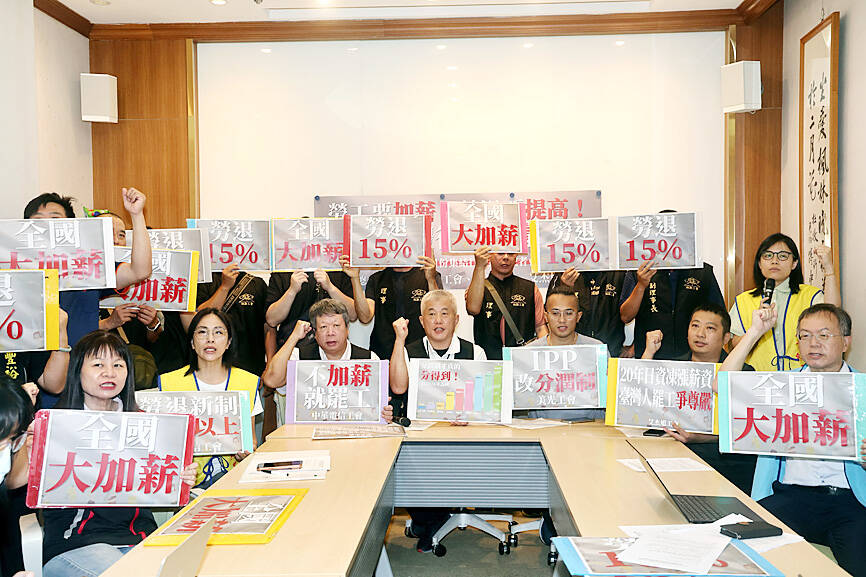
Labor groups yesterday called on the government to raise employers’ mandatory pension contributions to 15 from 6 percent, arguing that workers have not received a fair share of Taiwan’s economic and productivity gains.
“Over the past two decades, Taiwan’s workers have created greater economic value almost every year than they did before,” Taiwan Solidarity Front Confederation of Trade Unions chairman Ho Cheng-chia (何政家) said at a news conference at the Legislative Yuan in Taipei.
“But the additional profits they generated have not been reflected in their compensation,” Ho said, citing a report last month by think tank Taiwan Political Economy Collaborative that found that the productivity-pay gap had widened further after 2023 with the growth of artificial intelligence.
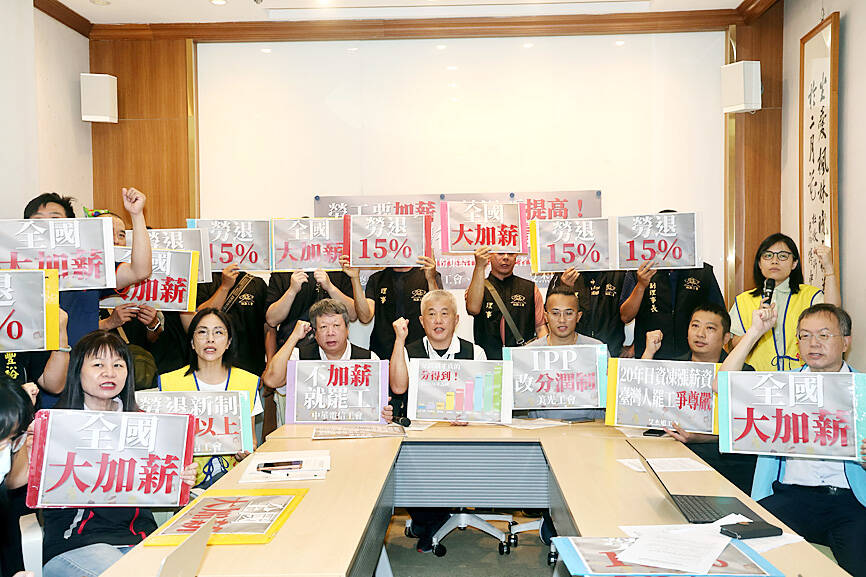
Photo: CNA
If the government really wants to address the problem of corporate profits not being fairly distributed to workers, “the most direct way is to raise employers’ pension contributions,” Ho said.
He was referring to Taiwan’s new labor pension system, introduced in 2005.
The new system covers about 7.7 million workers, with employers required to contribute at least 6 percent of a worker’s monthly wage to an individual pension account.
In contrast, under the previous system, employers set aside 2 to 15 percent of wages, depending on factors such as seniority and expected retirement, in a pension reserve fund.
Citing a National Audit Office report, Ho said that employers contributed an average of just 6.04 percent last year, which he said showed that most employers were contributing only the statutory minimum.
The labor groups called on the government to raise the minimum rate, which has not been changed since 2005, to 15 percent.
Chunghwa Telecom Workers’ Union chairman Teng Ke-lien (鄧克廉) said that increasing pension contributions could serve as a form of deferred pay raise for workers.
“The money is simply received later, and it can provide substantial protection for workers after retirement,” Teng said.
The groups also called for the government to help secure meaningful wage increases across state-run, foreign-invested and domestic private companies, saying that increases would do more to address long-term wage stagnation than a proposed universal NT$10,000 cash handout next year.
However, the groups did not specify a target wage increase, saying it would depend on the industry and individual companies.
Organizers said some unions are preparing or holding strike votes over labor disputes while more than 30 labor groups have backed the demands raised at the press conference and are discussing a broader Taipei mobilization in October over wages, pensions and labor rights.