
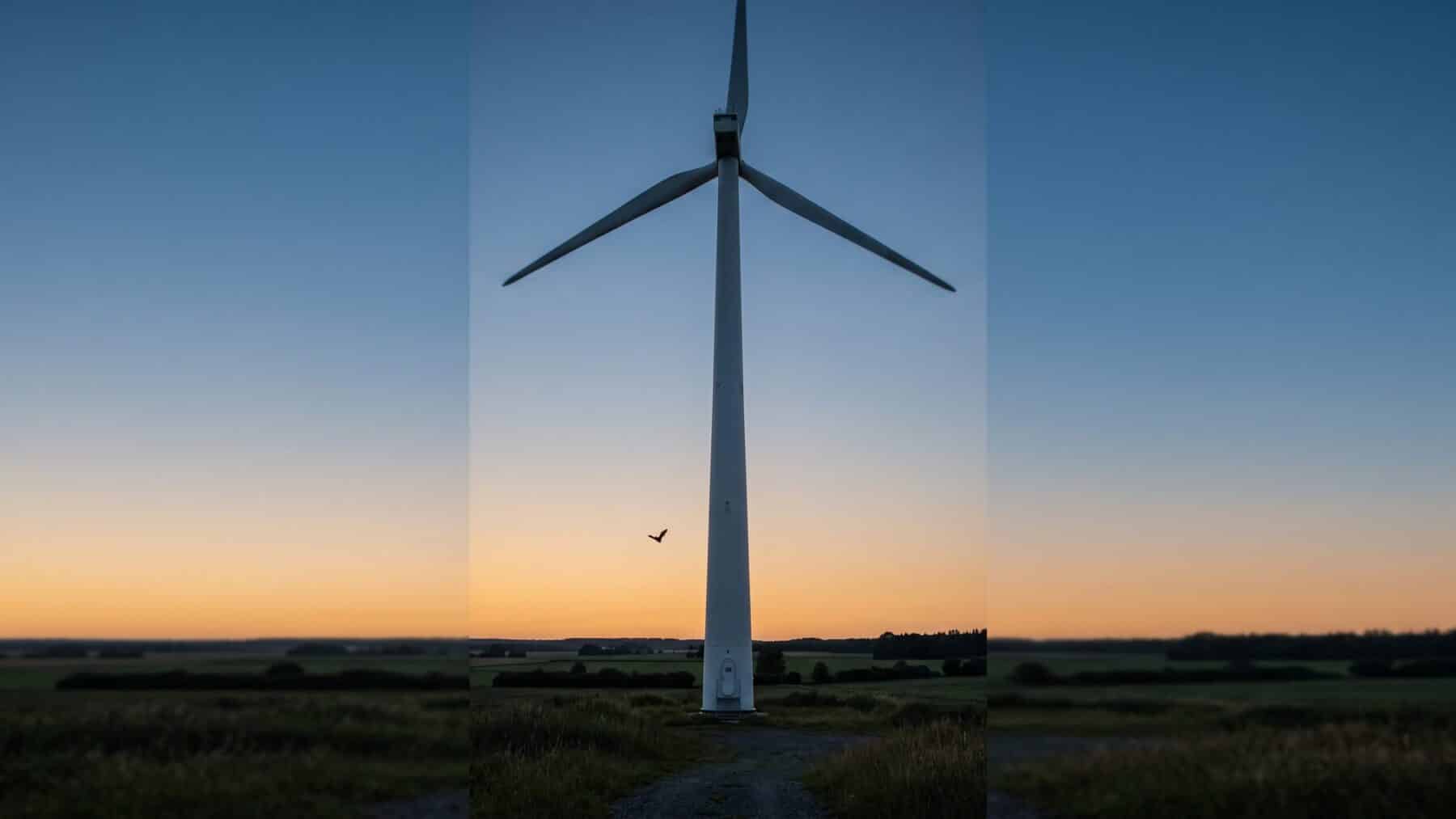
Every autumn night across central Germany, something climbs a wind tower that was never designed to receive it.
A bat, singing.
Then another, and another, circling the housing at the top while broadcasting calls that carry hundreds of feet across open farmland.
They logged 4,468 positions within 200 feet of the nacelle and 1,489 within 100 feet, with density falling off exponentially as distance grew.
The machine was built to capture kinetic energy from moving air.
Its structure has become something else entirely.
So what makes a tower full of turning blades a place a bat wants to be?
Why a steel tower reads as an address
Males of several bat species use prominent vertical features in the landscape as song posts.
They circle them while broadcasting courtship calls designed to carry as far as possible, because the point of the display is to be heard by females that are not there yet.
Height is the whole strategy.
In flat agricultural country, where most German wind farms sit, a turbine standing 400 or 500 feet tall is the tallest object for miles and the most conspicuous landmark in any bat’s acoustic neighborhood.
That is the catch.
What looks from the outside like a bat approaching a hazard is, from the bat’s side, a male advertising the best address available.
The tower does not merely sit in his territory.
It has become the center of it, and the most dangerous slice of air anywhere near it is exactly where the blades curve.
The slice of air where the singing happens
A modern rotor sweeps a disc more than 400 feet across.
The tips of those blades travel at highway speeds and faster, while the air just behind them drops in pressure sharply enough to injure a small animal that never touches anything.
Related
The housing at the hub sits in the middle of that disc.
Anything circling the nacelle at close range is therefore flying inside the swept zone by definition, not near it.
A bat holding station there is doing something that would be entirely safe on a church spire or a tall poplar.
The behavior is old.
The structure it is now being performed on is eighty years newer than the behavior, and it moves.
What the recordings and the cameras found
Microphones sat at nacelle height on 22 turbines across six German sites, covering 26 turbine years in total.
They captured 107,950 recordings, of which 83,292 held bat calls.
Inside those, researchers isolated 92 distinct song events averaging about 17 seconds each.
Seven species were singing: noctules, Leisler’s bats, three pipistrelle species, the parti colored bat and long eared bats.
Those seven account for 95 percent of recorded German bat fatalities at turbines.
Song turned up in 23 of the 26 turbine years, peaked between July and September, and was dominated by the common noctule at 41 percent of events and Nathusius’ pipistrelle at 24 percent.
Two thermal cameras then ran 30 hours of stereo recording over six nights at four turbines, reconstructing bat positions in three dimensions.
They logged 4,468 positions within 200 feet of the nacelle and 1,489 within 100 feet, with density falling off exponentially as distance grew.
What the study does not settle
The acoustic data were gathered more than a decade ago, at turbines of that generation.
Rotors have grown since, and whether a larger machine reads the same way to a singing male is untested.
Related
The carcass figures usually quoted alongside this are also a separate piece of work: 209 dead bats found under three unregulated turbines west of Berlin across August and September, roughly 70 per turbine in two months.
Three machines is not a national sample, and the authors of that count said so themselves.
What links the two is that around three quarters of Germany’s onshore fleet still runs without any bat curtailment program at all.
And curtailment, where it exists, keys on wind speed and temperature, not on the calendar of a mating season.
What would actually have to change
The practical implication is narrower and more awkward than a general slowdown.
Song peaks in late summer and early autumn, which in Germany is a comparatively calm stretch, so much of it already falls inside the low wind thresholds operators use.
The expensive part is the autumn tail, when output and prices are both climbing.
Deterrents are the other lever, and ultrasonic hardware already exists that jams echolocation near the blades.
Whether it also masks bat mating calls, or simply makes the singer work harder to be heard over it, nobody has tested.
One detail from the new study sharpens all of this: if males are singing at the tower, the animals arriving are disproportionately female.
That fits the sex ratio already seen in the bodies collected underneath, as the announcement pointed out.
A hazard that removes breeding females is not the same as one that removes animals.
Editor
Hugo is an engineer with strong technical expertise. Multilingual from an early age, his writing combines technical clarity with a strong interest in science and energy.

Hugo is an engineer with strong technical expertise. Multilingual from an early age, his writing combines technical clarity with a strong interest in science and energy.