
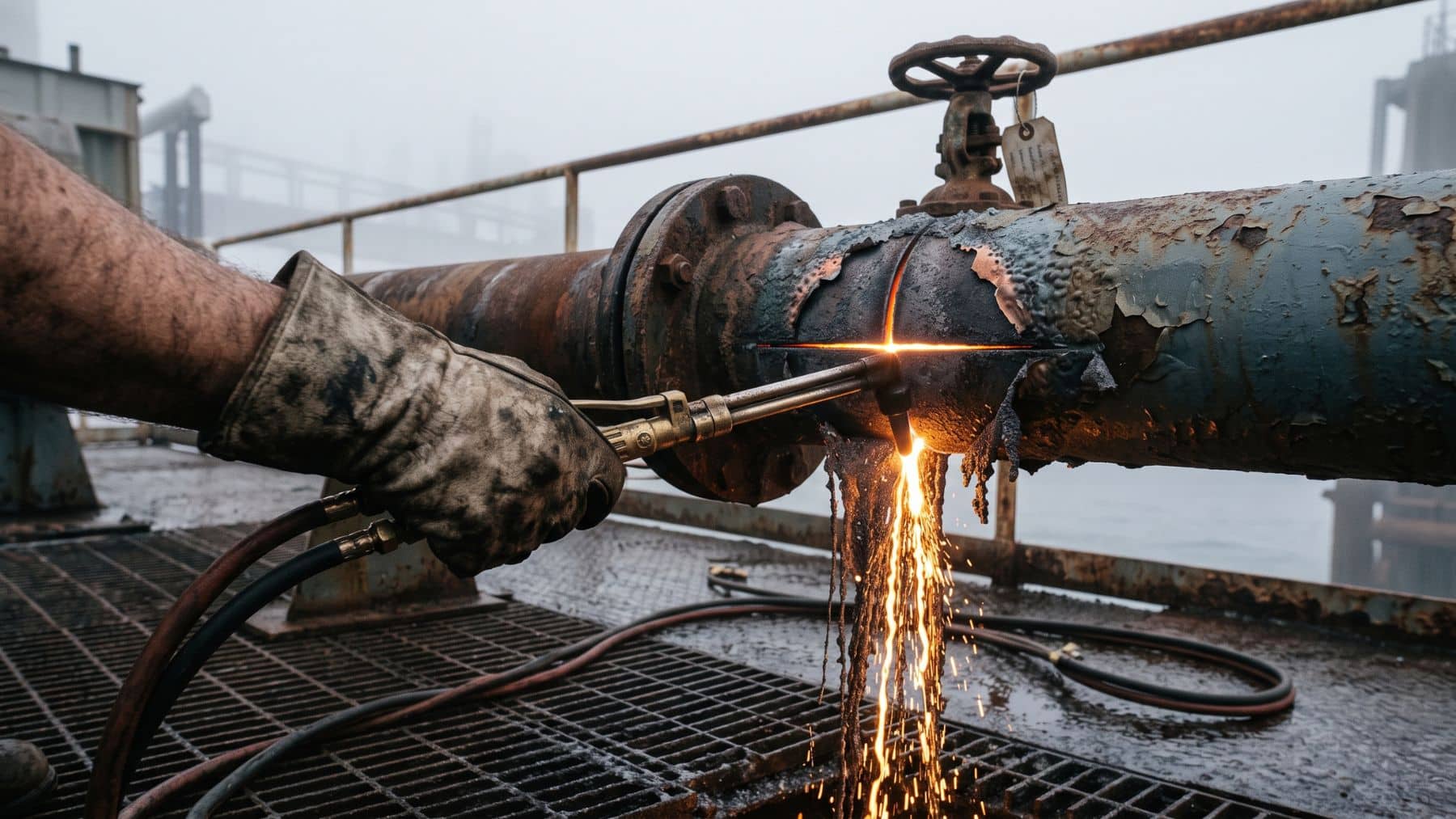
Torches were already lit on the upper deck when the shift settled in.
Fog sat on the channel thick enough that nothing was going to fly that morning.
The structure underneath the crew had not sold a cubic foot of anything in ten years.
The Coast Guard worked it from the water alongside county and city fire departments and the harbor patrol, with a 1,000 yard exclusion zone held around the platform.
It was a demolition site at that point, not a producer.
At half past six the gas found the flame.
Which raises the question nobody asks about a platform that is finished. Where was the gas coming from?
Why a platform that stopped producing is still full
Shutting a well in is not the same as emptying it.
A shut in well has valves closed on a column that still carries whatever pressure the formation puts behind it. The reservoir does not know the lease expired.
Above the seabed the same holds for the hardware. Production tubing, the annular spaces between casing strings, headers, separators and every run of pipe between them carried hydrocarbons under pressure for decades, and closing a valve traps what is inside rather than removing it.
Purging each of those volumes is a separate job with its own paperwork, and a complex topsides can hide more pockets than an isolation checklist has lines.
Then teardown brings the other half of it.
Cutting torches and welding gear are how a platform comes apart. They are also open flame, and a working platform keeps open flame and open hydrocarbons on opposite sides of a hard boundary.
Mid demolition that boundary is a permit, which is a piece of paper describing what somebody believes is isolated.
The structure they were taking apart
Platform Habitat stands in about 290 feet of water on the Pitas Point Unit, roughly eight miles off Summerland in the Santa Barbara Channel.
Related
It went in during 1981 and started producing in 1983, and it was the only gas platform off the California coast, every other one out there pumping oil.
Across its whole working life it delivered a little over 232 million cubic feet of gas and fewer than 250,000 barrels of crude, a modest total for four decades of steel standing in open water.
Its federal lease ran out in March of 2016, and well operations had stopped about six months before that.
What stayed behind were 20 wells, shut in rather than permanently plugged, each a closed column running down through the seafloor.
Final capping had been scheduled to begin at the end of 2025, and that work was in progress on the morning of May 11.
What happened between half past six and noon
The fire started around 6:30 while decommissioning was underway.
All 26 workers got off the structure. Two were reported with minor injuries, though not every account lists any.
Crews managed to close a safety valve, which stopped the leak feeding the fire and kept it from spreading.
It was out by 11:40, better than five hours after the first alarm.
The Coast Guard worked it from the water alongside county and city fire departments and the harbor patrol, with a 1,000 yard exclusion zone held around the platform.
No oil went into the water and no impacts to wildlife or the public were observed, in a channel with a long memory for the alternative.
What the record already said before the fire
The investigation is open and nobody has publicly identified the leak path.
Investigators will want to know whether the pipework being worked had been formally isolated and pressure tested, and whether residual inventory was written into the plan at all.
Related
One thing was on the record before any of this. The platform’s operator was cited 70 times across 2025 and the first part of 2026, with 66 of those requiring a facility shutdown, the highest count in the Pacific region.
That is context, not cause, and the distinction matters until the investigation closes.
The wider pattern is not offshore only. Hundreds of thousands of forgotten wells are venting across the country with no reliable record of where they sit.
The gap between a well being declared finished and a well actually being finished is wide enough to burn in.
Why this one matters past the channel
The federal offshore estate is full of structures in the same position.
Across the Gulf, regulators have spent years pressing operators to clear thousands of idle platforms sitting on expired leases, and the economics of asset retirement are why so many are still standing.
Every one of them eventually gets a crew with torches on its deck.
The Coast Guard officer running the incident command division put the priorities plainly, and on that morning they held. Everyone came off and the water stayed clean.
The next one is a separate roll of the dice.
What caught fire here was not a failure of production. It was a failure of the assumption that production ending means pressure ending.
Taking a well out is not the quiet end of drilling one. It is the same job run backward, with less room to be wrong.
Editor
Hugo is an engineer with strong technical expertise. Multilingual from an early age, his writing combines technical clarity with a strong interest in science and energy.

Hugo is an engineer with strong technical expertise. Multilingual from an early age, his writing combines technical clarity with a strong interest in science and energy.