
For over a decade, the ANITA balloon experiment has picked up anomalous signals from beneath Antarctic ice—signals that shouldn’t exist if our physics is right. Scientists are still hunting for answers.
Follow-Up Observations and Analyses
Other major detectors, like the Pierre Auger Observatory in Argentina and IceCube in Antarctica, have searched but found no matching anomalous signals. That suggests we’re not looking at new particles—just missing pieces in the puzzle.
The Search for Neutrinos
ANITA was built to spot ultrahigh-energy neutrinos by catching a flash of radio waves when they smash into Antarctic ice. These “ghostly” particles could reveal the origins of cosmic rays, the most energetic stuff in the universe.
An Anomaly in the Data
Twice, ANITA saw up-going radio pulses at steep angles—about 30 degrees below the horizon—where neutrinos can’t survive traveling through the Earth. According to the Standard Model, no known particle should make it that far.
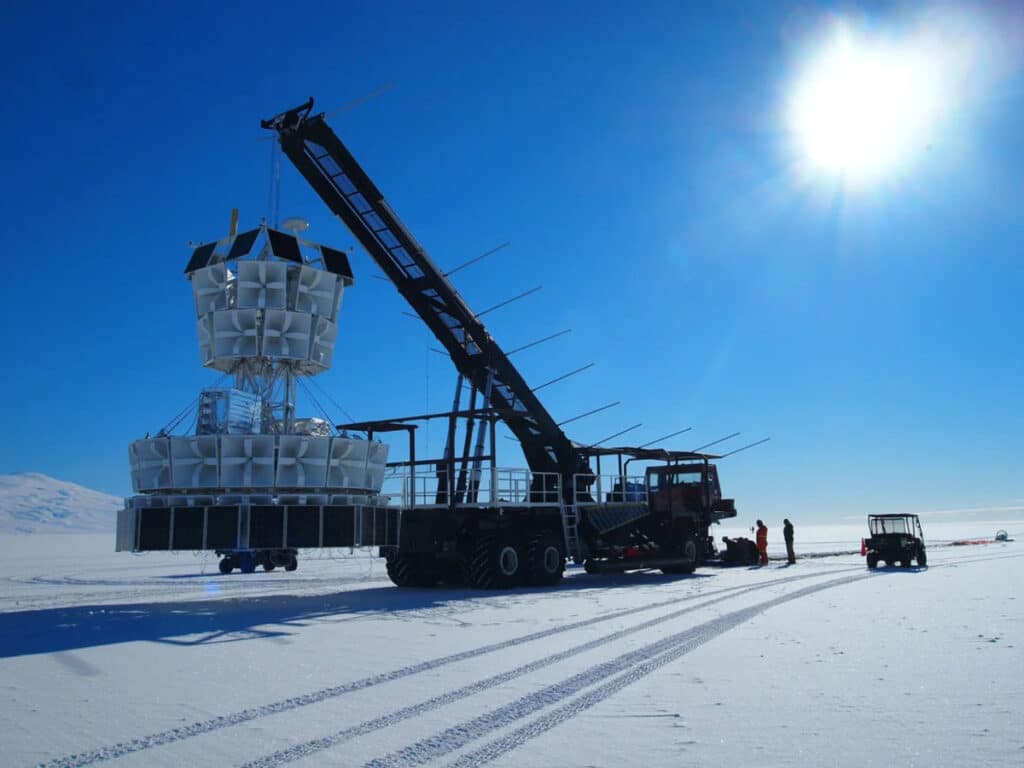
Unusual radio signals were detected by the Antarctic Impulsive Transient Antenna (ANITA) experiment, a series of instruments on balloons above Antarctica designed to detect radio waves emitted by cosmic rays hitting the atmosphere. © Stephanie Wissel, Penn State University
The Future of Detection
Now comes PUEO, launching over Antarctica soon. Ten times more sensitive than ANITA, it’s designed to catch more of these weird events. “With PUEO, we’ll finally know whether these signals are real or just quirks of our detectors,” says coauthor Stephanie Wissel.