
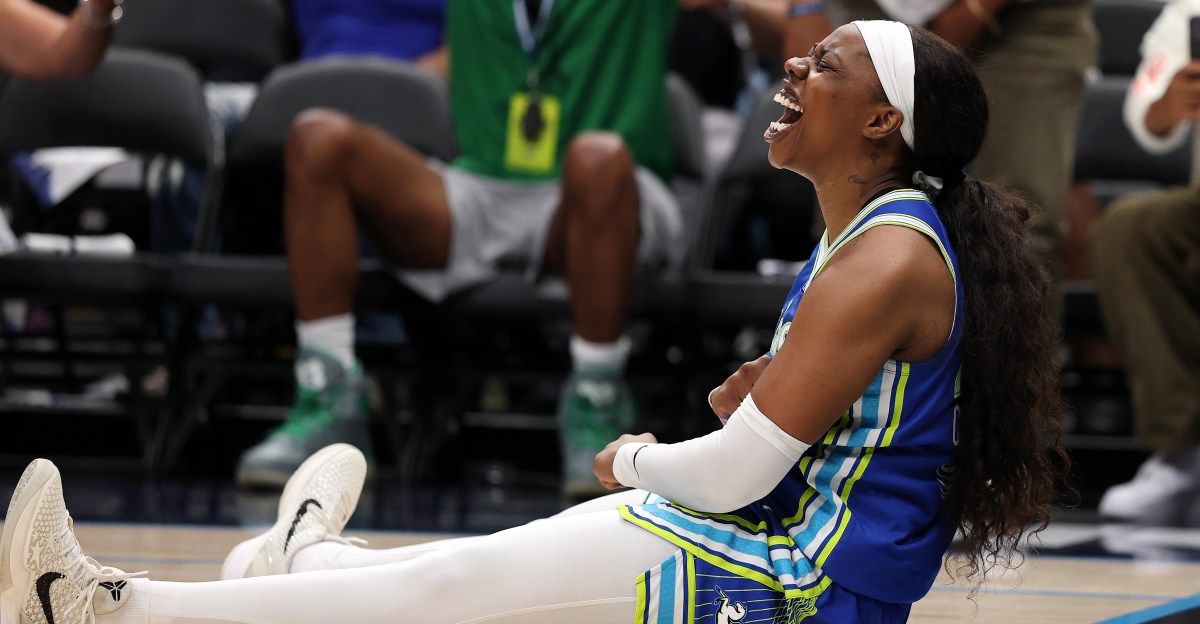
For most of its history, being the franchise player for the Dallas Wings has been a thankless job. Ask Skylar Diggins, who came to Dallas when the team relocated from Tulsa in 2016, her fourth WNBA season. After three years, two All-Star appearances, two All-WNBA finishes, and zero playoff wins in Arlington, Diggins had enough. She was tired of wasting her prime years on a lifeless, directionless franchise with no meaningful way forward. After the 2018 season, Diggins sat out on maternity leave and then requested a trade to Phoenix in early 2020. Her co-star, one-season wonder Liz Cambage, also asked out and fled to Las Vegas.
Suddenly, the Wings were completely rudderless. Their two best players had departed for greener pastures, and all that was left of the roster was promising youngster Allisha Gray and middling role players. Heading into the 2019 WNBA draft, Dallas held the fifth overall pick, hardly a spot to bank on landing a franchise-changing star.
Of course, Notre Dame guard Arike Ogunbowale was selected with that pick, and the Wings built things around her for the succeeding half-decade. Ogunbowale filled the void left by Diggins and Cambage, giving the franchise hope with a fantastic rookie season. Despite the Wings’ 10-24 record, Ogunbowale finished second in Rookie of the Year voting to future All-WNBA forward Napheesa Collier (taken one pick after Ogunbowale in the draft).

NEW YORK, NY – APRIL 10: Christy Hedgpeth poses with Arike Ogunbowale after being drafted by the New York Liberty during the 2019 WNBA Draft on April 10, 2019 at Nike New York Headquarters in New York, New York. NOTE TO USER: User expressly acknowledges and agrees that, by downloading and/or using this photograph, user is consenting to the terms and conditions of the Getty Images License Agreement. Mandatory Copyright Notice: Copyright 2019 NBAE (Photo by Catalina Fragoso/NBAE via Getty Images) NBAE via Getty Images
The next five years of Ogunbowale’s career brought numerous individual accolades, thousands of points scored, and little team success. Dallas won three total playoff games during this time and just one series, advancing to the semifinals in 2023. And while Ogunbowale compiled stats and awards, her style of play was not always conducive to winning basketball. Though her talent was obvious, she was inefficient, took bad shots, couldn’t finish, and played bad defense.
Of course, it’s important to remember that most of Ogunbowale’s Wings career has been marred by instability and incompetence. In the eight seasons Ogunbowale has played in Dallas, she’s had five different head coaches. Her co-star for most of the decade, Satou Sabally, could never stay on the floor and had one healthy, productive season alongside her (2023, their only playoff success) before demanding out. Allisha Gray also asked for a trade in 2023 and became a star in Atlanta. The Wings spent 2021-2024 whiffing on nearly every high draft pick they had. More often than not, Ogunbowale carried the expectations of both the franchise and fanbase entirely on her back.
All of those factors allowed Ogunbowale to lean into her worst tendencies as a player. The circumstances around the team didn’t encourage growth, development or accountability. There was no stability or culture. It was just “Arike, save us” for five years. If she wanted to hijack possessions to dribble 15 times and jack up a contested 20-footer? Cool, she can make those shots sometimes. If she wanted to take defensive plays off and wander around off-ball? No problem; she needs to save her energy for offense. If she fell in love with tough jumpers at the expense of getting downhill and finishing at the basket? Who cares, we aren’t winning anything anyway.
This is, of course, an oversimplification of how things have gone. Ogunbowale has limitations and flaws, like everyone else at this level. But so often, the negatives got in the way of what she could do to help a good team. They began to define her as a player, and the labels started getting tossed around: chucker, volume scorer, empty stats, hero-ball, losing player. I’m guilty of using those terms during the low points of her career.
Things only got worse in this regard for Ogunbowale after the Wings landed mega-star Paige Bueckers in 2025. Despite Ogunbowale’s prodigious talent and standing in the league, Bueckers’ arrival immediately relegated her to second fiddle. Many star players would take exception to that, especially given what the Wings gave her to work with throughout her career. But not Ogunbowale. From day one, she welcomed Bueckers with open arms, providing love, support, and guidance for the new franchise player. Ogunbowale willingly embraced taking on a new role, one that would ask her to do more with less.
It did not go well in 2025. Ogunbowale stumbled through a dismal, injury-riddled campaign, the worst of her career. While Ogunbowale willingly took fewer shots, operated more off-ball, and let Bueckers run the show, her efforts yielded no success for either her individually or the team. Her season was so poor that many, myself included, wondered whether Dallas would be better served by moving on and continuing the Bueckers era without the franchise player who preceded her.
When Ogunbowale re-signed with Dallas last offseason on a two-year, $2.4 million contract, I wasn’t happy. Despite Ogunbowale taking less than the maximum amount she was eligible for, I didn’t think it was a good idea to commit two more years at that cost to someone I didn’t really believe in. Add in the fact that Dallas used the No. 1 overall pick days later to select someone who played Ogunbowale’s position, and the deal looked downright silly.
Those concerns were amplified during the first 20 games of the 2026 season, when Ogunbowale couldn’t throw a rock into the ocean. During this stretch, she shot just 33.6% from the field and averaged a paltry 2.8 assists per game (her career-low for a season is 3.2). On the surface, it looked like a continuation of her disastrous 2025 season. Ogunbowale was less involved and less productive, and many began to use her as a scapegoat for all of Dallas’ issues.
But if you watched Ogunbowale’s games during that stretch, the numbers didn’t tell the whole story. Despite not being able to buy a bucket, she was doing the right things. She was playing within the offensive system, driving more, taking good shots, and trying harder on defense. It looked different than what we saw in 2025 under head coach Chris Koclanes, when Ogunbowale seemed adrift in a sea of confusion.

ARLINGTON, TX – JULY 12: Head Coach Jose Fernandez and Arike Ogunbowale #24 of the Dallas Wings smile before the game against the Chicago Sky on July 12, 2026 at American Airlines Center in Dallas, TX. NOTE TO USER: User expressly acknowledges and agrees that, by downloading and or using this photograph, User is consenting to the terms and conditions of the Getty Images License Agreement. Mandatory Copyright Notice: Copyright 2026 NBAE (Photo by Michael Gonzales/NBAE via Getty Images) NBAE via Getty Images
Over the last two months, Ogunbowale has been a revelation. She has completely turned her season around and is having the most efficient year of her career by true-shooting percentage (53.6%). When you factor in her dismal start, that’s remarkable. The main catalyst for this transformation has been a massive improvement in two-point scoring. Ogunbowale has never been an efficient scorer from inside the arc, sporting a career two-point field-goal percentage of 42%. She didn’t generate many rim attempts in the halfcourt, was a notoriously bad finisher, and preferred to operate in the mid-range, often settling for tough, contested attempts.
First-year Wings head coach Jose Fernandez and his staff asked Ogunbowale to switch things up. Though Ogunbowale is a good mid-range shooter, the Wings offense needed her to take fewer of those (inherently less efficient) attempts and put more pressure on the rim. This was difficult for Ogunbowale; it’s something she’s never done before. Last year, her backseat to Bueckers didn’t include more downhill attacking. Just 14.8% of her field goal attempts in the halfcourt came at the rim, and she finished at a poor 50% clip (per Synergy Sports).
And early in 2026, those struggles continued. Through the first 22 games of the season, Ogunbowale’s halfcourt rim rate sat at just 22.4%— better, but still lacking. More concerning was the finishing; Ogunbowale hit just 39.6% of those shots, a ghastly mark. Despite those struggles, Ogunbowale kept pushing, and the coaching staff kept encouraging her to get downhill. Since the July 10th game against Toronto (when this run of great play started in earnest), Ogunbowale has upped her rim rate to 32% in the halfcourt. She is finishing those shots at a 55% clip. While that finishing percentage is still pretty poor, it is a massive jump for Ogunbowale. And she’s coupled that improvement with a huge spike in free-throw attempts. In July and August, Ogunbowale is sporting a free-throw rate of .334. For context, that number exceeds what star guards Olivia Miles and Kelsey Mitchell have done this year. It’s lifted her season free-throw rate to .326, a career high.
Ogunbowale and the coaching staff have leaned into her strengths as a player, and it’s helped her improve her weaknesses. They’ve recognized that her elite handle, smart processing, and strong frame are good ingredients for getting downhill. Who cares if you aren’t a good finisher? A lot of times, simply getting into the paint and making the defense react is a huge win for the offense. They have to collapse. They have to foul you. They have to leave your teammates open. They have to wall off the rim and give up more open paint jumpers. All of this has been happening for Ogunbowale and the Wings over the last two months. Even during the rough patch Dallas faced following the WNBA All-Star break, Ogunbowale was playing winning basketball.

INDIANAPOLIS, IN – AUGUST 14: Dallas Wings guard Arike Ogunbowale (24) drives down the lane while defended by Indiana Fever guard Caitlin Clark (22) in the first half of play during a WNBA game between the Dallas Wings and the against the Indiana Fever on August 14, 2026 at Gainbridge Fieldhouse in Indianapolis, IN. (Photo by Jeffrey Brown/Icon Sportswire via Getty Images) Icon Sportswire via Getty Images
I don’t want to get my hopes up, as Ogunbowale is nothing if not volatile, but this feels like it could be sustainable. Watching recent games, it seems as though Ogunbowale has settled into this player. She knows her role, she’s comfortable with it, and she’s executing. Sure, she’ll still take a bad shot every now and then. But sometimes you need her to do that! She can still bail the Wings out in late-clock situations. She can still toss up some BS that breaks the other team’s back. Those are good things that you don’t want her to lose. And while Ogunbowale’s 3-point shooting is notoriously streaky, she’s a good floor spacer. The fact that she’s posted a sparkling 58.5% true shooting over the last two months despite hitting just 31.7% of her threes should be incredibly encouraging.
If this is the new normal for Ogunbowale, she’s earned her contract. More than that, this is a player who can fit with Paige Bueckers. That’s massive because, for the last year and change, it’s felt like Ogunbowale’s departure from Dallas was an eventuality. I never considered that she could truly be part of the core for a championship team around Bueckers. But if she keeps this up, there’s no reason that Ogunbowale and the Wings can’t make things work. Though they’d have to get very creative with shaping the rest of the roster, it could be done. One thing is for sure— a title in Dallas would be 100x more meaningful if the heart and soul of the franchise got to lift the trophy. For her part, Arike Ogunbowale is doing everything she can to make that happen.