
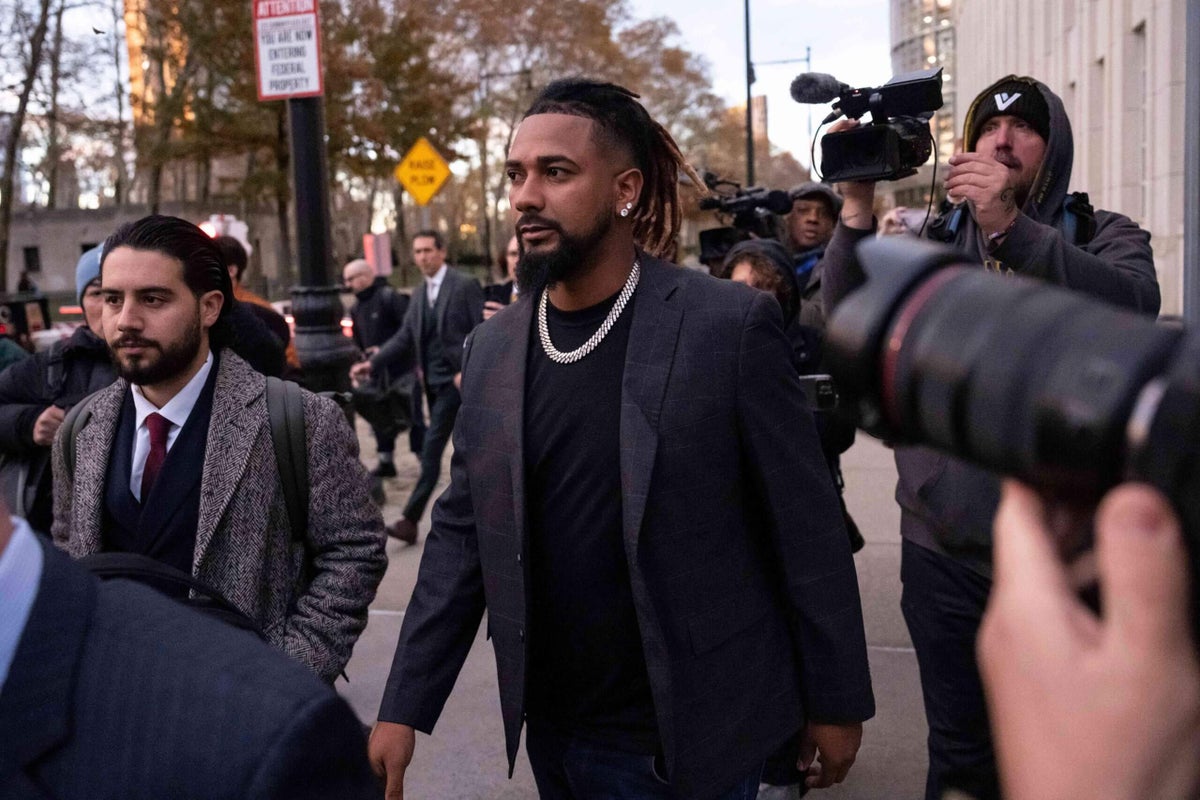
Federal prosecutors say that Cleveland Guardians pitchers Emmanuel Clase and Luis Ortiz tried to deceive Major League Baseball investigators about their alleged pitch-rigging scheme and they plan to make that a part of their case when the pitchers go to trial this fall.
Department of Justice lawyers have asked a federal judge to allow evidence that Clase and Ortiz, who have both pleaded not guilty, tried to obfuscate their involvement in the alleged betting ploy that netted at least $450,000 in winnings, and that they clearly knew they should not be betting on baseball because of MLB’s rules barring it. In one instance, they claim that Clase told Ortiz to try to hide a roughly $5,000 payment by saying he received it as payment for a horse. Ortiz, prosecutors said in a new filing, then did not disclose that fee when asked about it by MLB investigators.
The details of MLB’s investigation into the alleged scheme will be part of what lawyers for the U.S. Attorney’s Office for the Eastern District of New York say will be a central argument during the trial. They told Judge Kiyo A. Matsumoto that MLB’s Rule 21, which bars betting on the sport, will be a key point for them in proving that not only did Clase and Ortiz know they should not have rigged pitches on behalf of a group of bettors, but that in doing so they committed a federal crime.
“Clase and Ortiz’s violation of MLB Rule 21, and efforts to conceal their repeated violations of this rule, are direct evidence of, and inextricably intertwined with, the charged schemes,” lawyers for the Eastern District wrote in a new filing last week. “Both players received extensive training, and thus were on notice, that sports betting was strictly prohibited by MLB. The reason why they received the training — MLB’s Rule 21 — is necessary to telling the story of this case.”
Clase and Ortiz are both facing four counts related to what federal prosecutors say was a years-long effort to intentionally throw pitches for balls to win wagers on those pitches. Clase was a part of the scheme from May 2023 through June 2025, according to a federal indictment, and brought Ortiz into the fray during the 2025 season.
Lawyers for Clase and Ortiz did not respond to emails seeking comment.
The trial for Clase and Ortiz, and a third defendant, Robinson Vasquez Germosen, who federal prosecutors say worked with the pitchers, is set to begin Nov. 2. Last week, Matsumoto, the federal judge in Brooklyn, denied separate trials for Ortiz and Clase; they are set to face charges of conspiracy fraud, money laundering and sports bribery.
MLB’s Rule 21 bars players, and any league or team employee, from betting on games they’re involved in or otherwise. Anyone who does will be banned from the sport for life. Prosecutors say that Clase and Ortiz tried to hide their trail when MLB began to investigate them last summer.
DOJ prosecutors allege that Clase was part of a ploy to wager on prop bets on his pitches, with bettors placing bets that they would be balls and under a certain velocity. Clase is alleged to have also bet on his own pitches as well, and Ortiz allegedly joined the scheme in 2025.
Clase and Ortiz allegedly tried to obfuscate their plans, according to a government filing made last week. Prosecutors say that Clase referred to his pitches as roosters when he talked to men he collaborated with. For one alleged wager, in June 2025, Clase told Ortiz to say his winnings were sent as part of a payment for a horse.
When MLB began to investigate the two pitchers last summer, federal prosecutors say that Clase and Ortiz tried to hide their involvement. Ortiz hid the payment he said was for a horse when MLB requested documents and information as part of its investigation, and said he didn’t know Vasquez Germosen. Clase, federal prosecutors say in the latest filing, did not disclose a financial transaction with another bettor believed to have profited on his pitches despite a specific request by MLB. They also say that Clase and Ortiz attended Rule 21 trainings during spring training in 2024 and 2025.
Federal prosecutors have asked Matsumoto to allow them to use this information, and others, at trial this fall.
“The admission of the defendants’ violations of Rule 21 and their repeated disregard of a cardinal MLB rule, despite clear instruction, is also necessary context for the defendants’ later false statements to the MLB in response to the MLB Requests,” lawyers for New York’s Eastern District wrote. “Through the MLBPA, both defendants provided false and incomplete information to MLB in an apparent effort to conceal their association with their co-defendants and/or certain Bettors and, thus, their involvement in a pitch-rigging scheme. Those efforts to hide evidence constitute direct evidence of wrongdoing and consciousness of guilt. The defendants knew they were under criminal investigation when they gave false information to MLB because their phones had already been seized by the FBI. Doing so was also part of the broader pattern they and their co-conspirators employed during the conspiracy — using financial intermediaries, straw bettors, and coded language, all in an effort to conceal their criminal conduct.”
The Athletic’s Zack Meisel contributed to this story