
Sign up for the Slatest to get the most insightful analysis, criticism, and advice out there, delivered to your inbox daily.
The sales receipts are flowing in, and they come with good news for Coyote vs. Acme: The embattled Looney Tunes riff debuted at No. 2 at the domestic box office this weekend, raking in $15.4 million (on top of the $1.7 million it had already earned in sneak previews) and smashing all opening-weekend records previously held by its distributor, indie darling Ketchup Entertainment. For all his efforts, Wile E. Coyote finally seems to have caught a bird.
To be sure, those aren’t Odyssey numbers. But they are a potent showing for a hybrid live action–animated flick that’s infamously spent the past few years in cinematic purgatory, abandoned by the major studio that originated it (Warner Bros.), then rescued much later by a younger shop with fewer resources and still fewer hits to its name. Acquired by Ketchup for $50 million and given only $10 million more for marketing costs, Coyote vs. Acme wasn’t exactly made for the ascendant financial heights reachable only by Spider-Man. It was, however, meant to make a viable cultural impact—to celebrate the historic cartoons at its center, to convey an unabashed anti-corporate-monopoly message to audiences, and to demonstrate that a creative, unorthodox project once remanded to the Hollywood maw can, in fact, attract butts to seats. Even if the movie never scales to a technical profit, it is by any account an unambiguous success.
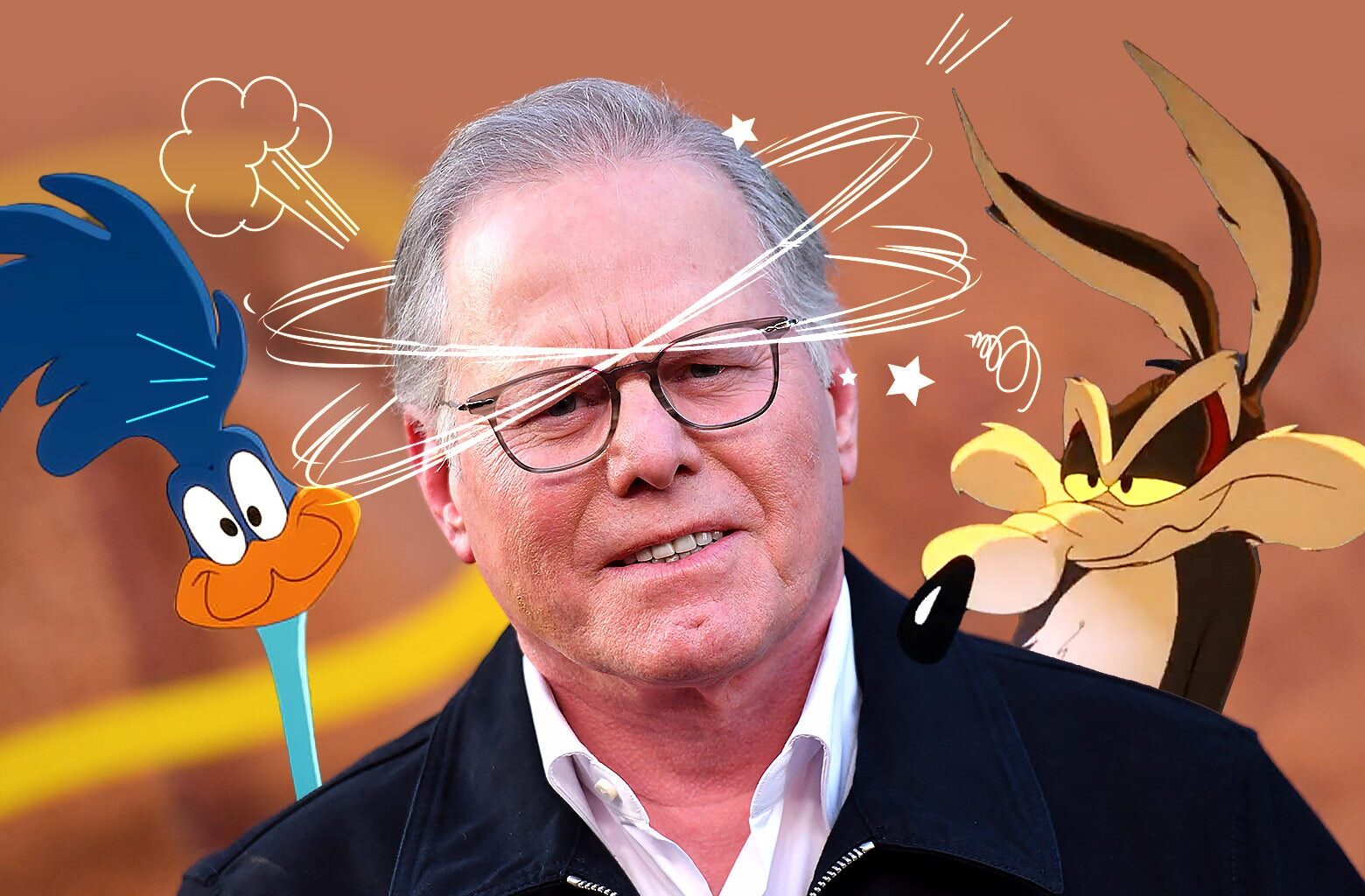
Crucially, it’s also another egg (or, perhaps, anvil) in the face of America’s most unimaginative studio boss, the man who tried to kill this film only to watch it take off like Road Runner on the internet, at the picket lines, and at the ticketing booths, while he slouched through a horrific year for his business: Warner Bros. Discovery CEO David Zaslav.
By now, anyone familiar with Coyote vs. Acme is likewise familiar with the lore. The motion picture was first commissioned eight years ago as one of the first new Looney Tunes features since 2003’s Back in Action, whose critical and commercial failure had been responsible for the drought in Merrie Melodies intellectual property plays. Like its predecessor, the new entry would set the fictional Acme Corporation as the omnipotent enemy of the beloved characters associated so strongly with the Warner Bros. archive (Bugs Bunny, Daffy Duck, etc.). This time, however, the motley resistance wouldn’t include a fictional Warner Bros. executive. Instead, as indicated by Coyote vs. Acme’s opening logos, WBD would be a subsidiary of the Acme juggernaut itself, now known as “Warner-Acme Group.”
That conceit ended up an unsubtle but no less effective metaphor for our new Gilded Age. The $70 million Coyote vs. Acme was filmed right as the steeply indebted Warner Bros. was merging with Zaslav’s Discovery Inc.; it then fell prey to the new CEO’s scythe. The feature had been completed under a relatively low budget, it had tested well with audiences, and big names like James Gunn and John Cena were involved. Nevertheless, Zaslav was determined to write down as many losses off the corporate balance sheet as he could, laying waste to whatever treasured in-house properties like Looney Tunes, the Turner Classic Movies channel, and rights to NBA broadcasts. Yet the quarterly tax write-off from shelving Coyote vs. Acme and other movies like it barely amounted to $100 million, and as my colleague Sam Adams noted, Zaslav’s hard-nosed austerity conveniently excluded any haircuts to his annual salary—which only came in a little below Coyote vs. Acme’s $72 million budget.
Even worse, Zaslav torched multiple projects while reportedly calling in personal favors for celebrity friends like Nicholas Pileggi, who penned the script for WBD’s 2025 bomb The Alto Knights, at great expense to the studio. (Coyote vs. Acme has already grossed more than what The Alto Knights earned worldwide, for the record.) To this day, his calculus for greenlighting any major production seems to come down to how vastly one’s star power burns.

Nitish Pahwa
David Zaslav Has No Clothes
Read More
Yet, the company’s cinematic lineup has been suffering this year, with high-profile releases like Supergirl, The End of Oak Street, and The Bride! coming up short even as rival studios report healthier returns on their output. Meanwhile, Coyote vs. Acme has already made up the amount WBD lost ($20 million) when the studio sold the flick to Ketchup Entertainment.
That’s not to say all is flopping now for Zaslav and team: “Wuthering Heights” and Evil Dead Burn did pretty well, and the upcoming Dune: Part Three is already wreaking box-office havoc. But, unlike last year, the broader cultural conversation in 2026 is not being led by WBD. In part, however, it is being led by the film that most aptly symbolizes Zaslav’s failures. The narrative around Coyote vs. Acme has cast the film as its own wily coyote facing up against Zaslav and his reign at WBD, the megaconglomerate that’s all about the bottom line and cares little about the real quality of its output, as long as it maintains market dominance. There’s no such broader conversation greeting another Evil Dead sequel, even though moviegoers seem to like it. That, alone, is its own triumph.
This Content is Available for Slate Plus members only
A Leaked Document Shows American Generals Are Squirming About Iran—and for Good Reason
This Content is Available for Slate Plus members only
Trump for a Decade Had One Superhuman Ability. Now, It Seems He’s Losing It.
HBO’s Great New Show Is Incredibly Sharp on Race and the Black American Experience
This Content is Available for Slate Plus members only
It’s Expensive. It’s Not Exactly Convenient. It Just Might Be the Secret to Aging Happily.
The funny thing is, when Warner Bros. made Coyote vs. Acme, its champions surely understood that Zaslav is only the latest of his kind. Coyote vs. Acme conspicuously sets the plot’s inciting actions in 1992—the same year Warner Bros. officially merged its entertainment operations with those of Time Inc., making for one of the largest media houses in the world. From there, the consolidation only accelerated: with Turner Broadcasting, AOL, and AT&T, the latter of which sold the whole thing off to Discovery Inc., which then fused with Warner Bros. in a manner resembling that huge mass of flesh in Akira. Now that monstrosity is on the verge of being acquired by Paramount Skydance for $111 billion—though that will ultimately be decided next year following a big antitrust trial. There have been mergers, acquisitions, divestitures, overlaps, layoffs, and quote-unquote efficiencies all along the way.
Coyote vs. Acme may have stuck it to Zaslav, but its creators know there’s a future where a potential follow-up to the movie is developed by a more unholy, further consolidated behemoth—one that, again, is disinclined to release that film at all. And then, like Wile E. Coyote, the upset moviegoers will raise their fists again.