
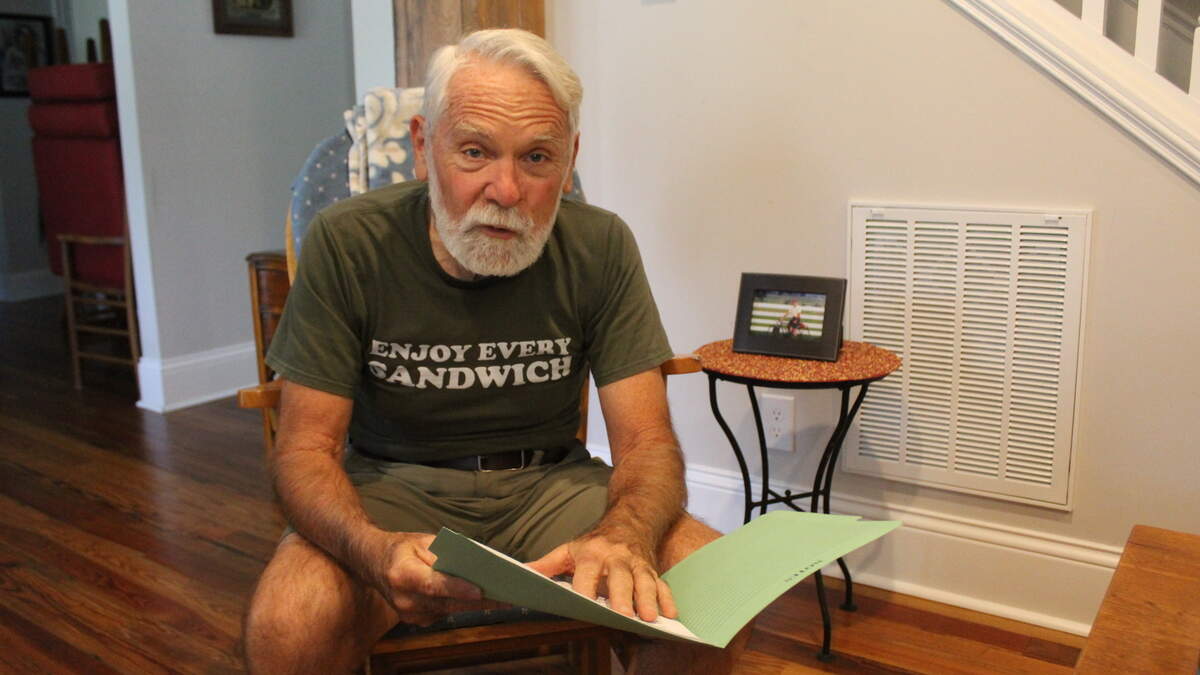
George Garber, 72, holds a diary logging decades of mental health-related incidents related to his stepson, Damian Hisle, 52, on Monday, Aug. 24, 2026, at his home in Lexington, Kentucky.
Jesse Fraga
jfraga@herald-leader.com
A man suspected of a hate crime near the University of Kentucky has been repeatedly found incompetent to stand trial and committed to a mental health treatment facility in criminal cases since at least the 1990s in Lexington, court records show.
The family of 52-year-old suspect Damian Hisle says he has been diagnosed with severe paranoid schizophrenia, and he has never been properly treated in order to prevent events such as the one that happened outside a UK hospital on Aug. 11, in which he allegedly harassed and threatened a woman wearing a hijab.
Hisle’s stepparents, George Garber and Sharon Hackworth, say Hisle has “lived in more places than you can count,” including psychiatric hospitals, homeless shelters and jails, as well as on the street. He has regularly found himself in courtrooms over the last 30 years.
“Nothing lasts,” Garber, 72, said. “I’ve kind of run out of optimism.”
Garber and Hackworth say Hisle has sought help for his mental health, but the aid has only ever been temporary.
“There is a bigger story here,” Garber told the Herald-Leader. “I have no doubt that he did it. The question is why he was in a position to commit this act at all.”
Hisle has faced over two dozen charges since 1999 in Lexington. He has faced charges including harassment, assault, terroristic threats, criminal mischief, assault on a correctional officer while incarcerated, menacing, alcohol intoxication in a public place, disorderly conduct, robbery and possession of marijuana, court records show.
Judges usually found him guilty of incidents until late 2014. But in the decade since, judges have dismissed most charges against him and ordered him to be committed to a few days in hospitals — usually Eastern State Hospital’s psychiatric facility — according to court records.
“But then in a very short time, I mean … it’s a very low stress, safe environment, so he’s really well-behaved,” Garber said. “After a few days of that, they’re ready to send him out.”
But Hisle’s schizophrenia prevents him from willingly continuing treatment, his stepdad told the Herald-Leader.
“He only gets treatment when he’s locked up,” Garber said. “Somebody like Damian, he’s proven to us that he can’t survive on the outside.”
.
Hoda A. Shalash reported she was verbally harassed and threatened while wearing a hijab near a UK hospital where she works on Aug. 11, according to her Facebook and a police citation.
Court records say Hisle harassed and threatened her, while Shalash’s Facebook post also accuses him of spitting on her.
“I’m disgusted and ashamed by the fact that this man felt so confident to be outwardly hateful,” Shalash said on Facebook. “Immediately I began to fear for the safety of every Muslim woman on campus.”
She did not respond to the Herald-Leader’s request for comment on this story.
The Lexington Police Department said in a news release it was a “reported hate crime.”
Like many times before, a judge has filed a commitment order for Hisle in this case, court records show.
Garber said he is empathetic for Shalash and other victims, but he wishes Hisle could get more help to prevent future problems.
“I feel bad for him. I’d like to see him get a better deal, and I also feel bad about the people that he attacks,” Garber said. “It’s not right for somebody who can do those dangerous things to be out in a position to do them.”
Mental health struggles make recidivism more likely
Recidivism, or re-incarceration, rates are higher among people with mental health and alcohol use disorders than those without, according to studies by Case Western Reserve University and the International Journal of Law and Psychiatry.
Legal, social and political intersections have “led to the current epidemic of psychiatric disorders in the U.S. prison system,” according to the National Library of Medicine.
Continuity of care that involves routine treatment and partnerships between the criminal justice system, mental health providers and social services reduces the likelihood of arrests among people with severe mental illnesses, according to a 2022 study published on Psychiatry Online.
Jail environments only exacerbate mental health issues among incarcerated people, according to the Prison Policy Initiative. Increased efforts to free people with mental illnesses from jails has put more pressure on mental health providers to keep up, according to a study by the American Academy of Psychiatry and the Law.
“Now, with decarceration and the release of many such persons, the mental health system may be expected to assume more responsibility for them and should be prepared and funded to meet their needs,” the study says.
Banned from homeless shelters
Hisle also spends short stints in homeless shelters. But he eventually breaks the shelter rules, gets banned and ends up on the street again, his stepparents said.
“He can’t even stay in a shelter now because he’ll sooner or later do something outrageous that they can’t allow,” Garber said. “Just recently they had him sign a promissory note that he would not cause any trouble with the Hope Center,” Hackworth, 71, said.
The Hope Center, one of Lexington’s largest nonprofits helping people who are homeless or with substance use issues, gave Hisle a “second chance, but that lasted about two days,” then he was asked to leave, Garber said.
Chris Peck, chief advancement officer for the Hope Center, said there’s a gap in services for people with severe mental health issues.
“That’s definitely a gap right now in the city of Lexington, is a strong program that deals with the severe mentally ill,” Peck told the Herald-Leader.
People can be banned for a year from the Hope Center’s shelter due to violence or drug use in the facility, according to Peck. Anyone who is barred from the shelter is still welcomed to its cafeteria, which provides three free meals a day for anyone in the community.
The Hope Center also has two vans that offer food, clothes and medical care resources to people on the street.
“It’s something we mull around all the time is how to make an impact on that population, and you know for us it’s just a matter of available resources to do that, and so we’re applying for different funding streams and grants and different things to hopefully help that group in the future,” Peck said.
Local police handle crisis on a ‘case by case basis’
Lexington police officers sometimes recognize Hisle and call an ambulance if he’s in crisis, according to Garber.
“The police in Lexington are really pretty well trained in how to deal with mentally ill people, and they don’t arrest Damian if he’s just acting crazy on the street,” Garber said.
But officers who don’t recognize him have more quickly arrested him, according to Garber. Hisle was arrested by the UK Police Department on Sept. 27, 2022, over alleged alcohol intoxication and threatening police, according to a citation.
“If the same event had happened with the Lexington police, it wouldn’t have been charged the same way,” Garber said.
Lexington and UK police take crisis intervention training to identify and handle people with mental health issues and disabilities, according to Lexington Police Sgt. Bige Towery and Dani Jaffe, a UK spokesperson.
“This training helps our officers kind of become familiar with what a mental health crisis looks like, and those warning signs that someone may be in a crisis,” Jaffe said. “And part of that is identifying if an individual is a danger to themselves or others.”
Officers handle each incident on a “case by case basis,” Jaffe told the Herald-Leader.
“If an individual has been identified to be a danger to themselves or others, they can be emergency detained and then taken to a mental health facility like our empath unit,” she said. “And then, if a crime was (allegedly) committed, charges can still be filed against that individual.”
In addition to the crisis intervention training, LPD participates in the Lexington Community Paramedicine Program, led by the Lexington Fire Department.
It encourages “proactive, people-centered care … addressing root causes of frequent emergency service use,” Towery said. “The program works to bridge gaps in care and meet people where they are—physically, emotionally and socially.”
Garber said people with severe mental health issues need better solutions for long term care, such as greater access to residential facilities.
“I think the best thing for people like Damian would be something closer to the treatment that severely mentally ill people got before deinstitutionalization, where they went to a place that wasn’t really a hospital-like setting,” Garber said. “He could live out his life in a place like that.”
This story was originally published September 1, 2026 at 5:00 AM.