
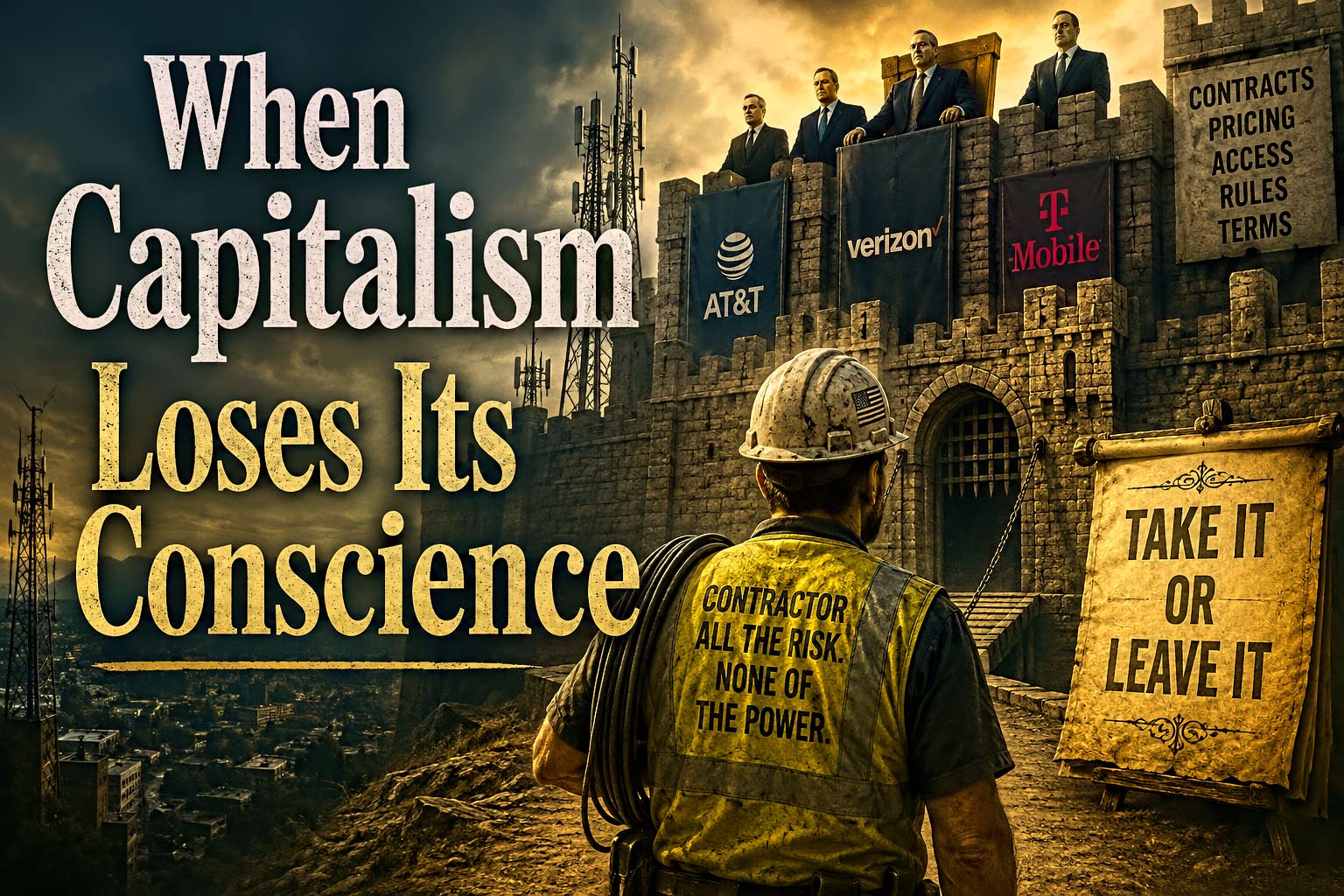
 Contractors carry the risk. Carriers hold the power. In his op-ed on corporate feudalism, Clif Peterson argues that one-sided contracts, inflexible pricing, and downward risk transfer are hollowing out the workforce building and maintaining America’s wireless networks — and he challenges AT&T, Verizon, and T-Mobile to replace domination with reciprocity, pursuing stakeholder relationships where everyone can win
Editor’s note: This op-ed runs long — but it’s the most direct argument we’ve published on carrier-contractor power dynamics in years, and it doesn’t stop at complaining. Clif Peterson names the problem, backs it with sourcing, and puts three specific asks on the table for AT&T, Verizon and T-Mobile. Worth the read.
By Wireless Estimator Contributor Clif Peterson
For nearly three decades, I have worked in and around America’s wireless infrastructure industry. I have watched extraordinary people build the physical networks that connect families, businesses, hospitals, schools and communities. I have also watched the business systems surrounding that work become more centralized, more impersonal and more one-sided.
The language is capitalism. The lived experience can feel a lot more like feudalism.
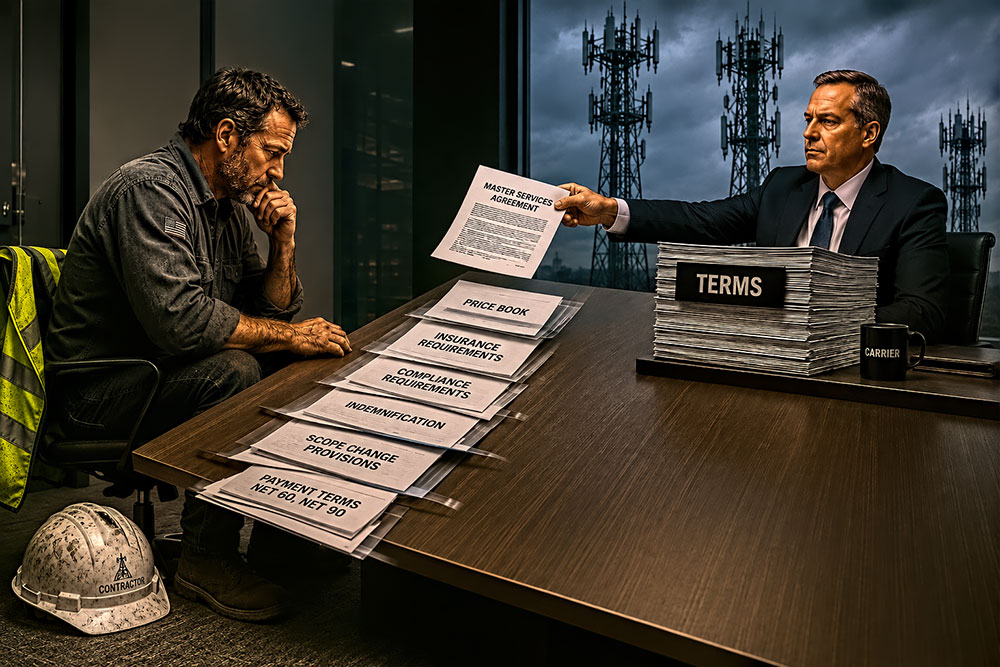
A small number of powerful buyers control access to the economic territory. They establish the master contract, the pricing matrix, the approved vendor list, the schedule, the payment process, the compliance burden and, increasingly, the acceptable margin. The contractor is still called an independent business. But independence without meaningful choice is mostly theater.
Take it or leave it is not a partnership strategy. It is an ultimatum wearing a procurement badge.
I call this corporate feudalism. The phrase is intentionally provocative, but it is not careless. In historical feudal systems, lords controlled the land and the economic access attached to it. Those beneath them supplied labor, loyalty and tribute in exchange for the ability to live and work within the system. The relationship was unequal, but it still carried reciprocal obligations.
The corporate version can be worse in one revealing respect: it preserves nearly every obligation of the contractor, availability, compliance, investment, performance, loyalty and risk, while allowing the most powerful party to retreat from its corresponding duties of fairness, stability, good faith and shared accountability.
This article is not an attack on capitalism. It is a defense of capitalism from concentrated buyer power, coercive procurement and profit severed from conscience.
Corporate feudalism is not a legal diagnosis, and every hard negotiation is not oppression. Customers have the right to demand value. Contractors have the responsibility to perform. Large companies need standards, consistency, scale and financial discipline. None of that is controversial.
The problem begins when scale becomes immunity from reciprocity, when a buyer can change expectations, transfer risk, suppress pricing, control access to future work and enforce compliance downward while remaining functionally unaccountable upward.
Economists define a monopoly as market power held by a single dominant seller, letting it push around buyers. “Monopsony” is the mirror image — power held by a dominant buyer over sellers — and in wireless infrastructure, thousands of contractors and technicians ultimately answer to a remarkably small number of companies controlling the work.
Modern usage of the term, especially in labor economics, has loosened past the textbook single-buyer definition — courts have applied it to markets with a handful of buyers, not just one, and NATE and Wireless Estimator have repeatedly raised the question of whether the three major carriers function that way here.
None of that makes the market abusive by itself. It does make it vulnerable. When losing one customer can sink an otherwise capable contractor, the theoretical right to walk away from an unreasonable term isn’t much of a right.
That is the heart of the feudalism metaphor: nominal independence combined with practical dependence. The supplier owns the trucks, employs the people, finances the operation and carries the risk. The powerful buyer owns access to the field.
Conscience Capitalism requires more than private ownership. It requires genuine exchange, meaningful choice, competition and accountability. Remove those disciplines and capitalism starts wearing a costume.
Wireless contractors know the pattern. Take-it-or-leave-it master service agreements. Turf arrangements that can make one buyer the gatekeeper to an entire market. Standard price books detached from actual field conditions. Unilateral policy and scope changes. Slow payment cycles. Uncompensated administrative work. Broad indemnification. Forecasts presented as commitments until the contractor invests, and treated as guesses when the work disappears.
The customer can demand speed, absorb delays internally, revise priorities and move schedules. The contractor must hold crews, vehicles, insurance, training, licenses, safety programs and working capital in readiness, then absorb the chaos when forecasts do not become purchase orders.
The asymmetry is obvious. One party can move the schedule. The other party carries the payroll. One party can revise the process. The other party pays to relearn it. One party can delay acceptance. The other party finances the delay.
This is where the word partnership becomes offensive. A partner participates in decisions and shares consequences. A vendor operating under unilateral terms does not become a partner because someone typed the word into a slide deck.
Pricing matrices are especially dangerous when they stop functioning as efficient catalogs and become instruments of economic denial. A price book cannot repeal inflation. It cannot make skilled labor cheaper, eliminate travel, remove weather, cure defective designs or make safety free. When real costs rise but approved prices remain frozen, someone still pays. Usually it is the contractor, then the technician, then the technician’s family, and eventually the network itself. The market calls this efficiency. Too often, it is merely cost displacement.

A wireless site is not built by a procurement portal. It is built by tower technicians, civil crews, electricians, fiber splicers, project managers, safety professionals, warehouse teams and families that live with the uncertainty and danger accompanying the work.
Corporate systems turn those lives into line items. Labor becomes a unit. Travel becomes a rate. Risk becomes boilerplate. The family waiting for a technician to come home safely does not appear in the pricing matrix.
That abstraction eventually becomes operational reality. Contractors without sustainable margins defer investment, lose experienced leaders, reduce training capacity, stretch equipment or leave the industry. Good companies are replaced by desperate companies. Desperate companies accept prices that responsible companies cannot. The buyer celebrates savings while the supply chain quietly becomes more fragile.
Then everyone acts surprised by turnover, inconsistent quality, failed schedules and the shortage of skilled labor. We starve the workforce-development engine and hold another conference about why it will not start.
This is not an argument for protecting inefficient businesses. Contractors that cannot estimate, lead, communicate, control cost or deliver quality should not be insulated from the market. But the market should distinguish between an inefficient contractor and an honest contractor refusing to perform skilled, dangerous work below its true cost. Today, those two are too often treated as the same thing.
AT&T, Verizon and T-Mobile each publish serious ethical expectations. AT&T’s policies include Principles of Conduct for Suppliers and a Code of Business Conduct addressing ethics, human and labor rights, responsible business practices and relationships with vendors. Verizon’s Supplier Code speaks of ethical conduct, respect, safe working conditions, resilient supply chains and treating workers with dignity. T-Mobile’s supplier framework addresses responsible sourcing, ethical performance, fair labor standards, safe workplaces and channels for reporting concerns.
Those commitments matter. Suppliers should be held to them. But every corporation that imposes ethical standards on its supply chain should willingly submit its own procurement practices, contractual leverage, pricing systems, escalation processes and treatment of suppliers to the same moral examination.
My company has experienced what we believed was a serious gap between published supplier principles and the treatment we received from a major customer. We raised concerns in good faith. What we encountered felt painfully familiar: nonnegotiable terms, concentrated buyer power, economic risk pushed downward and an accountability process that did not feel reciprocal.
That is our firsthand perspective. It is not an allegation that every carrier, employee, department or contract operates the same way. The larger principle does not depend on naming one corporation. A supplier code loses moral credibility whenever it functions as a one-way instrument.
If respect and dignity matter, they must matter at the negotiating table. If resilient supply chains matter, pricing must allow responsible suppliers to remain resilient. If speaking up is protected, suppliers must be able to raise concerns without fearing economic exile.
A code of conduct that governs only the weaker party is not a code. It is a collar.
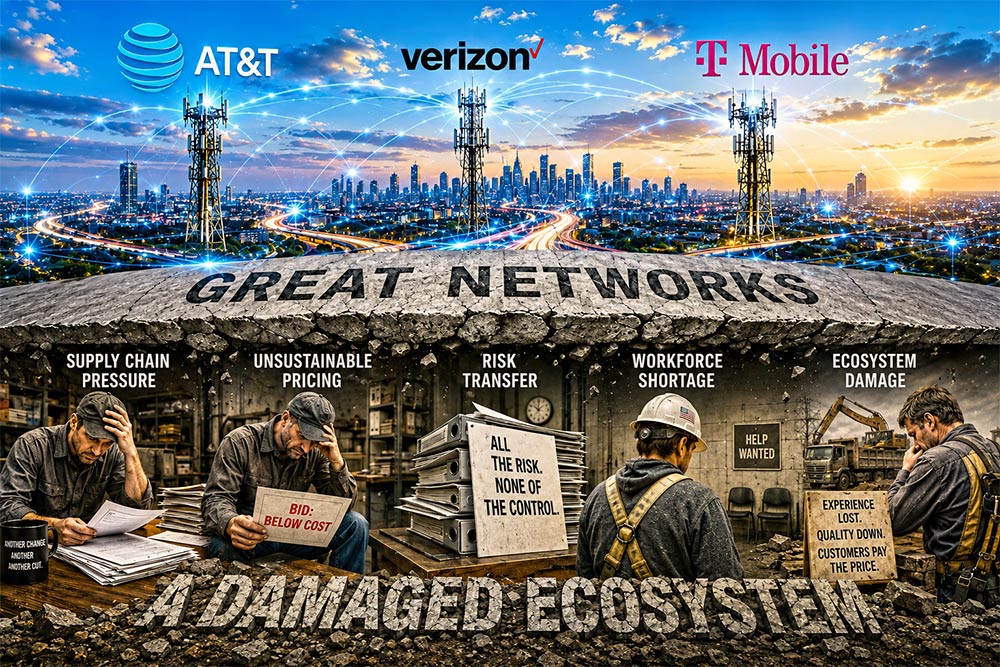
Any serious criticism of this industry must begin with intellectual honesty: America’s three national carriers operate remarkably capable networks.
RootMetrics’ first-half 2026 testing, summarized by Light Reading, included more than three million controlled real-world tests. The Big Three finished within 1.1 points of one another in overall RootScore performance, 98.4, 98.3 and 97.3, and traded leadership across speed, reliability, 5G experience, availability and geographic awards. Nationwide median download speeds also rose materially across the market.
Those results deserve recognition. They reflect enormous capital investment and excellent work by engineers, employees, field teams, contractors and suppliers. They also keep this argument from collapsing into lazy carrier bashing.
But network performance is not the same thing as corporate conscience.
A company can operate a technically excellent network while exhausting the ecosystem behind it. It can produce a strong customer experience today while weakening the people and businesses required to sustain that experience tomorrow. The proper question is not simply which carrier won the latest testing period. The harder question is whether the supply chain supporting all three networks is becoming stronger, or being consumed to preserve short-term financial performance.
The network may still have a conscience because the people building it do. Corporate leadership should not assume it can exploit that commitment forever.
The ultimate purpose of communications infrastructure is to serve the customer. Coverage, capacity, reliability, speed and trust are downstream products of thousands of field-level decisions. The people climbing towers, installing radios, pouring foundations, pulling fiber, troubleshooting failures and maintaining equipment are not expenses disconnected from the customer experience. They create it.
Procurement can negotiate a lower line item. It cannot negotiate away physics, geography, weather, safety or craftsmanship. When a commercial system drives out experienced contractors, increases technician turnover or rewards the lowest apparent bidder without measuring total cost, it may create a savings report while quietly creating an operational liability.
Shareholder value matters. Investors provide the capital that makes networks possible, and healthy companies must earn returns. But shareholder value should be the result of serving customers exceptionally well, not the excuse for hollowing out the people and companies responsible for delivering that experience.
The chain is not complicated: long-term shareholder value depends on durable customer trust. Customer trust depends on network quality and reliability. Network quality depends on skilled, stable and accountable contractors and technicians. Those people and companies cannot remain skilled, stable or accountable inside an economically destructive system.
Short-term extraction can flatter a quarter. It cannot build a durable network.
Criticism without a proposed correction is just sophisticated complaining. So here are three changes AT&T, Verizon and T-Mobile could make to demonstrate that their supplier relationships are genuinely anti-monopsonistic and built for long-term value.
1. Restore economically honest pricing
Create recurring, transparent reviews of pricing matrices using actual changes in wages, insurance, fuel, travel, training, equipment, regulation, safety requirements and inflation. Establish a defined exception process for scopes, geographies, schedules and risks that do not fit the standard catalog.
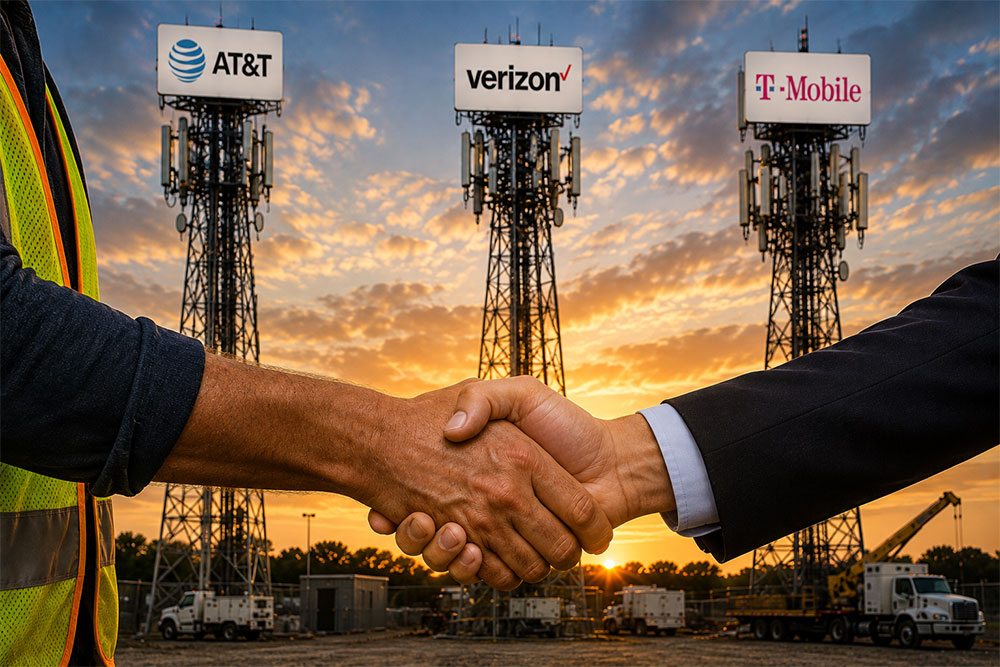
A price book should simplify common work. It should not be used to deny uncommon reality. If a scope cannot be executed safely and responsibly at the published rate, the answer cannot always be that the contractor should become more efficient. Sometimes the number is simply wrong.
A price book cannot repeal inflation.
2. Restore reciprocity to contracts
Reform master service agreements so risks, obligations, remedies, schedule changes, cancellations, payment terms and accountability are more fairly allocated to the party able to control them. If contractors must reserve crews and equipment based on carrier forecasts, the carrier should accept responsibility when those forecasts repeatedly vanish. If scope changes after mobilization, the commercial terms should change with it.
This does not mean equal power in every clause. It means reciprocal duty. A partnership cannot remain a partnership when only one party can change the rules and only the other party pays for the change.
3. Restore local judgment and build a responsible supplier ecosystem
Return meaningful decision-making authority to local market leaders who understand the geography, workload, network conditions, contractors and people performing the work. Decisions about contractor selection, pricing exceptions, scheduling, performance and scope should not be controlled exclusively by distant procurement departments, national spreadsheets or algorithms that cannot see what is happening in the field.
Local leaders should have room to work with legitimate small and midsize contractors that demonstrate genuine care for employees, serious investment in safety and training, ownership of the finished product, consistent quality, financial responsibility, local knowledge and a record of solving problems instead of processing work orders.
Small and midsize contractors are often close enough to recognize trouble early, know the technicians personally, understand local conditions and feel the consequences of poor workmanship. That proximity can produce accountability that national systems erase.
This is not an argument for favoritism, nostalgia or handing work to every local company with a truck and a logo. Local authority must operate inside transparent qualification standards, measurable performance, ethical safeguards and real accountability. Relationships should inform judgment, not replace competence.
Carrier procurement should also stop treating contractors as interchangeable line items. The lowest apparent price is not necessarily the lowest total cost. A contractor that retains skilled people, communicates early, prevents rework, protects the network and owns the outcome may cost more on paper while creating substantially more value for the carrier and its customers.
Finally, establish an independent supplier council, a confidential escalation channel and an executive review mechanism through which contractors and local carrier leaders can challenge unsafe, uneconomic, inconsistent or unethical practices without retaliation. Then require each carrier to measure its own behavior against the supplier and ethics standards it publishes for everyone else.
Empowering qualified local leaders and responsible midsize contractors is not charity. It is stewardship of the network, the workforce, the customer relationship and the shareholders’ long-term investment.
Carriers are not the only parties with work to do. Contractors cannot credibly demand accountability while refusing to practice financial discipline and operational excellence themselves.
We must know our costs and stop confusing revenue with profit. We must refuse work that cannot be completed safely, ethically and sustainably. We must document schedule changes, payment delays, uncompensated requirements and transferred cost with facts, not emotion. We must develop customer diversity so dependence on one buyer does not become economic captivity.
We must invest in safety, leadership, training, quality and professional business systems. We must stop enabling destructive procurement by accepting impossible pricing and hoping to recover the loss somewhere else. Every time a contractor knowingly accepts an unsustainable rate, it teaches the buyer that the rate is sustainable.
Industry associations such as NATE can help contractors aggregate legitimate cost and workforce data, identify systemic problems and advocate for transparent standards. That work must remain lawful. Contractors should never coordinate prices, allocate markets or collude. Collective advocacy is necessary; cartel behavior would merely reproduce the abuse we are criticizing.
Ownership cuts both ways. We should insist on fair terms, and then deliver the safety, communication, quality and accountability that make those terms worth paying for.
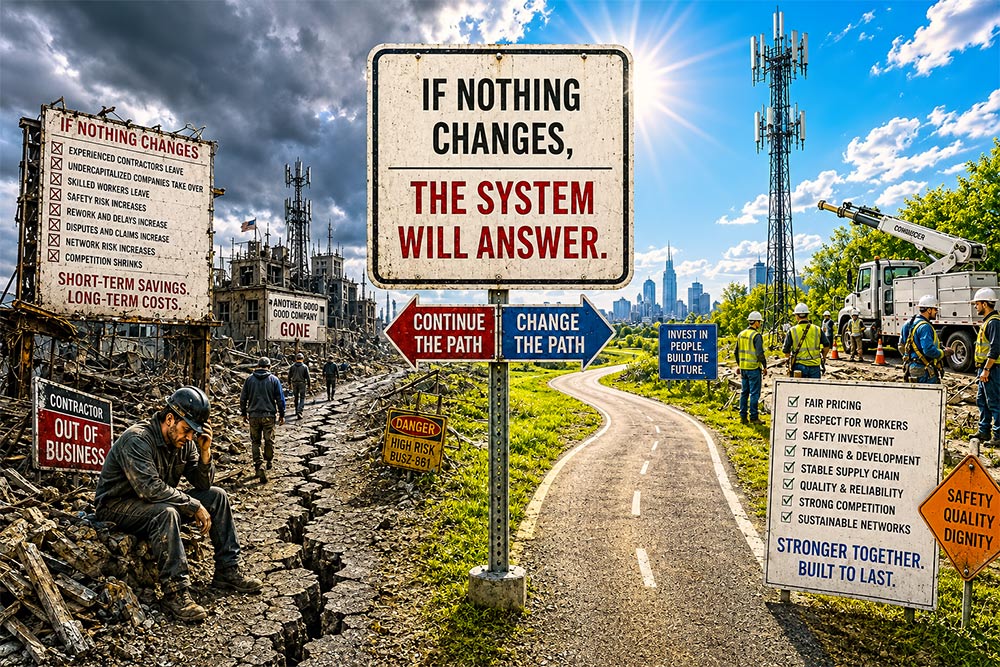
The strategic threats are not mysterious. Experienced and financially responsible contractors will continue leaving. Capable companies will be replaced by undercapitalized companies willing to gamble on impossible pricing. Skilled technicians will move to industries offering greater stability. Safety exposure, rework, schedule volatility, disputes and network risk will grow. Competition will shrink as smaller companies exit or consolidate.
The short-term savings will eventually return as a larger invoice.
There is also a political and labor consequence. When people are denied meaningful influence individually, they seek power collectively. Unionization did not emerge during the Industrial Revolution because workers suddenly developed a taste for bureaucracy. It emerged because concentrated ownership left too few credible ways to negotiate dignity, safety and compensation.
That reaction has already reached the edges of tower work. Workers at Tower Safety received voluntary recognition and joined the Communications Workers of America in 2021. In 2022, tower climbers at a QualTek operation sought formal union representation. Organizers framed their appeals around dignity, safety, compensation, training and the distance subcontracting creates between powerful companies and field workers.
I am not advocating unionization as the ideal solution. Concentrated worker power can become just as rigid and self-protective as concentrated corporate power. Moving domination from the boardroom to the union hall does not create balance. It changes who holds the hammer.
But carrier executives should understand the warning. If contractors cannot negotiate individually, they will search for collective leverage. If workers believe subcontracting is being used to distance powerful corporations from responsibility, organizers will give that belief a structure, a vocabulary and a bargaining unit. If procurement continues compressing prices while demanding more safety, training, speed and compliance, the workforce will eventually stop absorbing the contradiction quietly.
If corporations eliminate every reasonable avenue for negotiation, people will create collective leverage. Power never leaves a vacuum unfilled.
The answer to concentrated corporate power is not simply concentrated government power. Replacing one distant command center with another leaves the underlying disease intact.
Government has a legitimate role in protecting competition, enforcing contracts, preventing fraud and addressing anticompetitive conduct. Antitrust law recognizes that buy-side power can injure workers and suppliers as surely as monopoly power can injure consumers.
But regulation cannot manufacture conscience. A corporation can satisfy technical requirements and still use leverage in ways that degrade people and hollow out its supply chain. The higher standard must be chosen as an operating ethic, not merely endured as a rule.
We need competitive markets, enforceable reciprocal duties, transparent procurement and leaders willing to submit power to principle. We do not need one form of feudalism replaced by another.
I believe business is one of the most powerful forces for good human beings have created. Profit is not evil. Profit is oxygen. It funds innovation, investment, wages, training, generosity and growth.

But oxygen without boundaries can feed a fire that consumes the building.
The alternative to corporate feudalism is reciprocal capitalism, capitalism with a conscience. It is not charity, softness or an excuse for poor performance. It is a commercial system built on mutual benefit, fair exchange, honest pricing, shared accountability, respect for human dignity and sustainable profitability.
In practical work boots, reciprocal capitalism means allocating risk to the party best able to control it. It means pricing that reflects safe, skilled execution. Payment terms that do not force small companies to finance giant corporations. Forecasts that carry accountability. Change orders administered honestly. Supplier concerns receiving evidence-based review instead of retaliation or silence. Local leaders empowered to use judgment. Excellent contractors rewarded for the total value they create.
It also means contractors owning outcomes, solving problems, caring for people, delivering beyond expectations and remaining humble enough to examine their own failures. Reciprocity is not a demand that somebody else become virtuous first.
The goal is not for one party to win harder. It is for customers, shareholders, employees, contractors, technicians, families and communities to become stronger together.
“The beautiful thing about stakeholder theory, and healthy capitalism, is that all of these stakeholders can simultaneously be winning.” – John Mackey, Founder of Whole Foods Market
America’s mission-critical infrastructure is not built by procurement systems, pricing matrices or corporate slogans. It is built by human beings.
Those people deserve relationships grounded in reciprocal accountability. Customers deserve networks supported by stable, skilled companies. Shareholders deserve enterprises designed for durability instead of extraction. Carriers deserve suppliers that perform with excellence. And contractors deserve the opportunity to earn a sustainable return without surrendering their independence in everything but name.
Technology and infrastructure should serve people, not the other way around.
Capitalism works only when there is genuine exchange, meaningful choice, shared accountability and a conscience. When the powerful own the playing field, write every rule, transfer nearly every risk and still call everyone else a partner, capitalism begins to look a great deal like feudalism.
The machine has power. Humanity must retain moral authority.
Restore the conscience of capitalism.
Author’s note:
This article presents the author’s analysis and firsthand industry perspective. “Corporate feudalism” is used as an ethical and economic metaphor, not as a legal finding or a claim that modern contractors are literally medieval serfs. AT&T, Verizon and T-Mobile are named together only in connection with public network-performance reporting, published supplier standards and the industry-wide requests made in this article. The article does not assert that every carrier, employee, department or contract engages in the same conduct.
About the author:

Clif Peterson is the Founder and Chief Joy Officer of JOY Inc., a nationwide contractor that builds and maintains the mission-critical infrastructure keeping people connected and information flowing. With nearly three decades of wireless leadership experience, he advocates for an industry grounded in ownership, problem-solving, hospitality, excellence, humility and reciprocal accountability. JOY Inc.’s mission is bringing humanity and Joy to mission-critical infrastructure because technology and infrastructure should serve people, not the other way around. www.joyinc.com