

“While we’re excited, we also need to be cautious,” says Daniel Akerib, a particle physicist at Stanford University, and one of the cornucopia of experts involved with the new research.
Other experiments have hinted at the possibility of dark matter particle candidates in the past, but those ultimately fell through. To verify the WIMP signal, researchers will need more data. “This is a tantalizing anomaly, not evidence,” says Chamkaur Ghag, a physicist at University College London and another of the team’s researchers. But if scientists spot more of these odd collisions, a nearly century-long quest to unveil the true nature of dark matter may finally come to an end.
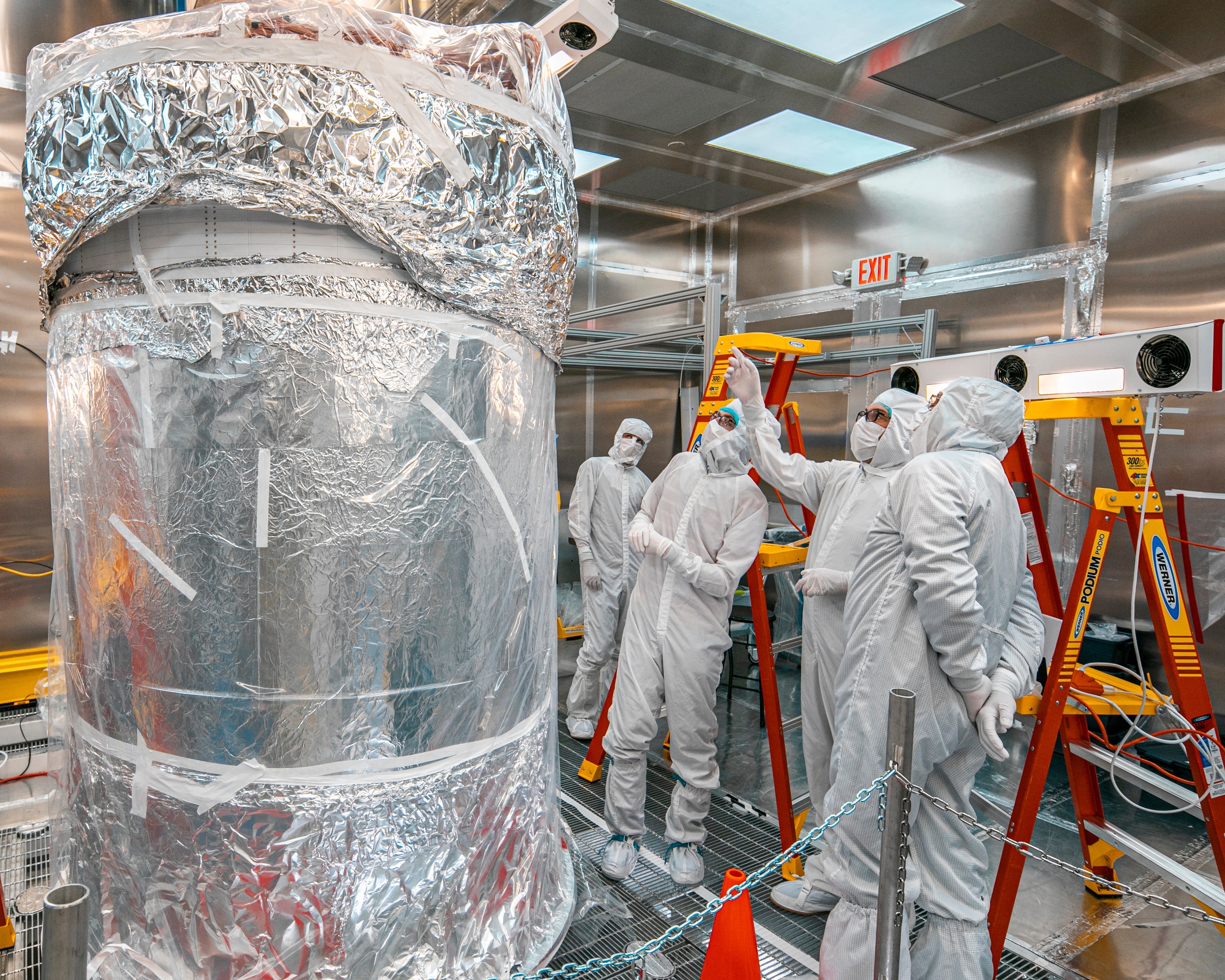
The detector, called LUX-ZEPLIN or LZ (shown during its installation), that picked up this possible dark matter signal is wrapped in layers of shielding to minimize background noise.
Matthew Kapust/Sanford Underground Research Facility
The Shadowy Puzzle of Dark Matter
To us, it seems like ordinary matter rules the universe. But dark matter—first inferred as an unseen mass in the 1930s, then suspected of being an unusual particle in the 1970s—makes up 85 percent of all the universe’s matter. This is based on plentiful observations of the visible universe, and an assessment of the gravitational forces that appear to be shaping its galaxies.
“We know that dark matter exists,” says Daniel Whiteson, a particle physicist at the University of California Irvine. “There are many independent lines of evidence for it.” Stars wouldn’t ignite under the influence of ordinary matter and its gravity alone. Spinning galaxies would be torn apart without its force. Light is bent around hidden halos in space—a process known as gravitational lensing—that only makes sense if copious amounts of dark matter is present.
“Cosmologists have a hard time building a universe—ok, a model of the universe—without dark matter,” says Akerib. “But what is it?”