
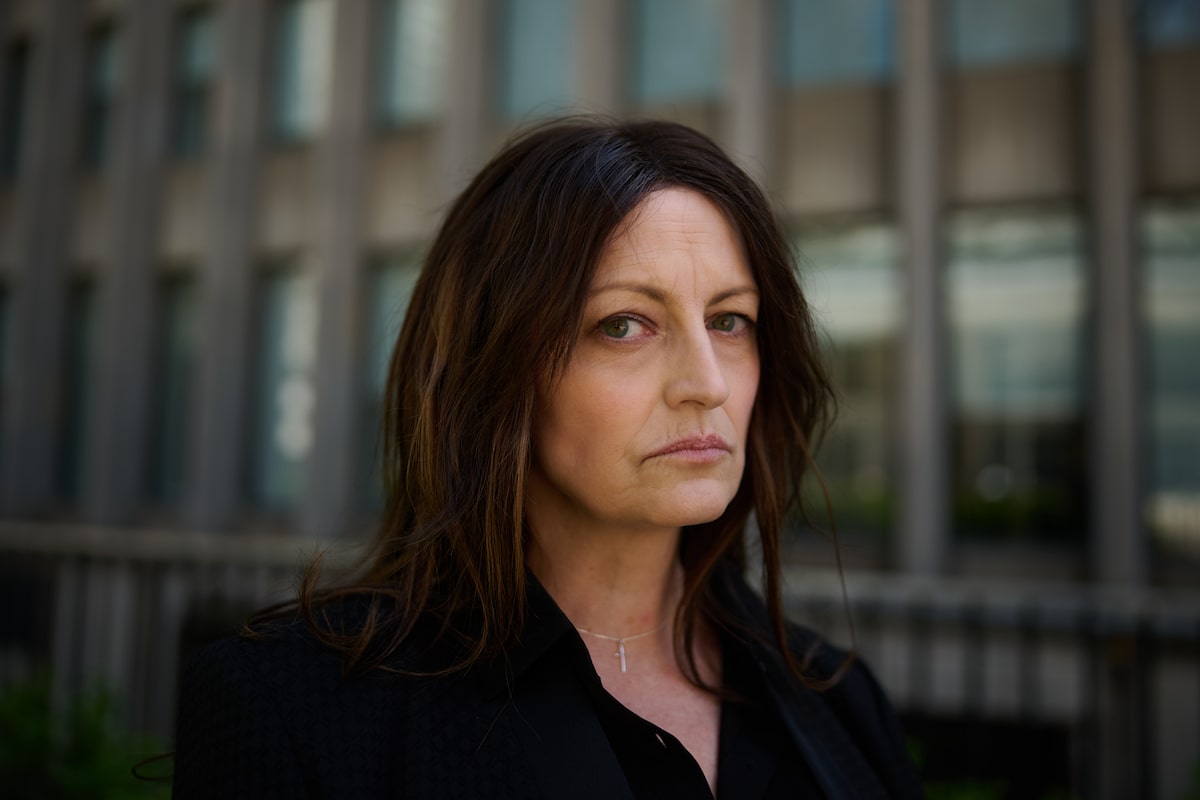
Claire Brosseau outside the Ontario Superior Court of Justice in Toronto on May 4. Ms. Brosseau requested an emergency stay from the court to immediately end her life with medical help.Sammy Kogan/The Canadian Press
An Ontario court has denied a Toronto woman living with bipolar disorder emergency access to medical assistance in dying.
In May, Claire Brosseau requested an emergency stay from the Ontario Superior Court of Justice to immediately end her life with medical help. She is also suing the federal government over its decision to bar MAID in cases of mental illness.
Toronto woman with bipolar disorder asks Ontario court to grant her emergency MAID access
In a written decision Thursday, Justice Carissima Mathen described how Ms. Brosseau presented compelling evidence of the harm she has suffered and will likely continue to endure.
Justice Mathen also noted the considerable interests on the other side including “Parliament’s role to make policy decisions on sensitive social issues and the proper interpretation of the Charter rights in play.”
Advocacy organization Dying With Dignity Canada said Ms. Brosseau and her legal team will take some time to review the court’s decision. In a statement on Thursday, it shared her reaction
“I am disappointed yet not surprised that my emergency motion was denied,” Ms. Brosseau, 49, said in the statement, adding that it amounts to an additional barrier extending her suffering.
“This is not living – I do not have a life.”
Crucial decision in MAID debate looms
MAID remains against the law for patients whose sole underlying medical condition is mental illness.
Ms. Brosseau, who has bipolar 1, a form of bipolar disorder, has said that she must be able to access MAID because she endures “constant pain and unrelenting torment.”
In August, 2024, Ms. Brosseau and Dying With Dignity Canada sued the federal government for barring MAID access to patients like herself. That matter remains before the courts.
Justice Mathen ordered the Attorney-General of Canada and Ms. Brosseau to take steps toward an urgent case conference on that suit within 14 days.
Ms. Brosseau’s legal battles – to die with the help of medical professionals – underscores a complex policy debate over whether patients with mental illness should be able to access medical help to die.
In July, Joseph Cheng, senior counsel for the Attorney-General of Canada, urged the Ontario Superior Court of Justice to consider findings from a special parliamentary committee.
A majority of the special committee’s members recommended this spring that the federal government disallow patients with mental illness from being able to access MAID early next year.
MAID access for patients with mental illness is currently set to become legal in March, 2027, but the timeline could change if the federal government introduces legislation.
Three sources told The Globe and Mail in May that the government is open to introducing such a bill. The Globe did not identify the sources because they were not authorized to speak publicly on the government’s plans.
The following month, Justice Minister Sean Fraser said the matter was serious and that he planned to take time to review the parliamentary committee’s report, as well as dissenting opinions.
Ottawa prepared to halt plan to allow MAID for mental illness
MAID first became legal a decade ago, in June, 2016. The law established access to the procedure for Canadians whose deaths were deemed “reasonably foreseeable.”
In 2021, the country’s MAID law was expanded after a Quebec Superior Court decision two years earlier found that the original law was unconstitutional.
The amended law expanded criteria to allow patients with incurable conditions to seek to end their lives, known as “track two” MAID.
A two-year temporary exclusion was put in place to give time to study the delivery of MAID for patients with mental illness, but implementation has been twice delayed.
This spring, the special parliamentary committee held hearings to determine if Canada is ready to allow MAID for patients with mental illness.
A report produced by a majority of its members said the committee heard “significant complexities and risks, grave concerns and deep divisions that continue to accompany this issue.”
It also recommended that Ottawa amend the Criminal Code to indefinitely exclude patients from becoming eligible for MAID if their sole underlying medical condition is a mental illness.
Lawyer for woman seeking MAID for mental illness asks court to ignore parliamentary report
In July, Ms. Brosseau’s lawyer, Michael Fenrick, argued before Justice Mathen that the parliamentary committee’s findings should not be considered as part of Ms. Brosseau’s request.
He said the findings did not reflect the will of Parliament and that Ms. Brosseau’s motion to seek MAID was brought on an “urgent basis.”