
Maryland Supreme Court rules to allow redistricting question on ballot with different language

 ANNAPOLIS, Md. —
The Maryland Supreme Court ruled late Thursday over whether the General Assembly’s attempt to amend the state constitution over redistricting can make it on the November ballot.
Maryland State Election Administrator Jared DeMarinis told WBAL-TV 11 News that the justices ruled to allow the constitutional amendment question to appear on the ballot — but with different language.
| DOCUMENT: Read the Maryland Supreme Court’s ruling
According to the ruling obtained by WBAL-TV 11 News, the high court, in part, affirmed and reversed the circuit courts’ judgments and remanded the cases with instructions to enter orders to resolve each side’s motions by Friday. The ruling comes amid a tight deadline, as the Maryland State Board of Elections is required to send ballots to the printer by Thursday.
The justices agreed with the circuit courts on the basis that the ballot question is misleading and therefore violates due process requirements.
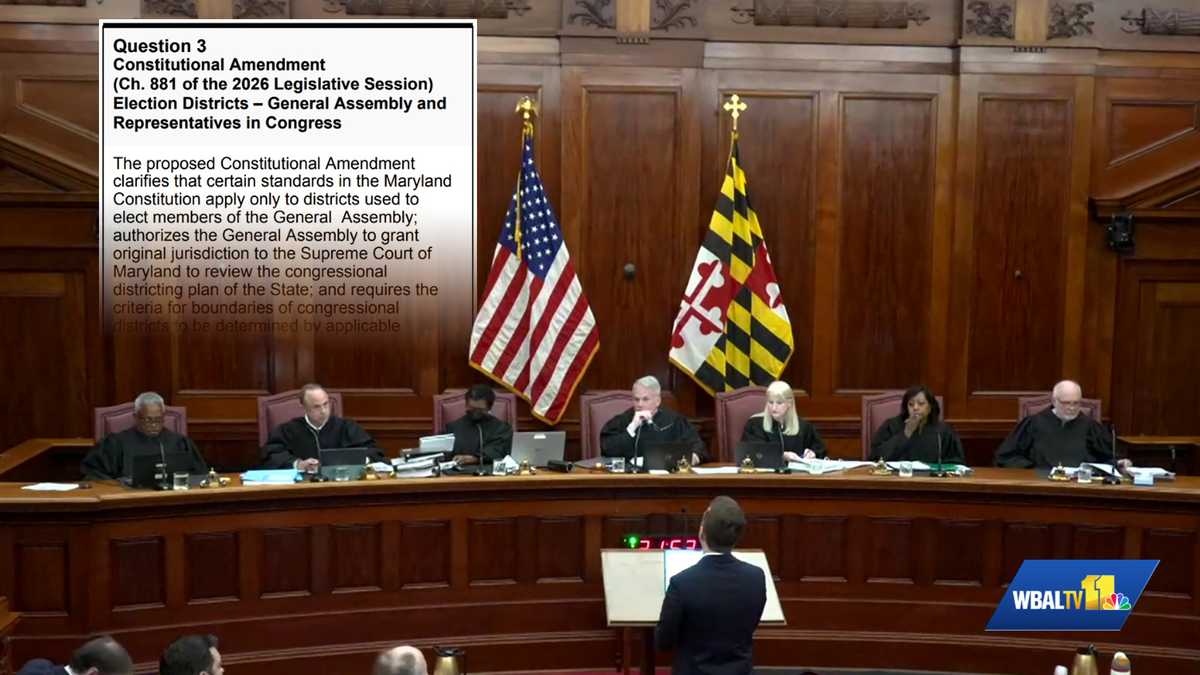
The ballot question’s text as passed by the General Assembly read as follows:
“The proposed Constitutional Amendment clarifies that certain standards in the Maryland Constitution apply only to districts used to elect members of the General Assembly; authorizes the General Assembly to grant original jurisdiction to the Supreme Court of Maryland to review the congressional districting plan of the State; and requires the criteria for boundaries of congressional districts to be determined by applicable federal laws.”
The Supreme Court ordered that the question be replaced with the language of the purpose paragraph, which reads:
“FOR the purpose of clarifying that certain requirements apply only to districts for the election of members of the Senate of Maryland and the House of Delegates; authorizing the General Assembly to grant original jurisdiction to the Supreme Court of Maryland to review the congressional districting plan of the state; and providing that nothing in the Maryland Constitution provides applicable criteria for the boundaries of a congressional districting plan.”
The justices found that the circuit courts erred in their rulings over whether the executive branch followed the Election Law Article and whether there was a violation of the state constitution’s single-subject requirement for the ballot question.
What led to this point
Justices heard arguments over two hours regarding a proposed constitutional amendment on redistricting that could change how the state draws its voting maps, with justices and attorneys debating its wording, timing and implications.
In early August, the General Assembly convened a special session, during which time Democrats passed legislation (House Bill 2100) to add a redistricting question to the ballot.
The amendment aims to create separate standards for drawing congressional and state legislative districts in Maryland.
Why Republicans filed lawsuits
Republicans and conservative groups sued to block the measure from appearing on the ballot, arguing it is part of a broader effort to eliminate Maryland’s sole Republican congressional seat on the Eastern Shore.
“Let’s be frank about what the practical outcome would be. The practical outcome is that they want to do redistricting that’s going to eliminate the last Republican seat on the Eastern Shore,” said Jeffrey Clark, an attorney representing Republicans.
Circuit court judges’ rulings led to appeals
Last week, circuit court judges in Anne Arundel and Dorchester counties ruled against the ballot question, calling its wording “intentionally misleading.”
| READ THE JUDGES’ OPINIONS: Anne Arundel County | Dorchester County
During Thursday’s hearing, Maryland Supreme Court justices echoed similar concerns.
“Are you at least willing to admit that the third clause of this question as worded is quite ambiguous?” Justice Shirley Watts asked.
Video below: Second judge blocks redistricting question from ballot
Assistant Attorney General Daniel Kobrin defended the amendment, saying: “The voter will understand that, moving forward, districting in the congressional sense is unincumbered by anything but federal law.”
Chief Justice Matthew Fader questioned why the General Assembly did not make changes through legislation.
“The congressional districts themselves are defined by state law, they’re actually in the code,” Fader said.
“The ballot question presents nothing about the General Assembly’s ability to make changes to the districting,” Kobrin responded.
Argument over deadlines, imposing changes to language
Republican attorneys also argued that the General Assembly failed to meet its own deadlines for passing the bill.
“The Legislature itself set these deadlines, and then, it proceeded to not set up a process that could possibly comply with it. It put itself in that impossible situation,” Clark said.
Video below: Judge blocks redistricting question from ballot pending appeal
Democrats emphasized the importance of allowing voters to decide.
“Really, it all drove back to the same question time and time again: How important (are) these issues when you set it against the rights of citizens to be able to go to the polls and define what their constitution looks like?” said Frederick County Delegate Kris Fair, D-District 3A.
The state’s assistant attorney general noted that no court has ever thrown out a ballot question before it reached voters. He also suggested that the court could require changes to the language of the question before it appears on the ballot.
Reactions
In a joint statement, Senate President Bill Ferguson and House Speaker Joseline A. Peña-Melnyk said the court’s decision was a victory for voters.
“Today is a victory for Maryland voters and affirms the General Assembly’s longstanding constitutional power to formulate ballot questions and present them to the State’s electorate. With this ruling, Marylanders will determine the standards governing congressional redistricting,” both said in a written statement.
“The most important outcome is clear: Marylanders will have their say. This November, the decision belongs to the people,” they added.
Senate Minority Leader Steve Hershey said he remains concerned the new language still fails to explain the consequences of the amendment.
“While I appreciate that the Maryland Supreme Court recognized the due process concerns raised by our lawsuit and acknowledged that the ballot language required revision, the Court ultimately provided political cover for the General Assembly by allowing this misleading constitutional amendment to remain on the ballot,” Hershey said.
He added that the Court’s rewriting of the ballot question usurped the legislative process.
“Rather than enforcing those requirements, the Court chose to rewrite the ballot question itself—relief that no party requested—and, in doing so, assumed a role that should belong to the legislative process, not the judiciary.”
Governor Wes Moore also celebrated the decision to reverse lower court rulings.
“Today’s ruling by the Supreme Court of Maryland is a massive victory for the people of our state and a powerful defense of our democratic process. The Court has rightfully reversed the lower court decisions, guaranteeing that this critical constitutional amendment will appear on the general election ballot this November,” Moore said. “This affirms what I have said from the very beginning: the final decision on how we draw our maps belongs in the hands of Marylanders, not politicians.”
The Maryland Freedom Caucus, in a statement, said it is considering next steps.
“While the Supreme Court of Maryland affirmed that the Maryland Freedom Caucus and our co-plaintiffs were correct that the ballot question written by Annapolis Democrats was misleading, they corrected the Democrats’ homework instead of striking it completely,” the delegates said in a statement. “Along with our legal team at Oversight Project, we are considering the next steps.”
Joe Francaviglia, political director of Fight Back Maryland, released a statement, saying: “Opponents of Question 3 tried every avenue they could find to keep this decision out of the hands of Maryland voters. They failed. We are going to organize in every corner of this state, make our case directly to Marylanders, and mobilize voters to vote YES on Question 3.”
Attorney General Anthony G. Brown also issued a statement following his office’s successful defense of Question 3.
“I commend the attorneys and staff of the Office of the Attorney General who successfully defended the constitutional amendment approved by the General Assembly. As Maryland’s chief legal officer, I have a responsibility to defend the constitutionality and legal sufficiency of measures enacted or approved by the General Assembly when they are challenged in court, and our team carried out that responsibility with skill and professionalism,” Brown said.
This content is imported from infogram. You may be able to find the same content in another format, or you may be able to find more information, at their web site.