
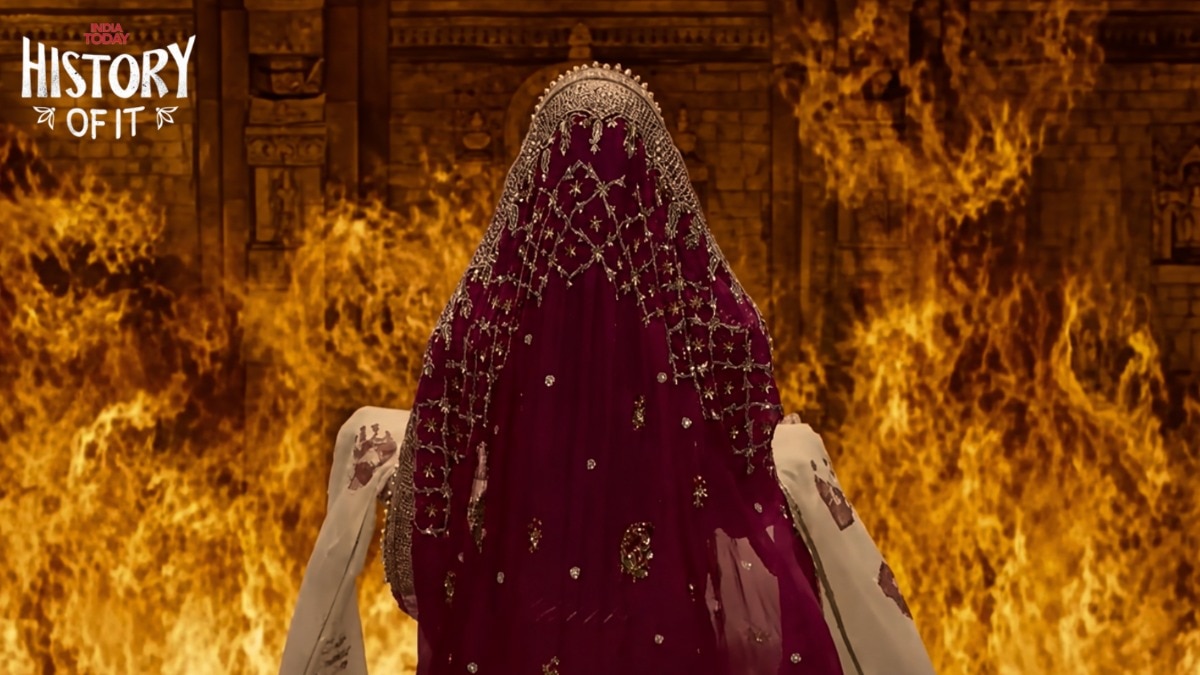
When the walls of a kingdom fall, it is usually the men whose names history remembers. The king who died. The army that lost. The conqueror who entered the gates. But there is another history — the history of the women left behind.
In 712, when Raja Dahir, the last Hindu King of Sindh, fell to Arab forces, the defeat did not end with his death. For the women of his family, the real terror was only beginning. Their kingdom had been broken, their protector was dead, and the victorious army was coming for the survivors.
The medieval accounts preserve what followed with a brutality that needs no embellishment. Some women chose the fire. Others were taken captive. That single contrast opens a question far more difficult than the arguments that surround Jauhar today.
Why did some choose death rather than captivity? And what did they believe awaited them if they surrendered?
The question has acquired a new urgency after Swara Bhasker’s renewed criticism of the Jauhar sequence in Sanjay Leela Bhansali’s 2018 film, Padmaavat. Bhasker has clarified that she was not calling Rani Padmavati, or the women who performed Jauhar, cowards. Her concern was different: what does the portrayal of women choosing death over capture communicate to women who have survived sexual violence?
That is a question worth taking seriously.
But if we are going to judge the choice of women who lived 13 centuries ago, history demands that we hear them first.
Not through the dialogue of a film or the assumptions of the twenty-first century, but through the medieval record itself. Because one of the women who stood at that precipice left behind an account of what she was choosing—and what she feared.
To understand that choice, we have to return to when Sindh’s Raja Dahir died.
WHY RAJA DAHIR REFUSED TO FLEE OR SEND HIS FAMILY TO SAFETY
The year was 712. Sindh is facing the army of Arab commander Muhammad bin Qasim. Raja Dahir had already resisted the Arab advances twice in the past, and now the decisive confrontation was approaching. Persian chronicle Chachnama records Dahir preparing for the final battle with a clarity that leaves little room for romantic invention. He knew precisely what was at stake.
“I am going to meet the Arabs in open battle, and fight them as best as I can. If I crush them, my kingdom will then be put on a firm footing. But if I am killed honourably, the event will be recorded in the books of Arabia and India and will be talked about by great men. It will be heard by other kings in the world, and it will be said that Raja Dahir of Sindh sacrificed his precious life for the sake of his country, in fighting with the enemy,” Dahir told his men.
Then came a suggestion that would make the later fate of his family all the more significant. Dahir’s vizier advised him to seek refuge with a friendly Indian ruler. If he refused to leave, the vizier urged him at least to send his family to safety.
Dahir refused and his answer, as recorded in the Chachnama, was brutally simple: he would not save his own family while the families of his thakurs and nobles remained behind. Dahir did not send his family away from the war. He did not place his household on a road to safety while the households of his nobles remained exposed. He stayed.
HOW RAJA DAHIR DIED AFTER HEARING THAT HIS WOMEN HAD BEEN CAPTURED
The battle followed. Dahir’s end did not come quietly.
Historians record that he was slain at the fort of Rawar at sunset, on Thursday, the 10th of Ramazan, in the year 93 (June 712 AD). What followed was one of the most extraordinary battlefield accounts to survive from the Arab conquest of Sindh.
As the army of Islam attacked and the fighting reached its bloodiest stage, a commotion suddenly erupted on the left flank of Dahir’s forces. Dahir heard the noise and believed his own men were calling him.
“Come hither; I am here,” he shouted.
But the voices that answered him were not those of his soldiers. They were the voices of his own women.
“O king, we are your women, who have fallen into the hands of the Arabs, and are captives,” they cried out.
For Dahir, the horror was immediate. His women had already been captured while the battle still raged around him. His answer was almost disbelief. “I live as yet, who captured you?” asked Dahir.
Then he did what he had promised to do. He turned his elephant towards the Arab army. There was no retreat now. Muhammad Qasim saw the opportunity and ordered the naphtha throwers to strike. One of them fired. The naphtha arrow tore into Dahir’s howda and set it ablaze. The flames rose around the king.
Dahir commanded his mahout to turn the elephant around. The elephant, however, was thirsty. It plunged towards the water. The driver tried to force it back but it would not turn. Man, animal and fire were now caught together in the chaos of battle. The elephant carried Dahir and his mahout into the rolling waves. Some of Dahir’s men followed them into the water; others stood helplessly along the banks. Then the Arab horsemen arrived, and those who stayed, fled.
The elephant drank, and then, turned back towards the fort.
And the arrows began to fall. The Muhammadan archers opened fire, filling the air around Dahir with a rain of arrows. One struck him in the breast, and he fell forward inside the burning howda. But even then, the battle was not over.
The elephant emerged from the water and charged. Men were trampled beneath its feet. Others scattered. Dahir climbed down and there, on the battlefield, he faced an Arab soldier. The account records what happened next with terrifying simplicity.
“But this brave fellow struck him with a sword in the very centre of his head, and cleft it to his neck,” according to the account.
That was the end of Raja Dahir on a battlefield, under a rain of arrows, after watching his own women become captives.
DAHIR WAS DEAD, BUT HIS FAMILY’S STRONGEST FORT STILL STOOD
The death of Dahir did not end the war. It only opened the next chapter — and for the women inside the fort in Brahmanabad, the choices narrowed with every passing hour. When news reached Jaisiya, Dahir’s son, that his father had been killed and that the white elephant had been hamstrung, he wanted to ride out and meet the enemy. He wanted, in his own words, to strike a blow that would preserve his honour and name, even if it cost him his life.
But his minister, Sisakar, stopped him. The king was dead. The army had been defeated and scattered. The men who remained had lost heart. Why throw away another life when Dahir’s dominions still survived, when the strongest forts remained in the hands of loyal warriors?
They went instead to Brahmanabad, the ancestral stronghold of Dahir’s family, its treasuries and stores still intact, its people still loyal to the house of Chach. There, Dahir’s sister Bai Main took charge.
She gathered the army. Fifteen thousand warriors stood within the fort.
The chronicler records that they had all resolved to die. Then Muhammad Qasim arrived and the siege began.
The defenders hurled stones from mangonels and balistas. Arrows and javelins rained from the walls. Qasim divided his forces, attacking by day and sending naphtha, stones and other projectiles against the fort through the night. The miners began undermining the walls.
WHEN BRAHMANABAD’S WALLS FELL, CAPTIVITY CEASED TO BE DISTANT FEAR
The bastions started to fall, and Bai Main knew what that meant. This was not an unknown fate in the world into which Sindh was conquered. Decades before Muhammad bin Qasim, Arab armies were already taking women captive. After Jall in Persia, al-abari records that Muslim soldiers allocated prisoners among themselves as booty and that “The women among them were taken as concubines and bore their Muslim masters children.”
Undoubtedly, the tale of what the invasion of the Islamic army meant was very well known.
Hence, she gathered the women.
BAI MAIN OFFERED THE WOMEN A CHOICE BEFORE ENTERING THE FIRE
What she said next is perhaps the most important passage in the entire account, because this is not a later historian explaining Jauhar. This is an early medieval chronicle giving us the words of a woman standing inside a besieged fort, watching the walls collapse around her.
“Jaisiya is separated from us, and Muhammad Qasim is coming. God forbid that we should owe liberty to these outcast cow-eaters! Our honour would be lost! Our respite is at an end, and there is nowhere any hope of escape; let us collect wood, cotton, and oil, for I think that we should burn ourselves and go to meet our husbands. If anyone wishes to save herself, she may,” said Bai Main.
Read that last sentence again. “If anyone wishes to save herself, she may.”
Whatever one thinks of Jauhar today, that sentence cannot simply be wished away.
The women were not being described as having no awareness of their circumstances. They knew the fort was falling. They knew Jaisiya was separated from them. They knew Qasim had arrived. And they knew that captivity was now a possibility.
Bai Main proposed the fire. And then the women went into a house. They set it alight. And they burned themselves. The fort fell.
Muhammad Qasim remained there for two or three days. Six thousand fighting men inside the fort were put to the sword; others were killed by arrows. The remaining dependents and servants were taken prisoner, along with their wives and children.
Now, here’s the other half of the story. The fire and the captivity are recorded in the same account. One cannot be understood honestly without acknowledging the other.
WHAT HAPPENED TO THOSE WHO WERE TAKEN ALIVE AFTER THE FORT FELL?
The chronicler then recorded the scale of the human spoils taken from Brahmanabad. Thirty thousand prisoners (as slaves and sex slaves). Among them were thirty daughters of chiefs. They were sent to al-Hajjaj ibn Yusuf, the Umayyad Governor in present-day Iraq. The head of Dahir was sent with them, along with a fifth of the prisoners.
And when Dahir’s head, the women and the wealth reached Hajjaj, he prostrated himself before Allah and gave thanks, declaring that he had effectively obtained the wealth, treasures and dominions of the world.
The language is cold, and the numbers are staggering.
And then comes another woman.
Ladi, Dahir’s wife. Her story is striking precisely because she did not immediately enter the flames. After Dahir’s death, she remained in the fort with his son. She refused to abandon it.
“How can I leave this strong fort and my family? It is necessary that we should stop here, overcome the enemy, and preserve our homes and dwelling[s]. If the army of the Arabs should be successful, I must pursue some other course,” the chronicler records her words as.
She chose to fight first. She brought out her wealth and treasures and distributed them among the soldiers, encouraging them as the battle raged at one of the gates. But she had already made her final decision should the fort fall.
The account says, “She had determined that if the fort should be lost, she would burn herself alive with all her relations and children.”
Then the fort was taken, and the nobles came to the gate of Dahir’s palace. His dependents were brought out and Dahir’s wife, Ladi, was captured.
When the prisoners and plunder were brought before Qasim, Ladi was identified among the captives, together with two daughters of Dahir by his other wives. Veils were placed over their faces.
They were separated from the others and handed to a servant. A fifth of the prisoners was selected and set aside. The chronicler gives the number as 20,000. The rest were distributed among the soldiers.
ONE WAR, TWO WOMEN AND TWO VERY DIFFERENT ENDINGS
This was the point at which the argument over Jauhar became impossible to reduce to a simple modern slogan.
Bai Main chose the fire. Ladi chose to fight, remained in the fort, prepared to burn herself if defeat came. And then, when the fort fell, she was taken prisoner.
The same war produced two endings for two women who faced the same defeat—and made different choices.
The medieval record does not leave us entirely to imagination. It preserves what happened to them.
So when we ask what Jauhar meant to the women who actually lived through these sieges, the answer cannot be manufactured centuries later. It cannot begin with what we think they ought to have felt. We have their words. We have their actions. And we have the fate that awaited those who were taken alive.
The accounts of al-Baladhuri and the Chachnama place Bai’s decision in that brutal world of conquest and captivity. The institution of taking conquered women as slaves and concubines by Arab armies was not unknown.
And then comes the moment the Chachnama preserved.
Bai gathered wood, cotton and oil. She told the women that those who wished to save themselves could do so. Then she entered the fire.
Ladi chose differently. She remained alive after the fall of the fort. She was captured. Her daughters were captured with her and sent away among the prisoners. That is the terrible contrast the medieval record leaves us: one woman chose the fire; another was carried away in chains.
We may debate Jauhar. We may reject it, condemn it, or struggle to understand it through modern eyes. But what we cannot honestly do is erase the world in which these women made their choices.
For Bai, the fire was not an abstraction.
It was a choice she made after defeat, in the shadow of captivity, with the fate of conquered women already known.
And if we want to understand Jauhar; not as a legend, not as a cinematic device, not as something to be explained away; but as an act performed by women who actually stood before the flames, then perhaps the first duty of history is the simplest one:
Let the women speak. And let us have the courage to listen.
(Aabhas Maldahiyar is the author of Babur: The Quest for Hindustan.)
– Ends
Published By:
Sushim Mukul
Published On:
Sep 4, 2026 07:00 IST