
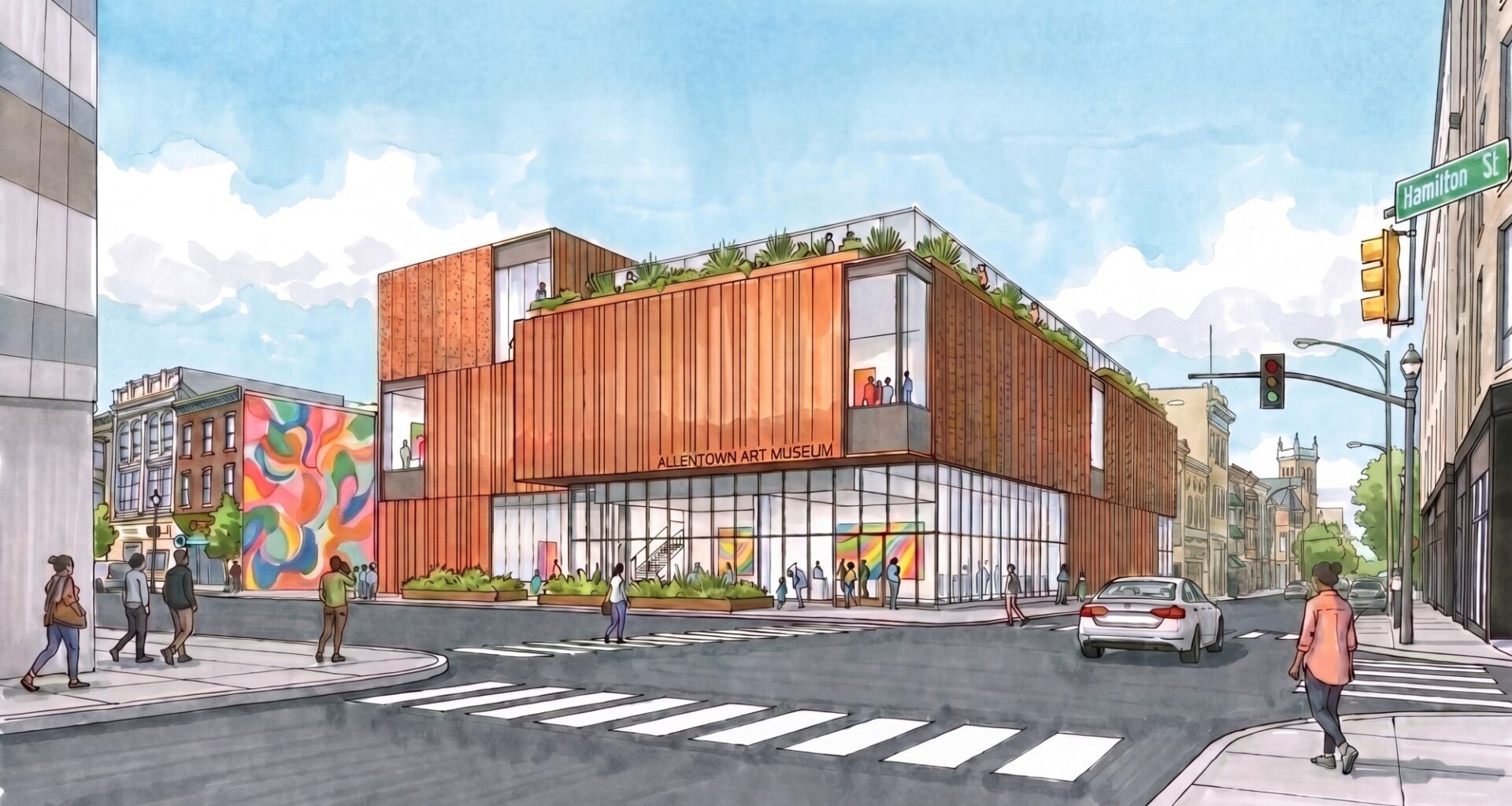
The Allentown Art Museum’s leaders have emphasized it is moving several blocks from its current location because of its aging infrastructure.
But another reason for the move is the museum, which has charged no admission since 2022, expects to greatly increase its revenue by holding events in the new space.
The iconic city landmark announced last year that it is relocating from its nearly 125-year-old building at Fifth and Linden streets to a new structure at 10th and Hamilton with the goal of opening in 2029.
Future income was among the questions Allentown Neighborhood Improvement Zone Development Authority members had before voting to put the site into the city’s unique tax zone and fund the project.
Museum President and CEO Max Weintraub said he anticipates revenue from events to increase from $20,000 currently to about $250,000 after the relocation.
That came after board member Carmen Dancsecs asked about the museum’s finances before voting on NIZ funding of up to 20% of project costs, not exceeding $9 million. Demolition and construction costs are expected to be $48.7 million. The museum is conducting a capital campaign to raise money for the project, along with securing state grants.
“How much did the Allentown Museum net last year, and what is the projected increase that you are expecting to see post-improvement?” Dancsecs asked. “Just so that I understand how well I might be investing, right? Obviously, I love art and I would support a project like this, but just so that I understand what the outcome is going to be of this investment.”
Weintraub said the figure is a conservative estimate, but could be $240,000-$250,000 “once we hit our stride.” Besides providing the ability to better preserve the museum’s collection with a modern climate control system, the three-story, 55,000-square-foot building would feature a great hall for large events along with dedicated classroom spaces that would bring in that additional revenue.
“We’re going from basically zero and certainly unattractive event spaces to dedicated event spaces that are designed to cater to corporate retreats, weddings, and other functions,” Weintraub said. A new cafe and gift shop is predicted to bring in revenue, too.
Attendance is also expected to go up, Weintraub said, from an average of a little more than 60,000 in recent years to about 100,000. Though it’s free admission, “a lot of the benefit that goes to the community would be indirect. There are a lot of businesses in the surrounding area.”
According to the Allentown Art Museum’s latest 990 tax form on ProPublica for the 2024-25 fiscal year, the nonprofit had revenue of $3.93 million with expenses at $4.4 million, for a loss of $510,463. Net assets were at $26.9 million.
Weintraub said he doesn’t think the Allentown Art Museum would struggle at its new location like the Da Vinci Science Center, which relocated downtown from Cedar Crest College.
Opened in 2024 at the PPL Pavilion, center officials originally projected that the Hamilton Street science museum would bring in 400,000 visitors annually. However, its first fiscal year fell short of that by more than 60%, bringing in 168,000 visitors. The shortfall led to the center’s letting go of around 15% of its staff in the fall.
Unlike the art museum, Da Vinci charges admission.
“Since it’s not part of our business model to rely on ticket sales, it won’t impact our bottom line in that way,” Weintraub said. “Special events demand has actually been very strong. Our event revenue projections are on the conservative side of realistic.”
To allow for the funding, ANIZDA approved putting the future site at 1001 Hamilton St. — a former Allentown Police substation — into the NIZ. To get the 0.67-acre parcel into the NIZ, the board voted to transfer a similar sized piece out of Buck Boyle Park because the city’s special tax zone is limited to 128 acres by law.
It also approved backing the project through an existing bank credit facility, supported by tax revenues generated by the new museum and City Center Group developments.
State Revenue Secretary Pat Browne attended the meeting in support of the move. He expressed strong support for using NIZ funds to back cultural and civic projects with significant public benefit, calling the museum relocation a worthy “gateway project” for downtown Allentown.
“A gateway project of this significance by one of the premier cultural institutions of the Lehigh Valley will definitely have a tremendous benefit on, safe to say, Allentown and the Commonwealth of Pennsylvania,” said Browne, who helped craft the legislation to create the NIZ in 2011 during his time as a Lehigh County state senator.
“And one of the purposes of this program that was written broadly in order to allow for effective implementation of new things along the way — it wasn’t just about new things. It was about making sure that the longstanding investments that have been in Allentown for as long as any of us have been alive continue to thrive as well.”
Morning Call reporter Evan Jones can be reached at ejones@mcall.com.