
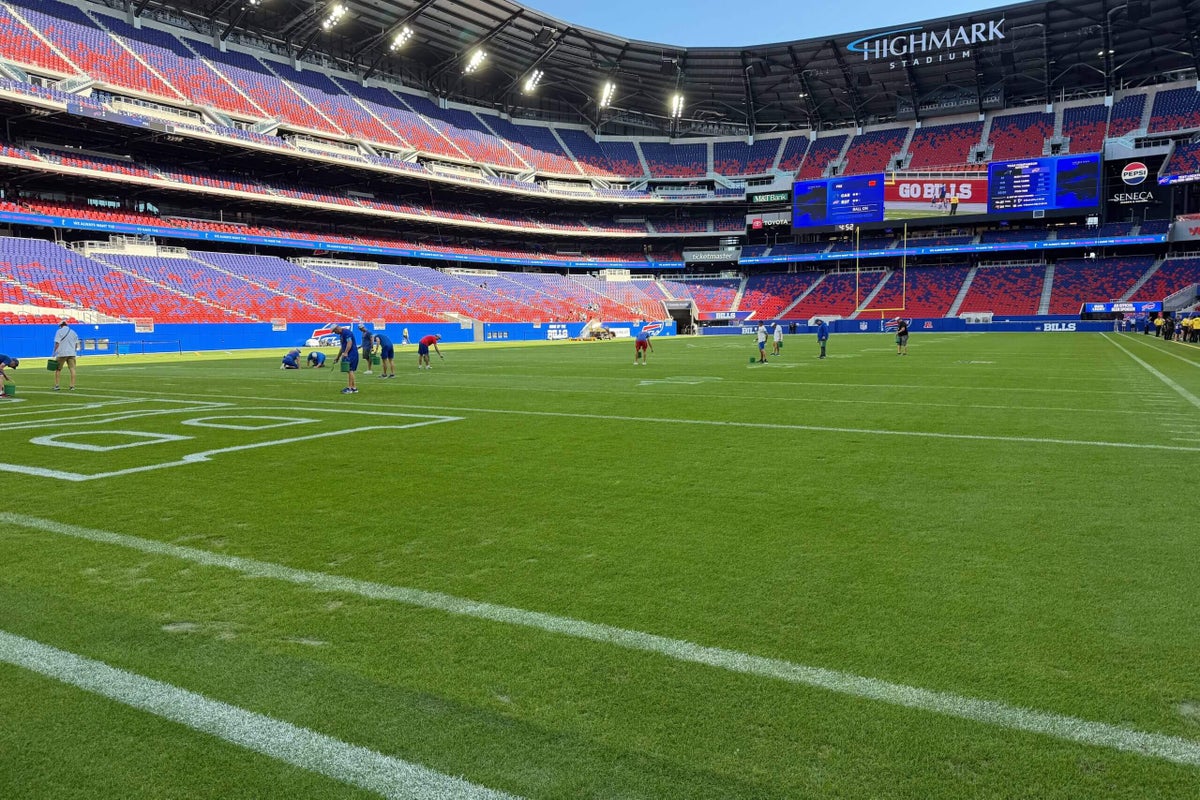
ORCHARD PARK, N.Y. — George Toma is known as The Sodfather. He’s the most revered groundskeeper in sports history, overseeing every Super Bowl field until three and a half years ago.
What’s been happening at Highmark Stadium troubles him.
“That hurts me,” Toma said. “That’s terrible to happen at all, but so soon? Somebody fell asleep.”
After just two preseason games, the Buffalo Bills tore out the grass field they had installed in October 2025. The field went unused for 10 months, but its roots didn’t take hold. Large chunks of sod were repeatedly gouged out by the players in exhibition games against the Carolina Panthers and Pittsburgh Steelers, as well as two open practices showcasing the new $2.2 billion stadium.
After the preseason opener, one Bills player told The Athletic, “The field is ass right now.” President of business operations Pete Guelli said the field was performing to expectations. This week, however, the team tore out all the grass and started over.
The Bills’ home opener against the Detroit Lions on “Thursday Night Football” is two weeks away — the first of three straight Highmark Stadium games in 18 days.
While resodding an entire NFL field is relatively common, experts find the circumstances surrounding Buffalo’s sudden tear-out disconcerting.
“I saw their press release and heard some of their rationale, and they probably ought to start their stories ‘Once upon a time,’” said an award-winning sports agronomist who has helped install dozens of NFL and college football fields over the decades. He requested anonymity to protect professional relationships.
“That’s the worst sod I’ve seen in the NFL in my career. I can’t even imagine how that could have happened.”
Buffalo switched to grass this year for the first time since 1972, when it left War Memorial Stadium, a bleak venue known as The Rockpile. The NFL Players Association has pushed owners to switch to grass stadiums. The union says 92 percent of its players prefer grass.
The campaign gained further traction this summer. The FIFA World Cup demands grass for its matches. When the tournament held games in 11 NFL stadiums, seven were forced to replace artificial turf with grass. Those venues have since returned to artificial turf for the NFL season.
“Yes, natural turf is safer in a perfect setting,” said Tony Dick, a sports management professor at Baldwin Wallace University and former Cleveland Browns assistant head groundskeeper. “But if you have the situation like you have in Buffalo — and I went back and watched the film — you cannot tell me that field was safer than the artificial turf they just left.
“I’m never putting Josh Allen on a field in that condition.”
NFL clubs replace their grass based on several variables, the biggest being climate and the number of events.
The Miami Dolphins resod eight to 10 times a year in the tropics, but Hard Rock Stadium simultaneously hosts University of Miami football and bowl games as well as soccer matches and major concerts year-round. The Denver Broncos resod twice a year — once in August after the summer concert season, and again in late autumn before the mile-high ground freezes.
The Steelers traditionally resod Acrisure Stadium’s entire field before the season, replace the grass between the numbers in October, and perform another full resod later that month. The University of Pittsburgh and local high school football also use their field.
But the Bills installed their Kentucky bluegrass in October 2025 and didn’t stage any events until a public practice on Aug. 8, one week before the Panthers preseason opener.
“We have consulted with the NFL and an independent expert who works with multiple NFL teams,” the Bills said in a statement to The Athletic. “These consultants recommended utilizing this three-week window before the home opener to install the sod. The NFL inspects every field and determines whether it meets league standards. We are confident that they are the appropriate group to ensure the field performs at the necessary level.”
An NFL spokesperson did not respond to a request for comment.
The agronomist acknowledged that he would know more about the field’s issues if he had the chance to examine it himself, but several mistakes seemed obvious to him.
“You could see brown spots throughout,” the agronomist said. “That looked like disease, probably dollar spot fungus or brown patch fungus because bluegrass is susceptible to that.”
He saw signs of overwatering and said the Bills may have misread the new field’s high percolation rate, a measurement of how fast water drains. He also suspected the grounds crew had not used enough wetting agents to slow the percolation rate and keep nutrients in the soil longer.
“I would have been overseeding the heck out of it, trying to draw that sod down a little bit,” the agronomist said. “I also would have pounded the top of the field with sand (for the Panthers-Bills game). When players were getting tackled, you should’ve seen plumes of sand coming off the grass. That at least would have held the field down, closed up the seams.”
Matteo Bartolotta has worked with the Bills’ director of grounds, Aaron Ramella, as recently as this summer, helping the Bills prepare St. John Fisher University’s grass fields for training camp. Bartolotta owns and operates M&K Turf in Auburn, N.Y.
“It’s a lot more common to replace sod fields than people think,” said Bartolotta, a Bills diehard and former season-ticket holder. “We do have the three-game stretch coming. If they wait, with that NFL test of playability, they might not have passed it if the conditions got worse. It’s not cheap, but I think it was the right choice.”
Similar to a doctor who would be hesitant to diagnose a patient he hasn’t examined, Bartolotta didn’t want to say for sure what was ailing Highmark Stadium’s ill field without having put his hands in the dirt.
Bartolotta did find it germane, however, to share the time he was hired by Merion Golf Club, the prestigious course outside Philadelphia that has hosted five U.S. Opens. He was summoned to solve an ongoing mystery on the greens.
“They were peeling like carpet,” Bartolotta said.
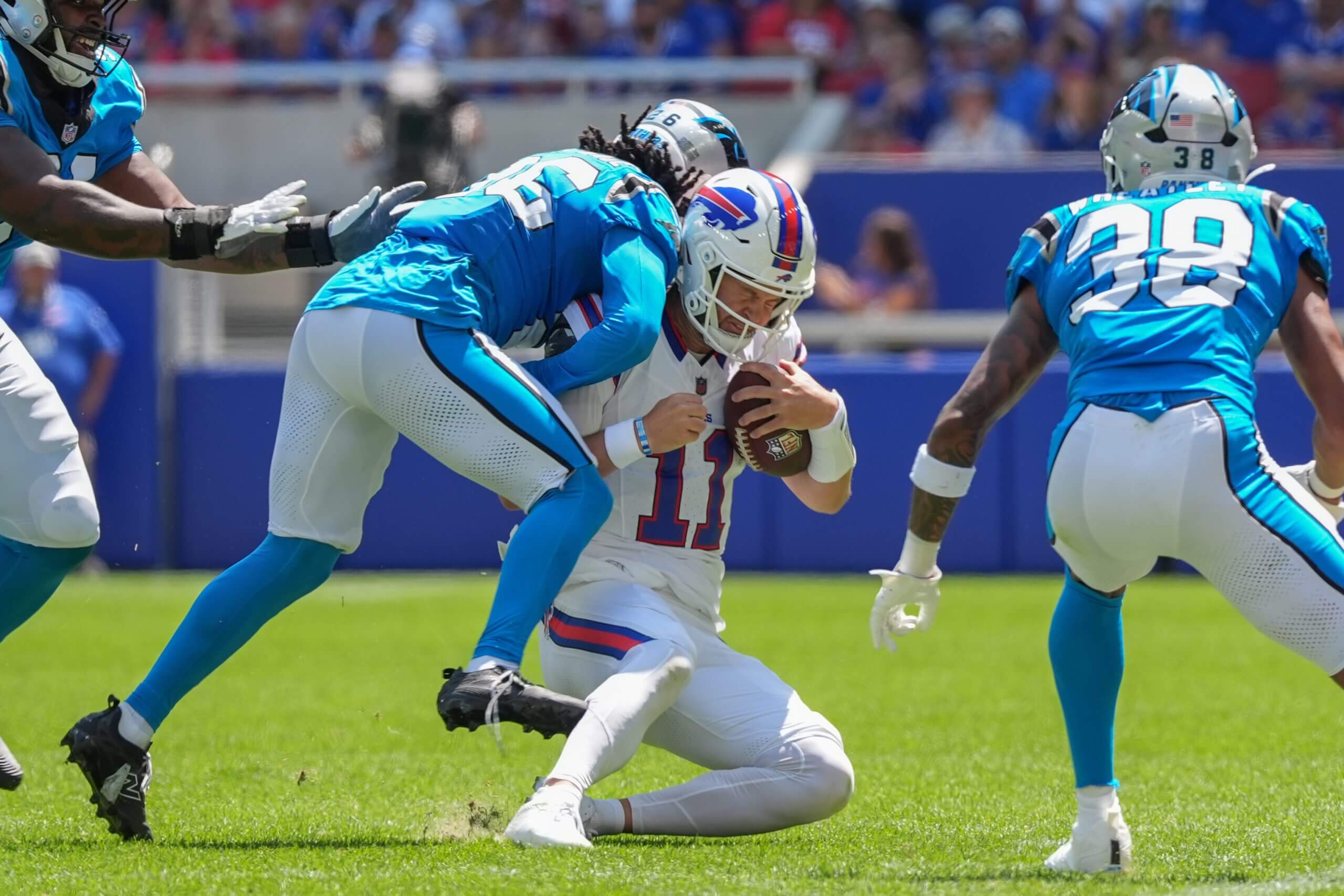
Carolina Panthers cornerback Chau Smith-Wade (26) hits Buffalo Bills quarterback Kyle Allen (11), as pieces of grass fly into the air during the teams’ August preseason game at Highmark Stadium. (Gregory Fisher / Imagn Images)
The final green was the putting area next to the clubhouse. It looked marvelous. Bartolotta asked the course superintendent and an assistant what the difference was.
“They just kind of looked at each other and chuckled,” Bartolotta recalled. “He said, ‘This one doesn’t have the precision air system underneath that the other ones have installed.’ So you’re telling me the greens that have the ability to heat and cool and suck out excessive moisture, those greens have weaker root structure than the one that’s just growing naturally with native soil?”
Even with all that money and innovation and pampering, the greens at Merion Golf Club weren’t stimulated to thrive. They merely existed.
“When you have the ability to give the root anything that it wants, the root doesn’t stress,” Bartolotta said. “It just lays back like it’s on vacation. You have to make grass work. When you give it everything — all the nutrients, all the fertilizer, all the grow lights — it doesn’t have to go and search. It just hangs out.”
Beneath Highmark Stadium’s grass are ventilation, heating, irrigation and vacuum systems. Myriad sensors track oxygen levels, temperature and moisture to the decimal point. The Bills invested in the latest grow-light technology to roll onto the field wherever too much shade encroaches.
“They have a control room that looks like the space shuttle control deck,” the agronomist said. “They’re practically God in how easily they should be able to grow grass. To lose that field is unbelievable.”
You probably wouldn’t be surprised to learn Toma, 97, prefers the old-fashioned methods. His famous “and then some” motto refers to adding extra effort or an extra touch to every job.
The Sodfather believes some measures are gratuitous.
“I’ve seen it all,” Toma said from his home in Kansas, “and sometimes in today’s world we agronomists get too sophisticated in groundskeeping. They go overboard.”
Toma’s career began on minor-league fields as a teenager during World War II. In 1955, he was the Buffalo Bisons’ groundskeeper at Offermann Stadium. Toma eventually went to Kansas City, where he tended Municipal Stadium for the Chiefs, Athletics, Royals and Spurs of the North American Soccer League. He recalled his annual budget was $960.
Then-NFL commissioner Pete Rozelle was so impressed with Kansas City’s field, especially given its year-round usage, that he asked Toma to handle L.A. Memorial Coliseum’s field for Super Bowl I. That budget was $500.
“Now, we’re spending $800,000 for a Super Bowl field, and they still don’t get it right,” said Toma, who, in addition to working all but the past three Super Bowls, oversaw the 1984 and 1996 Olympic Games and all nine pitches in the 1994 World Cup. “We’ve got to get away from doing too much.”
Another quirk that might affect grass development is Highmark Stadium’s design, meant to disrupt and weaken Western New York’s prevailing winds.
To keep fans more comfortable and footballs from blowing off course, the Bills and architect Populous rotated the stadium’s orientation southeast relative to The Ralph. They installed thousands of perforated metal panels on Highmark Stadium’s outer shell to create what the Bills have called “wind confusion.”
The Bills bought industrial fans to compensate, but airflow remains another significant variable.
“The grass they put in there was grown in an open field with direct, maximum sunlight,” Dick said. “They’ve got airflow going across. You take that grass and put it into an enclosed stadium with shadows, you’re going to run into some problems.
“Diseases can attack the root and prevent the grass from taking hold. If you don’t have the airflow, those diseases can destroy an entire field in a couple days.”
The agronomist disagreed with Dick’s airflow assessment — somewhat. The Bills have the technology to address that potential issue. The question is whether they deploy it properly.
“They can put air into the field whenever they want to. They spent the money already,” the agronomist said. “All you must do is use your systems.”
Bartolotta expressed confidence that Highmark Stadium’s field headache — like the 10-month-old grass itself — is a one-off.
“This is a little speed bump in the process of the new stadium,” Bartolotta said. “It seems like a drastic move, but it’s not. Just another day in the life.”
Dick and the agronomist remain skeptical.
Each predicted the home opener should go well, with the agronomist foreseeing substantial challenges by Week 3 against the Los Angeles Chargers.
“They will have a difficult time,” the agronomist said. “There’s so much going wrong, and there’s so little time. If that field makes it through the second game, I’ll be shocked.”
Unless matters improve drastically, Dick had a more dire outlook for Highmark Stadium’s grass field.
After all, the Bills fired coach Sean McDermott because they didn’t want to waste another year of their MVP quarterback’s prime. The risks to his health on a subpar field — or the weird bounce of a football or a defensive back’s unfortunate slip — are legitimate.
“You might have artificial turf back in there within three years,” Dick said, “just because it’s safer than whatever that was.”