
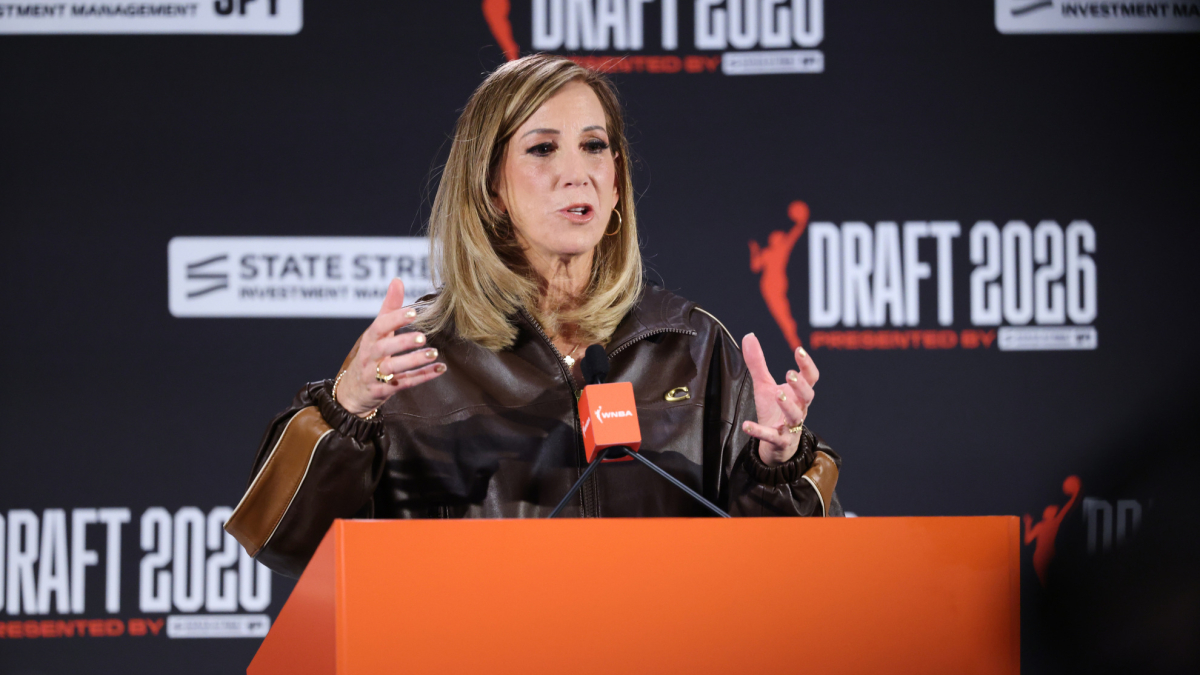
Cathy Engelbert is set to leave her position as WNBA commissioner at the end of 2026, bringing an end to a seven-year tenure that transformed the league while also exposing deep divisions over its direction.
The WNBA confirmed Friday that Engelbert, 61, will retire after the season. She became the league’s first commissioner in 2019 after previously leading Deloitte, taking charge of a competition with significant potential but far less mainstream attention than it commands today.
Caitlin Clark’s growing problem with WNBA cameramen is going viral
Her tenure has delivered major investment, new media agreements and an ambitious expansion plan.
The league is scheduled to grow from 12 teams to 18 by 2030, while a new collective bargaining agreement has created the first million-dollar player salaries in WNBA history.
But the remarkable commercial growth has been accompanied by increasingly difficult challenges. Engelbert has faced criticism over player relations, officiating, safety concerns and the league’s handling of controversies involving some of its biggest stars.
Caitlin Clark’s arrival in 2024 became a defining moment. The Indiana Fever guard helped propel the WNBA into a new era of television audiences, attendance and public interest, but the attention surrounding her also generated heated arguments about how the league handled hostile fan behavior, physical play and the treatment of its rising superstar.
Those arguments were only one part of the turbulence surrounding Engelbert’s final seasons.
Engelbert leaves behind a WNBA transformed by growth and controversy
The increasingly divisive debate over transgender athletes has created another major flashpoint.
Fever guard Sophie Cunningham attracted widespread attention after speaking about protecting young girls in women’s sports, prompting fierce reactions from supporters and critics.
Demonstrations and counter-protests have subsequently appeared around games, showing how cultural conflicts have increasingly spilled into the league.
Engelbert’s relationship with players has also been tested. Players have previously voiced frustrations about compensation, officiating, communication and trust in the league’s leadership.
Negotiations over the latest collective bargaining agreement were lengthy and tense before both sides eventually reached an agreement.
Despite those disputes, Engelbert can point to substantial accomplishments. During her time in office, the WNBA has experienced significant increases in viewership, attendance, sponsorship revenue, franchise values and investment.
The league has also continued its expansion, welcoming the Golden State Valkyries in 2025 and the Portland Fire and Toronto Tempo in 2026, with Cleveland, Detroit and Philadelphia planned for later this decade.
Engelbert has maintained that her decision to retire was her own and that she wasn’t pushed out by league stakeholders. She has said she initially expected to remain in the position for roughly three and a half years, meaning her seven-plus seasons ultimately lasted far longer than originally planned.
Her departure now leaves NBA commissioner Adam Silver with the task of selecting a successor at a pivotal moment.
The next commissioner will inherit a WNBA that’s bigger, wealthier and more influential than ever, but also a league whose players have become increasingly vocal about what they expect from its leadership.
That could make the choice particularly significant. A former player or experienced female basketball executive could offer a perspective rooted in the realities of the league’s athletes.