
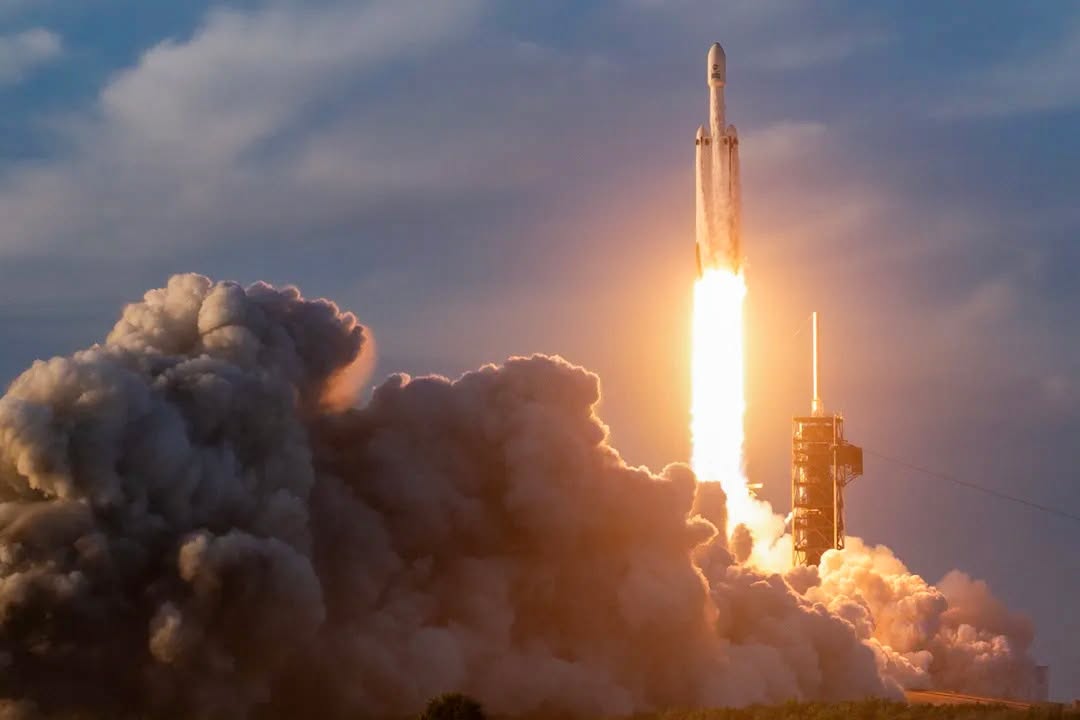
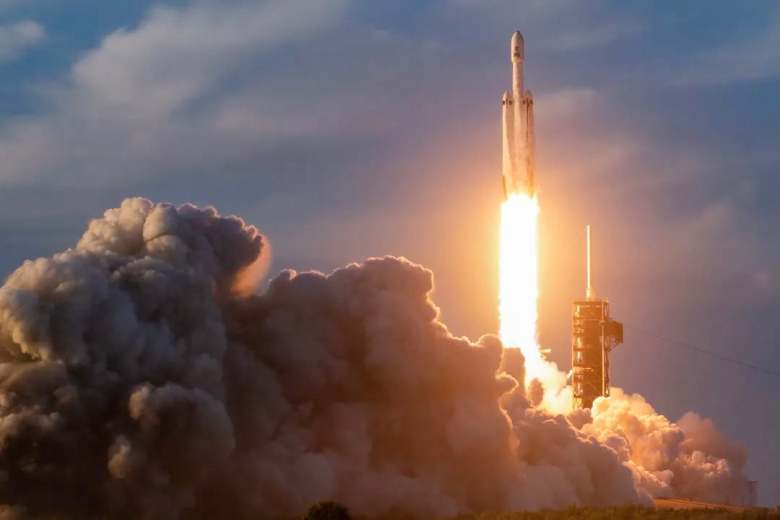
 The launch of NASA’s Nancy Grace Roman Space Telescope from Kennedy Space Center in Florida on Sunday, Aug. 30, 2026. NASA built, assembled, and tested the telescope at its Goddard Space Flight Center in Greenbelt. | Photo courtesy of U.S. Rep. Glenn Ivey. who represents Maryland’s 4th Congressional District
GREENBELT, Md. — A telescope built and assembled in Maryland is beginning a million-mile journey that could reshape scientists’ understanding of the universe.
NASA’s Nancy Grace Roman Space Telescope launched at 7:26 a.m. Sunday, Aug. 30, aboard a SpaceX Falcon Heavy rocket from Launch Complex 39A at Kennedy Space Center in Florida. The observatory launched nine months ahead of schedule.
Although liftoff occurred hundreds of miles away, much of the mission’s story is rooted in Maryland. Engineers built, assembled, integrated and tested the observatory at NASA’s Goddard Space Flight Center in Greenbelt.
Roman is the only NASA flagship mission to be fully integrated and tested at Goddard, according to the agency. Its parts were built across the country before being brought together in Greenbelt to create the completed observatory.
Roman will spend about three months traveling to its destination near the second Sun-Earth Lagrange point, known as L2, approximately 1 million miles from Earth. Its primary science mission is expected to last five years, and the telescope is designed to support an additional five-year extended mission.
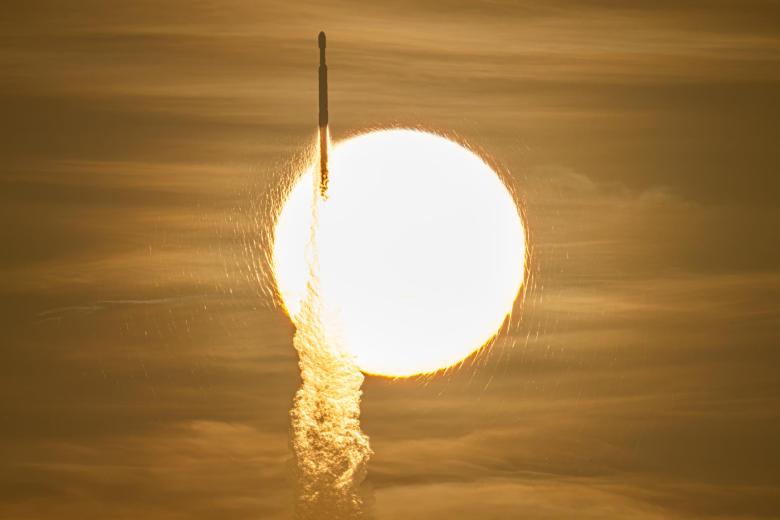 A SpaceX Falcon Heavy rocket with NASA’s Nancy Grace Roman Telescope on board is seen transiting the sun during launch from Launch Complex 39A, Sunday, Aug. 30, 2026, at NASA’s Kennedy Space Center in Florida. | Photo credit: NASA/John Kraus
Here is what the state’s role looks like, start to finish:
Built here. Components were produced nationwide, then assembled in Goddard’s largest clean room. Final assembly wrapped in December.
Tested here. Goddard’s facilities shook, froze and spun the hardware to prove it could survive launch and deep space.
Flown from here. Goddard runs the mission. The Roman Mission Operations Center sits on the Greenbelt campus, so every contact with the telescope routes through Maryland.
Studied here. The Space Telescope Science Institute in Baltimore is among the organizations participating in the mission.
Roman left Greenbelt in June after more than a decade of work, traveling by barge to Kennedy Space Center for final launch preparations. The mission launched nine months ahead of schedule, according to NASA.
A New View Of The Universe
Roman was built to investigate some of astronomy’s biggest unanswered questions, including dark energy, dark matter, planets beyond our solar system, black holes and the evolution of billions of galaxies.
The observatory’s Wide Field Instrument is a 300-megapixel infrared camera with 18 detectors. Its images will be as sharp as those produced by the Hubble Space Telescope, but each will cover a field of view at least 100 times larger.
Each Roman image will capture a patch of sky approximately 1.5 times larger than the full moon appears from Earth. NASA said that sweeping view will allow Roman to survey the universe roughly 1,000 times faster than Hubble.
That speed will produce an enormous amount of data. Roman is expected to send approximately 1.4 terabytes back to Earth each day, the highest daily data rate of any NASA astrophysics mission to date. Scientists, artificial intelligence and participating members of the public will help review the information and identify potential discoveries.
“We’ve never been able to view the universe with eyes like Roman’s before,” Julie McEnery, Roman’s senior project scientist at NASA Goddard, said in a NASA news release.
Searching For Other Worlds
Roman also carries a Coronagraph Instrument designed to test technology for photographing planets orbiting other stars.
The instrument blocks the glare of a star, allowing scientists to detect the faint light reflected by nearby planets. NASA expects it to capture images of Jupiter-like worlds while advancing technology that could one day help scientists find Earth-like planets.
During its five-year primary mission, Roman is expected to observe hundreds of millions of stars, billions of galaxies and potentially more than 100,000 distant worlds.
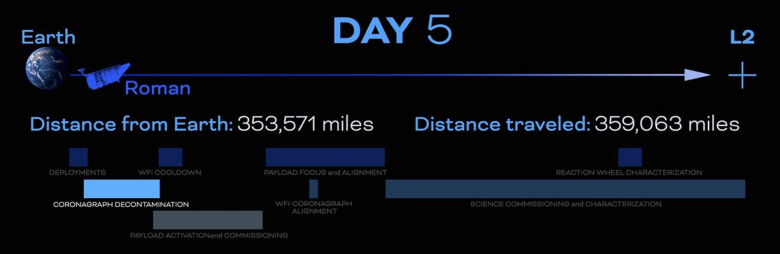 Five days after launch, NASA’s Nancy Grace Roman Space Telescope was more than 353,000 miles from Earth as it continued toward the second Sun-Earth Lagrange point, known as L2. Follow Roman’s journey and learn more about the mission. | Screenshot from the Nancy Grace Roman Space Telescope NASA.
The Woman Behind The Name — And Her Maryland Roots
The telescope honors Nancy Grace Roman, NASA’s first chief astronomer and the agency’s first female executive. She has a Maryland story of her own.
Born in Nashville on May 16, 1925, to a music teacher and a geophysicist, Roman moved to Baltimore in 1937. She attended junior high and high school there, and she finished Western High School in three years through an accelerated program, according to NASA.
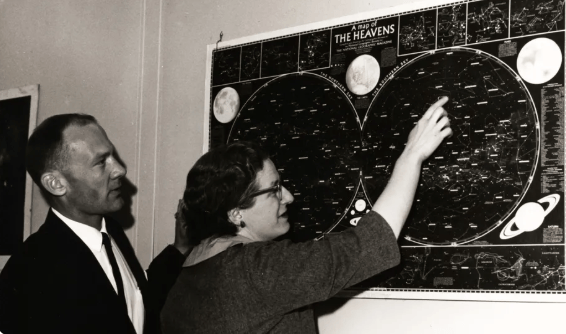 Nancy Grace Roman briefs Edwin (Buzz) Aldrin on celestial objects in Washington, D.C. in 1965. Aldrin would go on to complete three spacewalks and become the second person to walk on the moon. | Image credit: NASA
The interest started earlier than that, on night walks in Michigan where her mother pointed out constellations and the northern lights. Roman liked to say, half-joking, that her mother was to blame — though the same walks covered birds, trees and plants, not just stars.
At 11 she organized an astronomy club with her classmates and worked through her local library on her own, later saying she “read everything I could get my hands on,” according to a 1980 oral history interview with David DeVorkin cited by Space.com. By junior high she had decided she was going to be an astronomer, and her parents backed her.
That was not a simple plan in the 1940s. Some colleges did not accept women at all, so Roman needed a school that would take her and had a real astronomy program. She chose Swarthmore College, then went to graduate school at the University of Chicago and worked at Yerkes Observatory, where she was the first woman on the academic staff.
Building A Program From Nothing
Her early research career took her to the U.S. Naval Research Laboratory in Washington, where she studied stars and galactic structure, worked on orbital mechanics and helped bounce radar off the moon.
Then, in 1959 — one year after NASA was created — the agency asked her to build its astronomy program from scratch. She later described the pull simply: a blank slate, and a program she believed would shape astronomy for the next 50 years. She announced it that same year at the American Astronomical Society meeting.
Roman recruited astronomers to the agency, worked alongside engineers, built mission budgets and pushed proposals through the machinery of the federal government. She traveled to astronomy departments around the country, as much to hear what researchers wanted from NASA as to tell them what NASA was doing.
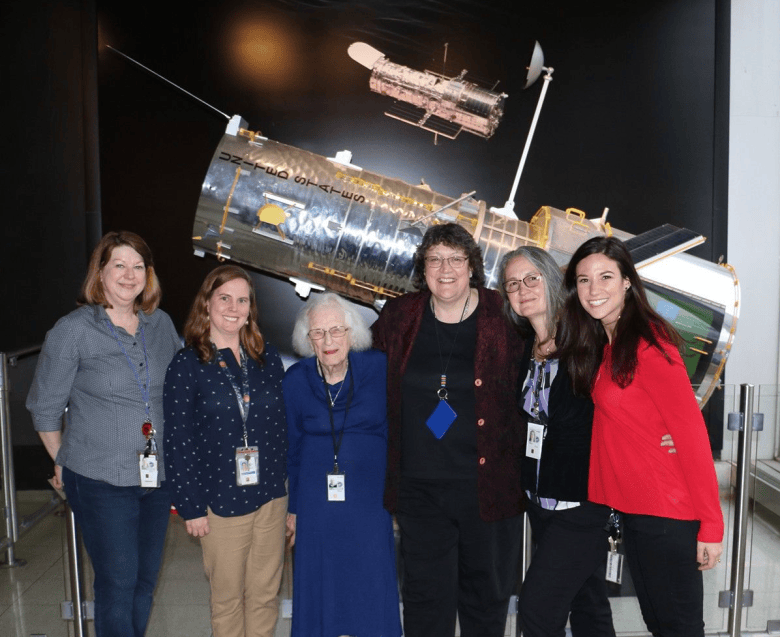 Dr. Nancy Grace Roman, center, NASA’s first chief astronomer and the namesake of the Nancy Grace Roman Space Telescope, poses with members of the Hubble team in front of a Hubble Space Telescope model at NASA’s Goddard Space Flight Center in Greenbelt. Photo courtesy of NASA. | Image credit: NASA
A decade into the job, Apollo 11 put humans on the moon and crewed spaceflight took over the agency’s spotlight. Roman and her colleagues fought to keep space astronomy moving alongside it. She was candid that politics shaped scientific decisions, even though scientists would rather settle questions on technical merit alone.
Roman died Dec. 25, 2018, in Germantown, Maryland, nearly eight years before the telescope bearing her name launched into space. She was 93.
What Happens Next
Roman is traveling toward the second Sun-Earth Lagrange point, known as L2, about 1 million miles from Earth. The James Webb Space Telescope also operates near L2, though the two observatories will stay far apart.
The trip takes roughly three months. Along the way, mission teams will deploy additional equipment and calibrate Roman’s instruments before science operations begin.
NASA expects to release the telescope’s first images in early 2027.
Follow Roman’s journey and learn more about the mission at science.nasa.gov/mission/roman-space-telescope.
NASA’s Roman Space Telescope: Widening Our Gaze | NASA Goddard
Related